
Introduction
Walk into any electronics store in India and ask for an AC, and the salesperson will almost always steer you toward a 1.5 ton unit. It's one of the most widely purchased cooling capacities in the country, and for good reason: it fits the typical Indian bedroom or living room.
But here's the problem. Many buyers pick 1.5 ton simply because it's popular, without checking whether their room actually needs it. Get the room size wrong, and you either pay for cooling you can't use or run a unit that never catches up with the heat.
This guide breaks down the real room size range for a 1.5 ton AC and the factors that shift that range up or down. You'll also find how to calculate it properly, and what happens when the match is off.
TL;DR
- A 1.5 ton AC nominally suits rooms between 150-200 sq. ft. under standard Indian conditions
- This range shifts 15-20% based on sunlight, ceiling height, occupancy, and insulation
- Undersizing and oversizing both raise electricity bills, not just one of them
- Inverter and high-ISEER units can stretch effective coverage beyond standard charts
- Always measure length × width × height before buying — don't trust the chart alone
What a 1.5 Ton AC Room Size Actually Means
"Ton" isn't a weight measurement here. It's a unit of cooling capacity. According to ASHRAE's technical definition, one ton of refrigeration equals 12,000 BTU/hr, roughly 3,517 watts. A 1.5 ton AC removes about 18,000 BTU of heat per hour, or 5.28 kW.
That number tells you how much heat the unit can pull out of a space. It doesn't automatically tell you which room it belongs in.
Room Compatibility Is a Derived Recommendation
Room size charts are a starting point, not a rulebook. The actual determinant is heat load: how much warmth builds up in the room. Four factors drive that load:
- Sunlight exposure through windows and room orientation
- Number of people regularly occupying the space
- Heat output from appliances and electronics
- Building insulation, wall material, and ceiling height
Two rooms of identical floor area can need different tonnages depending on these variables.
BEE's ISEER rating adds another layer. ISEER measures seasonal energy efficiency, meaning two 1.5 ton ACs with different star ratings can perform very differently in the same room, even though their nominal tonnage is identical.
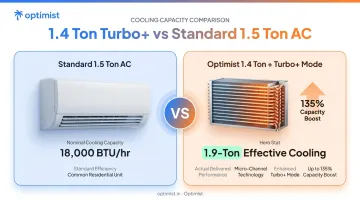
Technology can push cooling output beyond that fixed tonnage number, too. Optimist's 1.4 Ton AC uses a micro-channel heat exchanger with 1,180 flow paths in aluminium alloy, paired with a Turbo+ Mode that delivers a 135% capacity boost.
In practice, the unit pushes out the equivalent of 1.9 tons of cooling when a room genuinely needs it. That makes it a direct alternative to a standard 1.5 ton unit for 120-200 sq. ft. spaces.
That flexibility matters because standard sizing charts still assume "normal" conditions: 8-10 ft ceilings, moderate sunlight, two occupants. Most of the confusion around room size comes from rooms that diverge from this baseline without anyone accounting for it.
Room Size Range for a 1.5 Ton AC
Think of the recommended range as an engineering band, not a single figure. It has a comfortable middle zone, tolerance limits on either side, and a safety margin built in.
Nominal Operating Range
Under standard Indian conditions (normal ceiling height, moderate sun, up to three occupants), a 150-200 sq. ft. room is the sweet spot for a 1.5 ton unit.
That said, geography matters:
- In dry, well-insulated regions, the same AC can comfortably stretch to 220 sq. ft.
- In humid coastal cities, it may max out closer to 180 sq. ft. because latent moisture removal adds to the load
Allowable Tolerance and Boundary Limits
Go too far in either direction, and comfort drops off fast:
- Below ~120-130 sq. ft.: the AC becomes oversized for the space, cooling too fast and short-cycling, which hurts dehumidification
- Above ~220-250 sq. ft.: the unit struggles to pull down temperature during peak summer heat, running near-continuously
Safe Operating Margin
Manufacturers don't size units to the exact room area for a reason. Rooms don't stay static — guests arrive, someone cooks, afternoon sun hits differently than morning light. That margin absorbs these transient spikes.
Ignore it, and units running near their limit for extended periods see faster compressor wear along with higher long-term running costs. Optimist's 1.4 Ton unit, engineered with Turbo+ mode to deliver 1.9-Ton effective cooling for rooms sized for a 1.5 ton AC, backs this against wear with a 10-year compressor warranty covering parts and labour at zero cost, built for continuous peak-load operation rather than occasional heavy use.
Factors That Push Your Ideal Room Size Up or Down
The 150-200 sq. ft. figure is a lab-tested starting point. Real rooms rarely match lab assumptions exactly.
Sunlight and Window Exposure
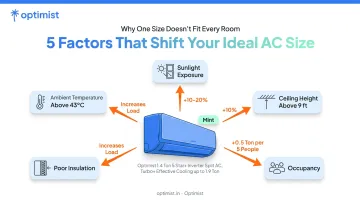
South- or west-facing rooms, or spaces with large glass windows, absorb significantly more heat through the day. Haier's tonnage guidance recommends adding 10-20% more cooling capacity for direct solar exposure — effectively shrinking your usable room size if you don't compensate.
Ceiling Height
Standard charts assume 9-10 ft ceilings. Taller ceilings increase air volume, meaning the same tonnage has to work harder across a smaller floor footprint. Haier's own recommendation adds 10% capacity for ceilings above 9 ft.
Occupancy and Equipment
Every extra person or heat-generating appliance adds load:
- Each additional occupant adds roughly 0.1-0.2 ton of equivalent heat load
- TVs, kitchen equipment, and dense electronics compound this further
- Haier's benchmark: add 0.5 ton for every five additional people in the space
Insulation and Floor Level
Poorly insulated walls, uninsulated roofs, or top-floor rooms sitting directly under a sun-heated slab all reduce the effective coverage of a 1.5 ton unit. A top-floor bedroom in Jaipur behaves nothing like a mid-floor bedroom in the same building.
Ambient Temperature Extremes
Cities regularly crossing 45°C put standard-rated ACs under real stress. Most units begin derating cooling output beyond 43°C ambient, cutting into the room size they can actually cool even though the chart says nothing changed. Optimist's platform is engineered specifically around this gap: government-lab tested to sustain full rated cooling output at 50°C ambient with no derating.
How to Calculate the Right Room Size for Your 1.5 Ton AC
Start simple, then refine.
Step 1: Basic area calculation
Length (ft) × Width (ft) = room area in sq. ft.
Compare this against the 150-200 sq. ft. nominal range.
Step 2: Refine with volume and load adjustments
- Multiply area by ceiling height to get room volume
- Add 10-20% tonnage adjustment for direct sun exposure
- Add roughly 0.1 ton per extra occupant beyond two people
- Add 0.5 ton for heavy appliance load (large TVs, kitchen equipment, dense electronics)
Step 3: Cross-check against the actual spec sheet
Generic charts don't account for inverter modulation or boost modes. Optimist's 1.4 Ton model, for example, runs Turbo+ mode for 1.9-Ton effective cooling — a different ceiling than a fixed-capacity unit rated at the same nominal tonnage. Always verify against the product's own specification sheet before finalising your purchase.
What Happens When Room Size and AC Tonnage Don't Match
Mismatch cuts both ways. Neither error is harmless.
Undersizing: Room Too Large for the AC
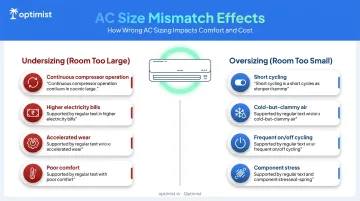
When the room outgrows the unit, the compressor runs continuously at maximum load and still never quite reaches the set temperature during peak heat. The result:
- Higher electricity bills from non-stop operation
- Accelerated compressor wear from sustained peak-load running
- Poor comfort even after hours of cooling
Oversizing: Room Too Small for the AC
Here the AC cools the space too fast and shuts off before it properly removes humidity. According to Carrier's explanation of short cycling, this creates a cold-but-clammy environment with frequent on/off cycling that stresses internal components over time.
The Common Misinterpretation
Many buyers treat a chart's nominal figure, say "200 sq. ft.," as an absolute ceiling instead of a guideline that shifts with sunlight, insulation, and occupancy. A 200 sq. ft. room with heavy west-facing glass isn't the same as a 200 sq. ft. room with shaded, north-facing windows.
Real-time energy tracking and gas-level monitoring can catch this problem early. Both are built into the Optimist app, so users see live kWh readings, projected monthly bills, and refrigerant alerts as soon as a unit is overworked by a size mismatch. That beats discovering the problem three months later through an unusually high bill.
Conclusion
A 1.5 ton AC's "right" room size isn't a fixed number. It's a range, roughly 150-200 sq. ft., that moves based on sunlight, ceiling height, occupancy, and insulation.
Get the tonnage-to-room match right, and you protect both comfort and long-term running costs. Get it wrong in either direction, undersized or oversized, and you pay for it in electricity bills and equipment wear.
Measure your room carefully. Adjust for the real-world factors that actually apply to your space. That matters far more than trusting any single chart figure at face value.
If you're already comparing options, Optimist's 1.4 Ton 5 Star+ Inverter Split AC is worth a look. Its Turbo+ mode delivers up to 1.9-ton effective cooling, matching a standard 1.5 ton unit's output, while its 6.05 ISEER rating, India's highest, keeps bills lower.
Frequently Asked Questions
Can I use a 1.5 ton AC for a 120 sq. ft. room?
It cools the room quickly, but expect short cycling and weak dehumidification below the ideal 150 sq. ft. threshold. A smaller unit fits better unless heavy sunlight or poor insulation raises the heat load.
How tall is a 1.5 ton AC unit in feet?
Indoor units typically measure around 1-1.2 ft in height and 3-3.3 ft in width; outdoor units run slightly taller at roughly 1.8-2 ft. Exact dimensions vary by brand and model, and this is separate from the unit's cooling "tonnage" rating.
Is a 1.5 ton AC enough for a 200 sq. ft. room?
Yes, 200 sq. ft. sits at the upper edge of the standard nominal range and works well under normal conditions. Heavy sunlight exposure or higher occupancy may need an upward adjustment.
How many square feet can a 1.5 ton AC actually cool?
The standard range is 150-200 sq. ft. Inverter and high-ISEER models, such as Optimist's 1.4 Ton AC with Turbo+ mode delivering up to 1.9 tons of effective cooling, can push this higher due to better sustained performance during peak heat.
What size room is too big for a 1.5 ton AC?
Rooms exceeding roughly 220-250 sq. ft. typically need a 2 ton unit. Beyond this size, a 1.5 ton AC runs continuously without reaching the set temperature.
Does a 1.5 ton inverter AC cool a larger room than a non-inverter one?
Not drastically. Inverter technology improves sustained efficiency and temperature stability rather than adding raw cooling capacity. It holds performance better at the upper end of the range, but doesn't expand room coverage outright.