
The actual watts drawn by a 1.5 ton split AC vary considerably based on star rating, whether the compressor is inverter-driven, outdoor temperature, and room conditions. In Indian summers — where 42–45°C is routine across Delhi, Rajasthan, and UP — the gap between label figures and real-world consumption is measurable and significant.
This guide breaks down exactly what those watts mean, what drives them up or down, and how to calculate what you'll actually pay.
Key Takeaways
- A 1.5 ton split AC draws roughly 900W to 1,800W — "1.5 ton" is cooling capacity, not wattage
- 5-star inverter models sit at the lower end; 3-star non-inverter models at the higher end
- BEE label figures are tested at 35°C outdoor — real Indian summers can push actual draw 10–20% above those label figures
- Monthly bills for 8 hours/day use range from approximately ₹2,200 to ₹4,500 depending on star rating and local tariff
- Thermostat at 24–26°C, clean filters, and proper room sizing can cut your electricity draw by 15–20%
What "Watts" and "Units" Actually Mean for a 1.5 Ton Split AC
Cooling Capacity vs. Electrical Input
"1.5 ton" refers to how much heat the AC removes — approximately 18,000 BTU per hour. It says nothing about how much electricity is consumed to achieve that cooling. The wattage drawn depends entirely on system efficiency, measured in India by the ISEER (Indian Seasonal Energy Efficiency Ratio).
ISEER is calculated as: Annual Cooling Output ÷ Annual Energy Input. A higher ISEER means more cooling delivered per watt consumed.
BEE's current ISEER thresholds for split ACs are:
| Label Period | 3-Star ISEER | 4-Star ISEER | 5-Star ISEER |
|---|---|---|---|
| Until Dec 2025 | 3.80–4.39 | 4.40–4.99 | ≥5.00 |
| Jan 2026–Dec 2028 | 4.30–4.99 | 5.00–5.59 | ≥5.60 |
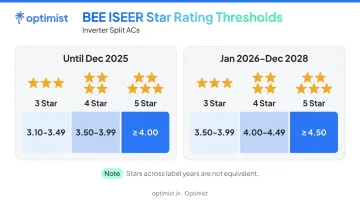
Note: Stars from different label years are not equivalent. A 3-star AC bought in 2024 is not the same efficiency as a 3-star AC bought in 2026.
Watts vs. Units — The Core Formula
- Watt (W): Rate of electrical draw at any given moment
- Unit (kWh): Total energy consumed over time
- Formula: kWh = Watts × Hours ÷ 1,000
A 1,300W AC running for one hour consumes 1.30 kWh (1.30 units). At ₹8/unit, that's ₹10.40 per hour.
What the BEE Label Actually Shows
The "rated power input" on a BEE label is tested at 35°C outdoor / 27°C indoor under controlled conditions. It reflects average seasonal consumption under those specific parameters — not peak wattage, and not what happens on a 45°C afternoon in Delhi.
Inverter type changes this picture considerably:
- Non-inverter AC draws its full rated watts every time the compressor runs — no modulation
- Inverter AC drops its draw significantly once the room stabilises; the nameplate wattage is peak load, not average load — which is why actual bills come in lower than the nameplate suggests
Factors That Drive Real-World Power Consumption Higher or Lower
Published wattage figures come from controlled lab tests. In Indian field conditions, multiple factors push actual consumption above or below those benchmarks.
Star Rating and ISEER
A higher BEE star rating directly means lower rated power input for the same cooling output. Real model data from 2025 illustrates this clearly:
- LG 3-star inverter (US-Q18JNXE): 1,482W rated
- LG 5-star inverter (US-Q19BNZE): 1,290W rated
- Blue Star 5-star inverter (IC518SNUR): 1,300W rated, ISEER 5.05
That 192W difference between a 3-star and 5-star model may seem modest, but across 240 hours of monthly use, it adds up to roughly 46 kWh per month — a meaningful sum at any tariff rate.
Inverter vs. Non-Inverter Compressor
Most buyers underestimate how much this one choice affects their monthly bill.
- Non-inverter: Compressor runs at full rated watts or switches off completely. There is no middle ground.
- Inverter: Compressor modulates speed. Once the room reaches the set temperature, draw drops significantly. The LG 3-star inverter, for instance, publishes a minimum draw of 275W alongside its 1,482W rated input — that's the range an inverter operates across.
A 2023 Indian residential study found 34–68% lower energy use for inverter versus fixed-speed units, though this figure covers both 1-ton and 1.5-ton units combined rather than 1.5-ton in isolation. The savings are most pronounced in homes where the AC runs more than 6–8 hours daily.
Outdoor Temperature and Heat Load
Lab ratings are tested at 35°C. Indian summers routinely go well beyond that. NABL-accredited lab tests of three 1.5-ton 5-star split ACs found:
- Input power rose approximately 1.9% per °C above 35°C
- At 40–50°C outdoor temperatures, actual consumption was 10–28% above the declared BEE input
One tested model (Voltas 185 CY) showed this progression clearly:
| Outdoor Temp | Measured Input |
|---|---|
| 35°C | 1,420W |
| 40°C | 1,555W |
| 45°C | 1,702W |
| 50°C | 1,833W |
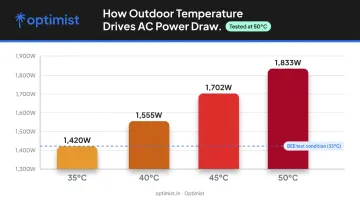
IMD recorded 48.3°C at Sri Ganganagar in May 2024, with 45–48°C across Rajasthan, Haryana-Delhi, and parts of UP and MP. If your AC runs during those conditions, expect your bill to exceed label-based estimates.
Room Size, Insulation, and Internal Heat Load
An undersized or poorly matched AC runs at or near full capacity continuously — raising average wattage draw throughout the day. Factors that increase thermal load:
- Direct afternoon sun through west-facing windows
- Poor door and window sealing
- Multiple occupants in a small room
- Running appliances (TV, laptop, lighting)
Maintenance State
Two maintenance failures consistently push watt draw higher:
- Clogged filters restrict airflow, forcing the compressor to work harder to move the same volume of air
- Low refrigerant reduces heat transfer efficiency, so the system runs longer to achieve the same cooling
No India-specific quantified penalty for 1.5-ton units exists in published research, but the practical implication is straightforward: schedule a service before summer peak, not during it.
Power Consumption by Star Rating and Compressor Type: The Numbers
The figures below represent typical rated operating ranges for 1.5 ton split ACs, based on published official specifications. Actual draw varies with conditions.
5-Star Inverter ACs
Based on 2025 model data:
- Rated (full-load) draw: 1,290–1,300W
- Steady-state draw: Much lower in practice — inverter compressors reduce speed once the room reaches target temperature; minimum operating watts are not published uniformly but can drop well below 600W on well-sized units
India's highest-efficiency 1.5 ton split ACs currently reach ISEER ratings above 5.0. For context, Optimist's 1.4 Ton 5 Star+ AC carries a declared ISEER of 6.05, meaningfully higher than standard 5-star competitors (typically ISEER 5.0–5.4), which translates to fewer units consumed per degree of cooling delivered.
The Optimist App pairs this with a live energy meter showing real-time kW draw and projected monthly bill — so users see exactly what their usage patterns cost, rather than estimating from a label.
3-Star Inverter and 5-Star Non-Inverter ACs
- 3-star inverter rated draw: 1,280–1,482W (wide range due to inverter modulation)
- 5-star non-inverter: No current official watt specification found in public BEE data for a standard market model
A 5-star non-inverter and a 3-star inverter can consume similar total electricity despite different technology: their ISEER values overlap at this tier. What separates them is behavior — the inverter model's average draw drops at steady state, while the non-inverter cycles on/off at full rated watts every time.
3-Star and 2-Star Non-Inverter ACs
Non-inverter ACs at lower star ratings are the highest consumers in this segment. Based on the pattern established by official model data, 3-star non-inverter units typically draw in the 1,400–1,600W range at full load — with no modulation capability, every compressor-on cycle draws that full amount.
BEE's market data shows inverter AC market share has grown from 1% to 77% over eight years, driven by the running cost difference that compounds over a full summer season.
How to Calculate Your Monthly Electricity Bill
The Formula
(Rated Power in kW) × (Hours/day) × (Days/month) × (Tariff per unit) = Monthly bill
Worked Example
Assumptions: 8 hours/day, 30 days, comparing a 3-star inverter (1.482 kW rated) vs. a 5-star inverter (1.290 kW rated):
| Metric | 3-Star Inverter | 5-Star Inverter |
|---|---|---|
| Monthly kWh | 355.7 kWh | 309.6 kWh |
| Delhi tariff (₹8/unit) | ₹2,845 | ₹2,477 |
| Maharashtra tariff (₹12.51/unit) | ₹4,449 | ₹3,873 |
| Karnataka/UP tariff (₹7/unit) | ₹2,490 | ₹2,167 |
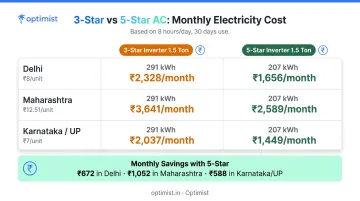
State tariffs vary significantly — CEA's 2024 data shows residential rates ranging from ₹7.00/kWh in Karnataka and UP to ₹12.51/kWh in Maharashtra. Use your household's actual marginal slab rate for accurate estimates.
What This Calculation Doesn't Capture
These figures give you a solid starting point, but a few real-world factors will push your actual bill higher or lower:
- These figures use continuous rated-input, so inverter modulation at steady state will lower actual consumption
- Outdoor temperatures above 35°C push consumption higher (10–28% above label at 40–50°C)
- The first 30–60 minutes of each cooling cycle draws more than the steady-state average
- Your real bill will vary from this estimate, so treat it as a ballpark, not a guarantee
Common Misconceptions About 1.5 Ton AC Wattage
Misconception 1: "The nameplate wattage is what I pay for"
The nameplate shows rated input power at full load. An inverter AC rarely operates at that level once the room cools — average watts drawn over a full day of use is far lower. Assuming the nameplate figure is what you pay overstates your actual bill, often by a wide margin.
Misconception 2: "A higher star rating always means lower watts"
Star ratings compare efficiency within a compressor technology class. A 5-star non-inverter AC can consume more total electricity than a 3-star inverter AC in heavy daily use — because the non-inverter cycles on/off at full wattage, while the inverter drops to a fraction of rated load at steady state.
Misconception 3: "Setting 18°C cools the room faster without using more power"
Lower thermostat settings force the compressor to run at high loads for longer. The room reaches a comfortable temperature at roughly the same speed whether you set 18°C or 24°C — but at 18°C, the compressor never settles into the low-power steady state an inverter is designed to achieve.
The numbers back this up: BEE estimates approximately 24% savings when shifting from a 20–21°C setting to 24°C.
Practical Ways to Reduce Power Consumption Without Sacrificing Cooling
Thermostat and Usage Habits
- Set target temperature at 24–26°C — BEE's recommended range, and the single most impactful habit
- Use sleep and timer modes to avoid running at full load when not needed
- Avoid frequent temperature adjustments that force the compressor to restart at high wattage
Room-Level Fixes
- Seal gaps around doors and windows — even small gaps significantly increase heat gain
- Use curtains or blinds on west and south-facing windows during afternoon hours
- Verify the AC is correctly sized for your room; an undersized unit running flat-out draws more total watts than a properly matched unit cycling efficiently
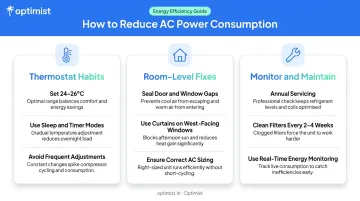
Monitor and Maintain the Unit
- Schedule annual servicing to check refrigerant levels and clean coils
- Clean filters every 2–4 weeks during heavy summer use
- Consider an AC with real-time energy monitoring — the Optimist app, for instance, shows live kW draw, projected monthly bills in rupees, filter health alerts, and a built-in gas level indicator, so you can spot exactly what's pushing consumption up before the bill arrives.
Frequently Asked Questions
What is the power consumption (in watts) of a 1.5 ton split AC?
Typically 900W to 1,800W, depending on star rating and compressor type. A 5-star inverter model draws 1,290–1,300W at rated load and considerably less at steady state; a 3-star non-inverter model draws 1,400–1,600W whenever the compressor runs. Actual watts fluctuate continuously during operation.
Is a 1.5 ton AC suitable for a 200 sq ft room?
A 1.5 ton AC is designed for roughly 150–200 sq ft under standard conditions. However, direct sun exposure, poor insulation, high ceilings, or outdoor temperatures above 40°C reduce effective coverage — in those scenarios the compressor runs harder and draws more watts. Room conditions matter as much as tonnage.
What will be the monthly electricity bill for running a 1.5 ton AC?
For 8 hours/day, expect roughly ₹2,200 to ₹4,500 per month depending on star rating and your state's tariff. A 5-star inverter model running at rated input costs approximately ₹2,477/month at ₹8/unit (Delhi) and closer to ₹3,873/month at ₹12.51/unit (Maharashtra). Actual bills vary with outdoor conditions and usage patterns.
What is the difference in power consumption between inverter and non-inverter 1.5 ton AC?
An inverter compressor modulates speed — once the room cools, draw drops well below rated watts. A non-inverter compressor cycles on/off at full wattage with no in-between, making inverter savings most pronounced when the AC runs more than 6–8 hours daily. That usage pattern is typical across Indian summers.
How does the ISEER rating affect the power consumption of a 1.5 ton split AC?
ISEER is the ratio of seasonal cooling delivered to seasonal energy consumed — a higher ISEER means fewer units of electricity consumed for the same amount of cooling. Moving from ISEER 4.0 to ISEER 5.0 can reduce annual energy consumption by 20% or more, directly cutting both average wattage drawn and the monthly bill.
Does outdoor temperature affect how much power a 1.5 ton AC consumes?
Outdoor temperature has a direct impact: the compressor works harder as heat rises, drawing more watts to maintain refrigerant pressure. Lab testing of 1.5-ton 5-star models found power consumption 10–28% above declared BEE input at 40–50°C outdoor temperatures. BEE label figures are tested at 35°C — in Indian peak summer, actual consumption will consistently exceed those figures.