
The problem is that "power consumption per hour" means different things on a spec sheet versus your electricity bill. The BEE star label gives you a standardised figure. Your meter gives you a different one. Understanding the gap between them — and why it exists — is what this article covers.
Key Takeaways
- A 1.5 ton split AC consumes 1.2–1.8 units (kWh) per hour on average; 5-star inverter models run closer to 0.9–1.35 units/hr
- BEE's ISEER rating is the most reliable single indicator of real-world efficiency — higher ISEER means lower bills
- Expect real-world consumption to run 15–25% higher than the BEE label during Indian peak summer
- Running at 24°C instead of 18°C saves roughly 6% electricity per degree, according to BEE guidelines
- Monthly costs typically run ₹1,700–₹2,600 for a 5-star inverter AC and ₹2,800–₹3,600 for a 3-star non-inverter at standard tariffs
What "Power Consumption Per Hour" Really Means
Cooling Capacity vs. Electrical Power
"1.5 ton" describes cooling capacity — specifically, the ability to remove 18,000 BTU/hr of heat from a room. It says nothing about how many watts the AC draws from the grid. Those are two separate numbers, and confusing them leads to bad purchase decisions.
Power consumption per hour is measured in kilowatt-hours (kWh), commonly called "units" on your electricity bill. One unit = 1 kWh = one kilowatt drawn for one hour.
Fixed vs. Variable Draw
How that draw behaves depends on compressor type:
- Inverter AC: The compressor modulates speed continuously. Draw peaks during initial cool-down, then drops once the room reaches set temperature. Average consumption is lower as a result.
- Non-inverter AC: The compressor switches fully on and fully off at maximum rated wattage each cycle. It always runs at full wattage with no speed adjustment between cycles.
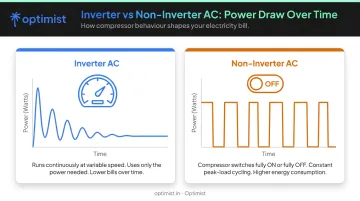
That difference in how compressors behave over hundreds of hours is exactly what ISEER captures.
What ISEER Actually Measures
ISEER (Indian Seasonal Energy Efficiency Ratio) = total seasonal cooling output ÷ total seasonal energy input, calculated over a 1,600-hour annual profile at outdoor temperatures between 24°C and 43°C. A higher ISEER means fewer units consumed per unit of cooling delivered — and that directly predicts your electricity bill.
For a 1.5 ton split AC, the practical consumption range is 0.9 kW to 1.8 kW, depending on the factors below.
Factors That Influence Real-World Power Consumption
The gap between your BEE label and your actual bill comes down to four variables that lab conditions don't fully replicate.
BEE Star Rating and ISEER
Current BEE star bands (effective July 2022–December 2024) for split ACs:
| Star Rating | ISEER Band |
|---|---|
| 2 Star | 3.50–3.79 |
| 3 Star | 3.80–4.39 |
| 4 Star | 4.40–4.99 |
| 5 Star | 5.00+ |
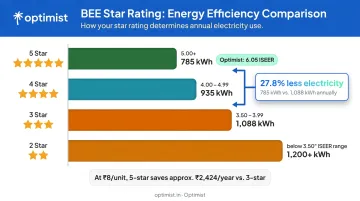
Comparing verified BEE label data: a Daikin 5-star inverter (ISEER 5.2) consumes 785.67 kWh/year, while a Blue Star 3-star fixed-speed model (ISEER 3.81) consumes 1,087.62 kWh/year — a difference of 301.95 kWh/year, or 27.8% less electricity for the 5-star model. That 27.8% gap is real and consistent across comparable models — a reliable basis for purchase decisions.
Outdoor Temperature and Indian Summer Conditions
BEE's standard capacity test uses a fixed 35°C outdoor temperature, and the ISEER seasonal profile only goes up to 43°C — assigning just 3 of 1,600 annual hours to that peak bin.
The reality: IMD recorded temperatures of 45.2–49.1°C across Delhi-NCR on May 29, 2024, and Ahmedabad hit 48°C on May 31, 2024. These temperatures fall entirely outside the BEE test profile, meaning the compressor must work harder than any label scenario accounts for. Most conventional ACs begin derating beyond 43°C — losing cooling capacity while drawing more power.
Room Size, Insulation, and Heat Load
A well-sized, well-insulated room lets the compressor stabilise at lower load. An oversized, poorly insulated room — direct west sun, kitchen nearby, high ceilings — forces continuous high-load operation.
General sizing guidance (per Voltas manufacturer data): a 1.5 ton AC is suited for rooms of 131–190 sq ft under standard conditions. Rooms outside this range, or with heavy heat loads, push consumption toward the upper end of the range.
Thermostat Setting and Maintenance
Beyond room conditions, set temperature and maintenance both shift real-world numbers in ways most owners underestimate:
- Each 1°C increase in set point saves approximately 6% electricity (BEE data). Running at 18°C instead of the government-recommended 24°C is a significant and entirely avoidable cost.
- Daikin India recommends cleaning filters every two weeks. Blocked filters and dirty coils restrict airflow, forcing the compressor to work harder — enough to noticeably widen the gap between your label rating and your actual bill.
Power Consumption by Star Rating: Reference Ranges
These ranges assume standard room conditions. Add 15–25% for Indian peak summer months.
5-Star Inverter Split AC
~0.9–1.35 units/hr
The lower end (0.9 kWh) is achievable once the room hits set temperature and the inverter compressor throttles down. The upper end reflects initial cool-down demand.
The Daikin FTKR50U (ISEER 5.2, 785.67 kWh/year) works out to a label-equivalent average of ~0.49 kWh per assumed operating hour — a seasonal average, not a moment-in-time reading.
3-Star Inverter Split AC
~1.1–1.5 units/hr
Inverter technology helps, but a 3-star inverter still consumes considerably more than a 5-star inverter under comparable conditions. The Panasonic CS/CU-EZ18CKYF (ISEER 4.50, 859.27 kWh/year) illustrates this efficiency gap.
3-Star and 2-Star Non-Inverter Split AC
~1.5–1.8 units/hr
Non-inverter compressors draw maximum rated wattage every cycle. The Blue Star FC318VNU (ISEER 3.81, 1,087.62 kWh/year, rated 1,405 W) is a real-world example — its label average works out to ~0.68 kWh per assumed operating hour, but at full-load wattage the draw is significantly higher.
Reading the BEE Label for kWh Estimates
The BEE label prints Annual Energy Consumption (kWh/year). Dividing by 1,600 (BEE's assumed annual hours) gives a rough seasonal average:
- 785 kWh ÷ 1,600 hrs = ~0.49 kW average (5-star inverter example)
- 1,088 kWh ÷ 1,600 hrs = ~0.68 kW average (3-star non-inverter example)
These are seasonal averages — not peak load, not idle draw. Rated input power (the full-load wattage on the spec sheet) is a separate figure and appears in the manufacturer's technical documentation, not on the BEE label itself.
5-Star Inverter vs. 3-Star Non-Inverter: Monthly Cost Comparison
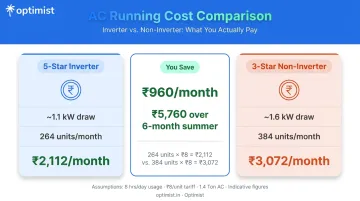
At 8 hours/day, 30 days, and ₹8/unit (a mid-range Indian city tariff):
| AC Type | Avg. Draw | Monthly Units | Monthly Cost (₹8/unit) |
|---|---|---|---|
| 5-Star Inverter | ~1.1 kW | ~264 units | ~₹2,112 |
| 3-Star Non-Inverter | ~1.6 kW | ~384 units | ~₹3,072 |
Difference: ~₹960/month, or roughly ₹5,760 over a 6-month summer season.
How to Calculate Your Monthly Electricity Bill
The formula is straightforward:
Monthly Bill = Average Power Draw (kW) × Daily Hours × 30 × Tariff (₹/kWh)
Worked Example
- AC type: 5-star inverter, mid-range draw of 1.2 kW
- Daily use: 8 hours
- Tariff: ₹8/unit (Delhi upper slab; BESCOM Bengaluru charges ₹5.90/unit flat)
- Monthly units: 1.2 × 8 × 30 = 288 units
- Monthly cost: 288 × ₹8 = ₹2,304
Use effective average draw — not peak wattage from the spec sheet. For an inverter AC that has reached set temperature, effective draw is typically 70–80% of rated input power. A unit rated at 1,325 W may average closer to 950–1,060 W once the room stabilises.
Indian tariffs are slabbed, not flat — so the rate you pay depends on your total household consumption, not just AC usage. Two common examples:
- BESCOM Bengaluru: flat ₹5.90/kWh
- Tata Power Mumbai: ₹2.18/kWh (first 100 units) stepping to ₹12.56/kWh (above 500 units)
The Optimist App (iOS + Android) tracks actual units consumed per session and projects your monthly bill from real usage — no estimates needed.
Why Your AC Likely Consumes More Than the Label Says
Three specific mismatches explain the gap between the BEE label and your meter:
The seasonal profile stops at 43°C. BEE assigns only 3 of 1,600 seasonal hours to 43°C — its highest bin. When Delhi, Ahmedabad, or Nagpur hit 47–49°C in May and June, your compressor runs in conditions the label never tested. Peak-summer consumption is routinely higher than the annual average implies.
The label is an annual average, not a monthly one. BEE's 1,600-hour figure spread across 12 months is misleading. Peak summer months draw far more; mild months far less. Your May–June bills will always exceed what the label average suggests.
Maintenance degrades performance over time. A clogged filter or low refrigerant means more current drawn for less cooling. Compare models using the Annual Energy Consumption figure on the BEE label — not wattage ratings, which don't reflect seasonal modulation or real operating conditions.
Frequently Asked Questions
How much electricity does a 1.5 ton split AC consume per hour?
A 1.5 ton split AC typically draws 1.2–1.8 kWh per hour under average conditions. A 5-star inverter model runs closer to 0.9–1.35 units/hr, while a 3-star non-inverter model sits at the higher end. The exact figure depends on room heat load, outdoor temperature, and set-point temperature.
How much does it cost to run a 1.5 ton split AC for 8 hours a day?
At 1.3 units/hr (a mid-range 5-star inverter), 8 hours = roughly 10.4 units/day. At ₹8/unit, that's ₹83/day or ₹2,500/month. A 3-star non-inverter at 1.6 units/hr works out to around ₹102/day or ₹3,072/month under the same tariff.
Does a 5-star inverter AC really consume significantly less than a 3-star model?
Yes. Verified BEE figures show a 5-star inverter using 27.8% fewer annual units than a comparable 3-star fixed-speed model — over a 6-month Indian summer, that gap adds up to ₹1,500–₹2,000 in savings at typical tariffs.
What is the monthly electricity bill for a 1.5 ton split AC running 8 hours a day?
Monthly bills typically range from ₹1,700–₹2,600 for a 5-star inverter and ₹2,800–₹3,600 for a 3-star non-inverter at standard Indian tariffs. Actual cost varies by city: BESCOM Bengaluru's flat ₹5.90/unit produces a lower bill than Mumbai's upper slabs at ₹11–12/unit.
Why does my 1.5 ton AC consume more electricity during peak summer?
At outdoor temperatures above 40°C, the compressor must work harder to reject heat against a smaller temperature differential. BEE's ISEER profile only goes to 43°C; once temperatures breach that ceiling — common across North India in May–June — the compressor operates outside the rated efficiency curve, drawing more power while delivering less cooling.
How does ISEER rating affect power consumption per hour?
Higher ISEER = more cooling output per unit of electricity consumed. Moving from ISEER 3.81 (3-star non-inverter) to ISEER 5.2 (5-star inverter) cuts annual energy use by nearly 28%. At ISEER 6.05, the gap widens further: Optimist's 5 Star+ Inverter logs just 620.2 kWh annually, versus 850–1,088 kWh for most competing models.