
The truth is that a 5-year AC warranty is rarely a single blanket promise. It's a layered structure with different coverage durations for different parts, a list of exclusions that can run longer than the coverage list, and eligibility conditions that can void your protection before you've even switched the unit on.
This article decodes all of it: what the 5-year warranty actually covers part by part, what's routinely excluded, what conditions you must meet to keep your warranty valid, and what separates a genuinely strong warranty from one that looks good on paper.
Key Takeaways
- A "5-year warranty" almost never covers the entire AC for five years — it's a tiered structure with different parts covered for different durations
- Most brands offer comprehensive coverage only in Year 1; from Year 2 onwards, visit and labour fees are commonly charged even for covered repairs
- Plastic parts, the remote handset, air filters, and damage from power fluctuations or pests are universally excluded
- A compressor warranty and a full-unit warranty are two different promises — don't confuse them
- Warranty validity depends on authorised purchase, authorised installation, and timely registration with the brand
What Does a "5-Year AC Warranty" Actually Mean?
The phrase "5-year warranty" is one of the most misread claims in consumer electronics. It almost never means the entire AC unit is covered uniformly for five years.
In practice, most brands operate a tiered structure:
- Year 1: Comprehensive coverage — the full unit is covered for manufacturing defects, including parts, labour, and often visit charges
- Years 2–5: Extended coverage — only specific named functional components remain covered (typically PCB, coils, motors), and visit/labour charges often shift to the customer
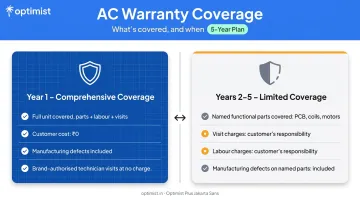
Carrier's 2026 warranty terms illustrate this: year 1 is the standard warranty; years 2–5 extend coverage to listed functional parts only, with visit, labour, and gas charges payable by the customer from year 2 onwards. Hitachi's promotional terms follow the same pattern — parts covered through year 5, but service and visit charges apply after year 1.
That tiered structure is just one part of the puzzle. The compressor warranty — often advertised separately — adds another layer of confusion worth unpacking.
Compressor Warranty vs. Full Unit Warranty
Many brands advertise a "10-year compressor warranty" alongside a "5-year warranty." These are two separate promises, and confusing them is expensive.
The compressor warranty covers one component — the compressor — for repair or replacement if it fails due to manufacturing defects. It does not mean:
- The rest of the AC is covered for 10 years
- Labour, gas, or other affected parts are included in that extended period
Daikin's standard terms confirm this: the 10-year compressor tail covers compressor repair or replacement only — gas charging, labour, transportation, coils, capillary, suction line, and electronic parts are all outside that extended period. LG's terms for purchases after August 2024 make gas and labour payable by the customer during the additional compressor period.
Before buying, ask the brand specifically: what does your extended compressor warranty actually cover when something goes wrong — and who pays for the gas recharge, the service visit, and the technician?
What's Actually Covered Under a 5-Year AC Warranty
A 5-year comprehensive AC warranty typically covers these functional components — though exact terms vary by brand:
- Indoor and outdoor PCB (Printed Circuit Board)
- Evaporator coil (indoor heat exchanger)
- Condenser coil (outdoor heat exchanger)
- Fan motors (indoor and outdoor)
- Swing motor
- Sensors
- Compressor (often with a separate, longer tail)
"Covered" means the brand will repair or replace these components if they fail due to manufacturing defects or faulty workmanship — not due to wear, misuse, or external damage.
What "Repair or Replace" Actually Means
The decision on whether a defective part gets repaired or replaced rests entirely with the brand, not the customer. Most warranty documentation — including Optimist's — reserves that choice for the brand alone. Replaced parts become the company's property.
Gas Refilling: Conditional for Most Brands
For most brands, gas refilling is only covered when refrigerant needs to be recharged as a consequence of repairing a covered component — a leaking coil or a failed compressor, for instance. A standalone gas top-up requested independently of any component repair is almost always chargeable.
Optimist's approach differs here. Its 5-year refrigerant gas coverage states refill and repair at ₹0 "in all cases" — not just when tied to a component fault.
Visit and Labour Charges by Year
This is where most buyers get caught off-guard:
| Coverage Period | Typical Industry Approach | Optimist |
|---|---|---|
| Year 1 | Parts + labour + visits at ₹0 | Parts + labour + visits at ₹0 |
| Years 2–5 | Parts covered; visits/labour often chargeable | Parts + labour + visits at ₹0 throughout |
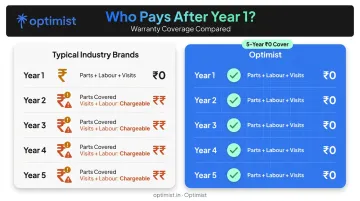
Carrier, Hitachi, Daikin, Blue Star, and Panasonic all make visit and inspection charges payable after year 1. Optimist's warranty documentation, by contrast, clearly states no labour charges, gas refill charges, or part replacement charges for covered faults — throughout the entire 5-year period.
What's NOT Covered: The Fine Print That Surprises Most Buyers
Components Excluded Across Most Brands
- Plastic parts: Body panels, louvers, trims, and the outdoor unit fan guard are treated as cosmetic/consumable items, not functional components
- Sheet metal components: Structural casings and housings are excluded
- Remote handset: Universally excluded in standard warranties (though Optimist provides a 5-year remote warranty covering internal malfunctions, with physical damage excluded)
- Air filters: Filter cleaning, replacement, and filter-related performance issues are always the customer's responsibility
Damage-Type Exclusions
These apply regardless of which year you're in:
- Unstable or faulty electrical supply voids coverage — Optimist's terms specifically exclude voltage exceeding 290V and sudden surges including lightning strikes
- Accidents, drops, and mishandling are excluded across all brands
- Insect or rodent damage is explicitly excluded, regardless of how or when it occurred
- Corrosive-environment installations — near the sea, chemical plants, or sewage areas — are excluded by brands including Carrier and Daikin
Maintenance Is Not Warranty
None of the damage exclusions above are the most common warranty surprise — that distinction belongs to maintenance. Preventive maintenance, routine cleaning, and AMC servicing are not covered under any warranty. If a technician visits and finds the unit only needs a clean or a gas top-up unrelated to a covered component fault, that visit is chargeable — even within year 1.
A part must provably fail for a warranty claim to be honoured. Underperformance without a clear component failure won't qualify.
Conditions You Must Meet to Keep Your Warranty Valid
Authorised Purchase and Installation
Most brands require both:
- Purchase from an authorised dealer
- Installation by a brand-authorised service partner
Daikin's standard terms state that installation or service by an unauthorised person will void coverage. Carrier requires authorised purchase, installation, and service — full stop. Self-installation using a local technician is one of the most common reasons warranty claims get rejected.
Optimist handles this differently: warranty activates automatically once an authorised Optimist technician completes the installation. No separate registration needed.
Registration Requirements (Industry Standard)
For most brands, warranty registration within a set window is mandatory:
- Carrier's 2026 terms require registration in real time on the day of installation by an authorised partner
- Hitachi requires installation or inspection by the company within 45 days of purchase
- Daikin's standard warranty card requires the authorised dealer's stamp, date, and signature
- Missing the registration window typically drops you back to standard 1-year coverage, forfeiting all extended protection
Keep your original GST invoice. It's the primary proof of purchase date for any warranty claim, regardless of brand.
Residential Use Only
Extended warranties across brands are restricted to residential installations. Installing in a commercial space voids extended warranty eligibility. This includes:
- Shops and retail outlets
- Offices and co-working spaces
- Hotels and guesthouses
- Hospitals and clinics
Brands do verify installation sites before honouring claims, so the use case matters.
What Separates a Strong 5-Year Warranty from a Weak One
Before accepting a warranty at face value, ask these questions:
- Does the 5-year coverage include labour and visit charges, or are these payable from year 2?
- Is gas charging included with component repairs — or also for standalone refills?
- Are all functional parts covered, or only a listed subset?
- Is there a separate, longer compressor warranty on top?
- Does the registration process protect you or create trip-wires?
A strong warranty answers all of these clearly upfront. Weak ones look comprehensive on the headline, then bury visit charges, narrow parts lists, and registration hoops in the fine print.
Optimist's AC comes with a comprehensive structure designed to eliminate these hidden-cost surprises:
| Component | Coverage | Cost to Customer |
|---|---|---|
| Outdoor Unit (all components) | 5 years | ₹0 parts + labour |
| Compressor | 10 years | ₹0 parts + labour |
| Indoor Unit (PCB, sensors, fan motor, display, swing motor, evaporator coil) | 5 years | ₹0 parts + labour |
| Refrigerant gas | 5 years | ₹0 in all cases |
| Remote control | 5 years | ₹0 (physical damage excluded) |
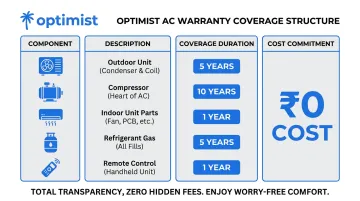
No visit charges from year 2. No mandatory AMC to maintain coverage. Gas covered for the full 5 years, not just when tied to a component repair. The warranty is also transferable, linked to the product serial number, so a new owner inherits whatever remains of the original period automatically.
Frequently Asked Questions
What is the meaning of a 5-year warranty?
A 5-year warranty means the manufacturer commits to repairing or replacing covered components that fail due to manufacturing defects within five years of purchase. Coverage structures vary significantly by brand — some offer narrowing protection after year 1, while others provide the same comprehensive coverage throughout all five years. Always check what's actually covered in each year, not just the headline number.
Does warranty mean free repair?
Not always. Many manufacturers charge visit and inspection fees from year 2 onwards, even for repairs that qualify under warranty. Routine maintenance and service calls that find no covered fault are always chargeable — regardless of how comprehensive the warranty looks on paper.
What parts are typically NOT covered under a 5-year AC warranty?
Plastic body parts, sheet metal components, the remote handset, and air filters are excluded by most brands. Damage from physical mishandling, power fluctuations (especially voltage surges), pest or rodent intrusion, and corrosive environments (coastal, industrial, or chemical) is also excluded regardless of the warranty period.
Does a 5-year AC warranty cover refrigerant/gas refilling?
For most brands, gas is only covered when a recharge is a direct consequence of repairing a covered component — a leaking coil or failed compressor, for instance. Standalone top-ups are typically chargeable. Some brands with more comprehensive warranties include refrigerant gas as a covered item throughout the warranty period, which is worth checking before purchase.
Is the 5-year warranty valid if the AC is not installed by an authorised dealer?
In most cases, no. Brands typically require installation by a brand-authorised technician for extended warranty terms to apply. Using a local technician — even a skilled one — is a common reason claims get rejected. Some brands now bundle authorised installation with the purchase price, which eliminates this risk entirely.
What happens if I don't register my AC warranty on time?
With most brands, missing the registration window means losing eligibility for the extended warranty — coverage typically reverts to standard 1-year protection only. Registration deadlines vary by brand, sometimes as short as the day of installation. Check the requirement at the time of purchase, not when something goes wrong.