

This happens to millions of Indian households every summer — and the confusion is understandable, because inverter AC power consumption doesn't work the way most people expect. It's not a fixed number. It shifts constantly based on outdoor temperature, your thermostat setting, how well your room is sealed, and how your state's electricity slab rates happen to stack up that month.
This guide breaks down exactly how inverter AC consumption works, what real-world usage looks like by tonnage and star rating, how to calculate your monthly bill, and what you can actually do to bring costs down.
Key Takeaways
- Inverter AC power consumption is variable — it peaks during the first 15–20 minutes, then drops significantly to maintain temperature
- A 1.4-ton 5-star+ inverter AC (like Optimist's, with ISEER 6.05) consumes just 620.2 kWh annually at BEE test conditions
- Monthly bills depend on tonnage, ISEER rating, usage hours, thermostat setting, and your local electricity slab
- BEE recommends setting your AC to 24°C — each degree higher saves approximately 6% in electricity consumption
- India's slab tariff system can amplify your AC bill significantly if extra usage pushes you into a higher rate band
How Inverter AC Power Consumption Actually Works
Most people assume their AC draws a fixed number of watts — like a light bulb. It doesn't.
The Variable Speed Mechanism
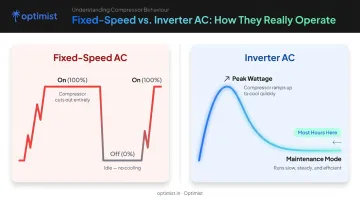
A conventional fixed-speed AC has one mode: full power on, full power off. The compressor runs at 100% capacity, cools the room, shuts off when the thermostat is satisfied, then restarts at full power again. This constant cycling is why non-inverter ACs are power-hungry.
An inverter AC works differently. The compressor adjusts its speed continuously to match how much cooling the room actually needs at that moment. When you first switch it on in a hot room, the compressor runs near full capacity — this is where peak wattage occurs.
Once the room reaches your set temperature, the compressor slows to a low "maintenance" speed, drawing much less power. The rated wattage on the AC label reflects that peak moment, not your actual running draw. Per BEE's labelling rules, measured full-capacity power may be up to 105% of rated power — but the AC only operates at that level during initial cool-down. Most of the time, it runs at a fraction of that.
What This Means for Your Bill
For planning purposes, ignore the nameplate wattage. Instead, use the annual energy consumption figure (in kWh) displayed on the BEE star label — this is calculated over 1,600 standardised cooling hours and gives you a far more useful planning number.
A 2023 peer-reviewed study of 15 Indian residential buildings found that inverter room ACs used 34–68% less energy than fixed-speed units under comparable conditions (Energy and Buildings, Elsevier). The range is wide because actual savings depend heavily on operating temperature and usage patterns, not just the inverter mechanism.
When reading your BEE star label, focus on these three numbers:
- Annual kWh figure — your most reliable consumption estimate
- ISEER rating — higher means more cooling per unit of electricity
- Rated input power (W) — the peak draw, not your average running wattage
The Temperature Myth Worth Correcting
Running your AC at 18°C for four hours is almost certainly more expensive than running it at 26°C for eight hours. At 18°C, the compressor has to surge repeatedly to maintain a temperature far below ambient — it rarely gets to settle into low-speed maintenance mode. At 26°C, it reaches the set point quickly, then barely runs. The longer-but-easier approach wins on the bill.
Inverter AC Power Consumption by Tonnage and Star Rating
BEE certifies individual AC models — there's no single official hourly kWh figure for "all 1.5-ton 3-star ACs." The consumption figures in the table below are derived from BEE-label annual consumption data and should be treated as indicative ranges, not guaranteed values for every model.
Hourly Consumption Reference (Indicative)
| Capacity | Star Rating | Approx. Hourly kWh | Annual kWh (BEE basis) |
|---|---|---|---|
| 1 ton | 3-star | 0.65–0.85 kWh | ~900–1,100 kWh |
| 1 ton | 5-star | 0.50–0.65 kWh | ~750–900 kWh |
| 1.4–1.5 ton | 3-star | 0.90–1.20 kWh | ~1,200–1,500 kWh |
| 1.4–1.5 ton | 5-star | 0.65–0.95 kWh | ~750–1,000 kWh |
| 2 ton | 3-star | 1.20–1.60 kWh | ~1,500–1,900 kWh |
| 2 ton | 5-star | 0.95–1.30 kWh | ~1,200–1,600 kWh |
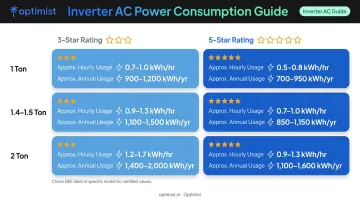
Always check the BEE label of the specific model you're buying — these are indicative ranges, not official BEE-published figures.
Estimated Monthly Bill (8 Hours/Day)
Using MSEDCL Maharashtra slab rates as an illustration (rates vary significantly by state — check your DISCOM for local figures):
| Capacity | Star Rating | Est. Monthly kWh | Est. Monthly Cost* |
|---|---|---|---|
| 1 ton | 5-star | 155–165 kWh | ₹1,300–₹2,000 |
| 1.4–1.5 ton | 5-star | 170–230 kWh | ₹1,450–₹2,850 |
| 2 ton | 5-star | 230–310 kWh | ₹2,000–₹3,900 |
*Cost estimate uses MSEDCL's FY 2026–27 LT-I(B) variable tariff: ₹5.56/kWh up to 100 units, ₹12.40/kWh for 101–300 units, ₹16.64/kWh for 301–500 units. Actual cost depends heavily on total household consumption and slab progression.
Room Size and AC Tonnage
No official BEE square-footage table exists, but common retailer guidance (not a government standard) suggests:
- 1 ton: Up to approximately 100–120 sq ft
- 1.4–1.5 ton: 120–200 sq ft
- 2 ton: 180–240 sq ft
Using an undersized AC is worse than using an oversized one — an undersized unit runs at maximum capacity continuously, consuming more power and cooling less effectively.
Indian Summer vs. BEE Test Conditions
Once you've chosen the right size, one more gap between spec-sheet estimates and real bills is worth understanding: BEE tests are not conducted in Indian peak-summer conditions.
- BEE standard test temperature: 35°C outdoor ambient
- Real North Indian peak summer (Delhi, Rajasthan, UP): 45–50°C regularly
Most ACs derate their cooling capacity and draw more power at these temperatures. That's why real-world bills during May–June can surprise even careful planners — the AC on your shortlist may be rated for conditions far cooler than your actual summer. When comparing models, check whether the manufacturer publishes performance data at 50°C ambient, not just 35°C.
How to Calculate Your Monthly Inverter AC Electricity Bill
Calculating Daily and Monthly Consumption
The core formula:
Daily consumption (kWh) = (Rated wattage ÷ 1,000) × Hours used × Load factor
For inverter ACs, the load factor accounts for variable speed operation — the AC doesn't run at full rated wattage throughout. A load factor of 0.7–0.85 is commonly referenced, though BEE does not publish this as an official standard. Use it as a planning approximation, not a certified figure.
Worked example using the Optimist 1.4-ton 5-star+ AC:
| Step | Calculation |
|---|---|
| Rated input | 1,070 W = 1.07 kW |
| Hours/day | 8 hours |
| Load factor | 0.75 (indicative) |
| Daily consumption | 1.07 × 8 × 0.75 = 6.42 kWh/day |
| Monthly consumption | 6.42 × 30 = ~193 kWh/month |
| Annual consumption (BEE label) | 620.2 kWh (official figure at 1,600 hours) |
The BEE annual figure of 620.2 kWh is the most reliable number to use for annual cost projections. Divide it by 1,600 hours to get an average hourly rate of ~0.39 kWh/hour — lower than full-rated-wattage assumptions because it reflects real seasonal operating patterns.
Understanding Indian Electricity Slab Tariffs
India doesn't charge a flat per-unit rate. Consumption is billed in slabs — the more you use, the higher the per-unit cost for subsequent units. Maharashtra's MSEDCL FY 2026–27 residential tariff illustrates this clearly:
| Monthly Consumption | Rate per Unit |
|---|---|
| 1–100 units | ₹5.56 |
| 101–300 units | ₹12.40 |
| 301–500 units | ₹16.64 |
| Above 500 units | ₹19.13 |
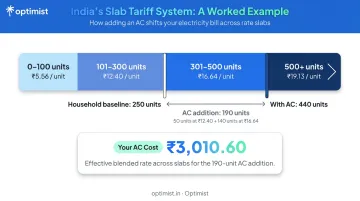
Your AC doesn't add units at a flat rate. If your household normally consumes 250 units/month and the AC adds 190 units, your total hits 440 units.
Those 190 AC units get split across two slabs: the first 50 (taking you from 250 to 300) are billed at ₹12.40, and the remaining 140 cross into the ₹16.64 slab. The effective per-unit cost of running the AC ends up higher than the headline rate suggests.
Quick Bill Calculation Checklist
- Find your AC's rated wattage (nameplate or BEE label)
- Apply a 0.75 load factor for inverter operation
- Multiply by daily hours × 30 days to get monthly kWh
- Identify your total household monthly kWh including the AC
- Apply your state DISCOM's slab rates progressively to the total
- Compare against last month's bill without AC to isolate the AC's contribution
What Is ISEER and How It Affects Your Electricity Bill
ISEER — Indian Seasonal Energy Efficiency Ratio — measures how many units of cooling an AC delivers per unit of electricity consumed, calculated across India's actual seasonal temperature distribution (24°C to 43°C, over 1,600 hours).
The key distinction from EER (Energy Efficiency Ratio): EER is measured at a single test condition. ISEER aggregates performance across the full range of temperatures your AC actually encounters through an Indian summer. That makes ISEER far more predictive of your real electricity bill.
Current BEE Star Rating Bands (2026–2027)
| Star Rating | ISEER Range |
|---|---|
| 3-star | 4.30 – 4.99 |
| 4-star | 5.00 – 5.59 |
| 5-star | 5.60 and above |
These thresholds apply to split AC labels valid from January 2026 to December 2027. From January 2028, the bar rises further (3-star: 4.70–5.19; 5-star: 5.80+).
What Higher ISEER Means in Rupees
To put ISEER in rupee terms: the Optimist 1.4-ton AC carries an ISEER of 6.05, above the current 5-star threshold of 5.60. At ₹5.50/unit:
| AC Type | ISEER | Annual kWh | Annual Cost |
|---|---|---|---|
| Optimist 1.4 ton | 6.05 | 620.2 kWh | ₹3,411 |
| Typical 5-star (1.5 ton) | 5.0–5.2 | 850–920 kWh | ₹4,675–₹5,060 |
| Premium 5-star (1.5 ton) | 5.3–5.4 | 800–850 kWh | ₹4,400–₹4,675 |
The annual saving of ₹1,000–₹1,650 compounds to ₹5,000–₹8,000+ over five years. Households already in the ₹6–₹8/unit tariff slabs see an even sharper impact, since every unit saved comes off a higher marginal rate.
Practical Tips to Reduce Your Inverter AC Electricity Bill
Thermostat and Scheduling
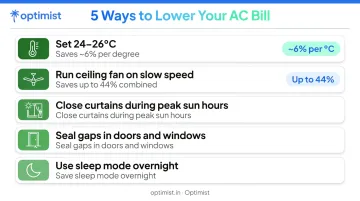
- Set to 24–26°C. BEE's official guidance states that raising the setting by 1°C saves approximately 6% in electricity consumption. Running at 18°C versus 26°C could mean consuming 48% more electricity for the same cooling duration.
- Use sleep mode overnight. Most inverter ACs reduce cooling intensity automatically; you stay comfortable and the compressor works less.
- Pre-cool, don't blast. Schedule the AC to start 20–30 minutes before peak afternoon heat rather than switching it on to maximum when the room is already at 45°C. The compressor runs at lower wattage maintaining a cool room than recovering a hot one.
Room Optimisation
- Run a ceiling fan alongside the AC. A 2023 Indian residential study found that raising the AC setpoint from 24°C to 28°C while using ceiling fans saved 44% in total energy with maintained comfort. Higher fan speeds eliminated those gains — slow speed is the sweet spot.
- Close curtains during peak sun hours. Sun-facing walls can dramatically increase the cooling load.
- Seal gaps around doors and windows. Cooled air escaping through gaps forces the compressor to run longer.
Monitor Actual Consumption
Traditional AC users have no real-time feedback — just a bill shock at month's end. The Optimist App changes that. It shows cumulative kWh consumed and a projected monthly bill in ₹, updated in real time. If usage is tracking higher than expected mid-month, you can adjust settings before the bill finalises — not after.
Beyond billing, the app covers other hidden efficiency killers:
- Filter health alerts — notifies you when cleaning is overdue; a clogged filter forces longer compressor runs
- Scheduling — pre-cool rooms before peak afternoon heat without manual intervention
- Remote diagnostics — flags issues before they affect performance or efficiency
In Indian homes, especially in cities with high dust and pollution, filters clog faster than manufacturer defaults suggest. Staying on top of it through the app takes 10 seconds instead of a surprise service call.
Frequently Asked Questions
How much does it cost to run an inverter AC for 7 hours?
Using a 1.4-ton 5-star inverter AC at 1,070 W with a 0.75 load factor: 1.07 × 7 × 0.75 ≈ 5.6 kWh per day. At ₹8–12/unit (mid-slab Maharashtra rates), that's roughly ₹45–₹67/day — your actual figure will shift based on tonnage, ISEER rating, and your household's slab position.
How much power does a 1.5-ton inverter AC consume?
Hourly consumption ranges from roughly 0.65–1.20 kWh for a 1.5-ton inverter AC depending on star rating and conditions — it's not a fixed number. The BEE label's annual energy consumption figure (in kWh) is the most reliable source for any specific model you're evaluating.
How many inverter ACs can a 3 kW supply run?
A typical 1.4–1.5-ton inverter AC draws 1.0–1.5 kW at steady state and more during startup surges. A 3 kW supply can run one AC with limited headroom for other appliances. A dedicated circuit with appropriate MCB rating is strongly recommended.
Is a 5-star inverter AC worth the higher upfront cost in India?
At 8+ hours/day through a 5–6 month summer, the annual electricity savings over a 3-star model typically amount to ₹2,000–₹5,000 depending on usage and local tariff. For most households, the cost premium pays back within 2–4 years. Slab progression can accelerate that payback further if your household crosses into a higher tariff band.
What temperature should I set my inverter AC at to save electricity?
24–26°C is BEE's recommended range. Each degree below 24°C increases compressor run time and pushes consumption up approximately 6% per degree. Setting 18°C is not more comfortable than 24°C in most cases — it's just significantly more expensive.
Why does my inverter AC electricity bill vary month to month?
Three main reasons: outdoor temperature (hotter days mean longer compressor run times), total usage hours, and India's slab tariff structure. One unusually hot month can push your total household consumption into a higher slab, making every additional unit of AC usage more expensive than the previous month — even if you ran the AC for the same number of hours.