
Against that backdrop, buying the wrong AC isn't just uncomfortable. It's expensive.
The market has shifted fast. Inverter compressors, smart app controls, and energy efficiency ratings now matter as much as brand logos on the box. This guide breaks down the top AC brands in India for 2026, what actually separates them, and how to pick the right one for your home rather than just the most familiar name.
Key Takeaways
- Daikin, Voltas, LG, Samsung, Blue Star, Panasonic, Carrier, and Haier are 2026's top established brands.
- ISEER rating matters more than sticker price for long-term running costs.
- Service network strength often decides satisfaction more than brand prestige.
- Newer entrants like Optimist are pushing ISEER benchmarks past what legacy 5-star ACs offer.
- Room size, budget, and local climate should drive your final decision, not brand recall alone.
Overview of the Air Conditioner Market in India in 2026
What makes an AC genuinely "top-rated" in India isn't the same as what matters in milder climates. Three things separate the good from the mediocre here:
- Cooling performance in extreme heat – many ACs quietly reduce output once ambient temperature crosses 43°C
- Energy efficiency – measured through ISEER and BEE star ratings
- After-sales service – because even the best compressor eventually needs a technician
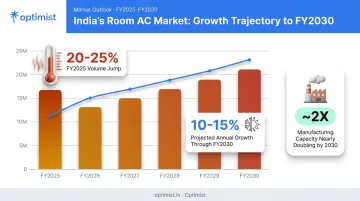
The scale of this market is hard to overstate. Industry estimates from ICRA projects 10-15% annual volume growth for India's room AC segment through FY2030, following a sharp 20-25% jump in FY2025 alone. Manufacturing capacity is expected to nearly double by 2030 to meet demand.
That growth is pulling manufacturers toward higher ISEER ratings and inverter-first designs, partly due to tightening BEE efficiency norms and partly because consumers have become savvier about electricity bills.
The list below evaluates brands on cooling power in real heat, energy efficiency, innovation, and how much trust they've earned through actual customer experience — not just marketing claims.
Top Air Conditioner Brands in India for 2026
Each brand below is assessed on cooling performance in extreme heat, energy efficiency, service network reach, innovation, and price-to-value ratio.
Daikin
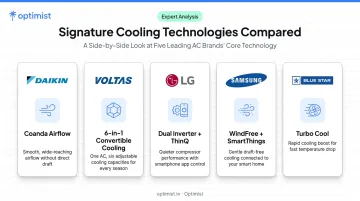
Daikin is the Japanese premium name most Indian buyers associate with quiet, dependable cooling. Its Coanda airflow technology pushes air along the ceiling rather than straight down, distributing cooling more evenly across a room without a direct cold blast.
What sets it apart is compressor longevity. Daikin's inverter models consistently hold 5-star ratings across their range, and select models claim stable operation up to 55°C ambient.
| Attribute | Details |
|---|---|
| Key Features | Coanda airflow, PM 2.5 filter, stabiliser-free operation |
| Best For | Bedrooms and premium home cooling |
| Price Range | Approximately ₹46,000–₹50,000 for a 1.5-ton, 5-star split AC |
Voltas
Owned by the Tata Group, Voltas sells more room ACs by volume than any other brand in India. ICRA data places Voltas at roughly 19.8% room-AC market share in H1 FY2025, supported by a distribution network exceeding 30,000 touchpoints, a major reason it dominates tier 2 and tier 3 cities.
Its 2026 lineup features 6-in-1 convertible cooling modes, letting users dial capacity up or down based on occupancy and outside temperature.
| Attribute | Details |
|---|---|
| Key Features | Copper condenser, anti-dust filters, high ambient cooling support |
| Best For | Budget-conscious buyers and tier 2/3 cities |
| Price Range | Roughly ₹46,000–₹53,000 for a 1.5-ton, 5-star split AC |
LG
LG built its reputation on Dual Inverter Compressor technology, which reduces friction and noise while stabilising power draw. Its AI-based convertible modes adjust cooling automatically depending on room occupancy.
The ThinQ app is the real differentiator here: most households actually use it, unlike some rival apps that get downloaded once and forgotten. It supports remote scheduling, low-noise mode toggling, and usage tracking.
| Attribute | Details |
|---|---|
| Key Features | Dual inverter, AI convertible modes, HD filter |
| Best For | Tech-savvy households wanting app-controlled cooling |
| Price Range | Around ₹41,500–₹51,500 for a 1.5-ton, 5-star split AC |
Samsung
Samsung's WindFree technology disperses cooled air through thousands of tiny holes instead of a direct vent, so the room cools without the harsh draft. Paired with AI Auto mode, it quietly optimises energy use based on usage patterns.
SmartThings integration is the standout feature for anyone already inside Samsung's ecosystem: control from a Galaxy Watch or phone, no separate app needed.
| Attribute | Details |
|---|---|
| Key Features | WindFree cooling, AI Auto mode, convertible 5-in-1 |
| Best For | Living rooms and smart-home integrated setups |
| Price Range | Varies by retailer and offer; check current listings before buying |
Blue Star
Blue Star built its name in commercial cooling before extending that heavy-duty engineering into residential ACs. That commercial DNA shows up in build quality that tends to outlast typical residential-grade compressors.
Turbo Cool is genuinely useful during peak summer: it's a preset that prioritises rapid temperature drop over energy conservation for the first several minutes, then settles into efficient inverter operation.
| Attribute | Details |
|---|---|
| Key Features | Convertible cooling, copper coils, self-clean function |
| Best For | Homes needing durable, heavy-duty performance |
| Price Range | Approximately ₹43,000–₹48,000 for a 1.5-ton, 5-star split AC |
Panasonic
Panasonic leans hard into indoor air quality with its nanoe purification system, which the brand claims deactivates airborne particles alongside standard PM2.5 filtration. This is a manufacturer claim, not an independently verified test result.
The MirAIe app rounds things out with hourly sleep profiles, proximity-based alerts, and voice control through Alexa or Google Assistant.
| Attribute | Details |
|---|---|
| Key Features | Nanoe purification, WiFi control, eco-friendly refrigerant |
| Best For | Health-conscious households |
| Price Range | Roughly ₹43,000–₹54,000 for a 1.5-ton, 5-star split AC |
Carrier
Carrier pioneered modern air conditioning globally, and its Indian lineup carries genuine cooling muscle suited to larger rooms and home offices. Hybridjet 2.0 technology directs cooled air toward the outdoor unit's electrical components, protecting the compressor and PCB from heat stress.
Moisture removal is a strong point too, with some models rated at over 1 kg of dehumidification per hour, useful in India's humid coastal cities.
| Attribute | Details |
|---|---|
| Key Features | Hybridjet inverter, auto-clean, effective moisture removal |
| Best For | Larger rooms and office spaces |
| Price Range | Varies by capacity and retailer; confirm current pricing before purchase |
Haier
Haier has carved out a strong budget-to-mid-range position through AI-assisted cooling and long air throw, meaning the cold air actually reaches the far corners of a room rather than pooling near the unit.
Its Heavy Duty AI Smart range emphasises energy savings alongside rapid cooling, though specific AI decision logic varies across models.
| Attribute | Details |
|---|---|
| Key Features | AI cooling, self-clean tech, long air throw |
| Best For | Budget-to-mid-range buyers wanting modern design |
| Price Range | Approximately ₹40,000–₹48,500 for a 1.5-ton, 5-star split AC |
Optimist
Optimist is the newest entrant on this list, launching its first product in January 2026 out of its Gurgaon R&D lab. Rather than spreading across dozens of SKUs, the brand sells a single 1.4-ton inverter split AC engineered specifically for extreme Indian heat.
That focus shows in the specs: an ISEER rating of 6.05, the highest currently in the Indian market, with government-lab testing confirming stable cooling at 50°C ambient. Turbo+ mode pushes the unit to 1.9-ton effective cooling, and a built-in gas-level indicator, a first for the category, flags leaks before they turn into a bigger repair.
| Attribute | Details |
|---|---|
| Key Features | ISEER 6.05, built-in gas-level indicator, Turbo+ mode, 50°C-tested |
| Best For | Buyers prioritising energy savings and transparent performance data |
| Price Range | ₹39,990 for the 1.4-ton, 5-star+ inverter split AC |
Spotlight: Optimist – India's Highest ISEER-Rated AC for Real Indian Summers
Every brand above is well established. Optimist isn't, and that's exactly why it's worth a closer look.
Founded in 2024 by Ashish Goel, former CEO of Urban Ladder, alongside CTO Pranav Chopra, Optimist was built specifically to solve a problem legacy brands have largely ignored: most ACs sold in India were never actually engineered for 45-50°C conditions.
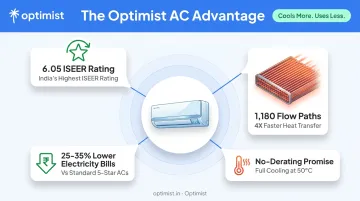
The headline number is a 6.05 ISEER rating, India's highest, translating to 25-35% lower electricity bills compared to standard 5-star inverter ACs. That efficiency comes from a micro-channel heat exchanger borrowed from automotive cooling design, with 1,180 individual flow paths delivering 4X faster heat transfer than conventional coil-and-tube systems.
That engineering enables Optimist's no-derating promise. While most 1.5-ton ACs start losing cooling capacity beyond 43°C, Optimist's 1.4-ton unit is government-lab tested to deliver full rated cooling at 50°C, with no drop-off exactly when you need it most.
A few smart features stand out:
- India's first built-in gas level indicator, showing refrigerant status through the app to end the common gas top-up scam where technicians falsely claim refill is needed
- Real-time energy tracking, including projected monthly bills and savings comparisons against a standard AC
- Filter health monitoring with cleaning reminders
- Turbo+ mode boosts capacity by 135%, so the 1.4-ton unit cools like a 1.9-ton AC, a direct alternative to 1.5-ton units in 120-200 sq ft rooms
Warranty coverage is unusually generous too:
- 5-year comprehensive warranty on outdoor and indoor units
- 10-year compressor warranty
- Refrigerant gas refills covered at no cost
That level of backing matters because it signals staying power beyond the product specs. Optimist is backed by USD 12 million in funding from Accel, Arkam Ventures, and Sparrow Capital, engineered at its Nalanda 1 R&D Lab in Delhi with technical input from IIT Delhi. It's priced at ₹39,990 direct-to-consumer, with no-cost EMI available.
For a two-year-old brand, that's a credible enough foundation to earn a spot on any 2026 shortlist, particularly for households in North India where extreme heat exposes the weaknesses of older AC designs.
How to Choose the Best AC Brand for Your Home in 2026
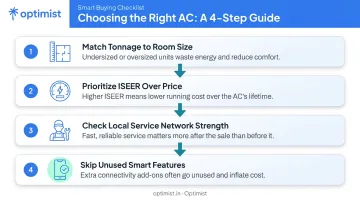
Brand name matters less than these four factors, in this order:
- Match tonnage to room size. LG's guidance suggests up to 120 sq ft needs a 1-ton unit, 120-180 sq ft needs 1.5-ton, and anything larger needs 2-ton. Sun exposure, ceiling height, and occupancy can shift this up or down.
- Prioritise ISEER over sticker price. A higher-ISEER 5-star AC costs more upfront but recovers that difference through lower electricity bills over its lifespan, often within two to three summers. Models like Optimist's, rated at ISEER 6.05, sit at the top of this curve.
- Check local service strength before buying. Compressor warranty length and technician availability in your city matter more for long-term satisfaction than brand prestige. LG, for instance, reports over 1,000 service centres and 13,000+ personnel nationwide as of mid-2025.
- Skip smart features you won't use. App control, gas monitoring, and air purification are genuinely useful, but only if you'll actually engage with them. Paying extra for a feature that goes untouched is money wasted.
Conclusion
There's no single "best" AC brand in India for 2026. The right fit depends on your room size, budget, local service availability, and how brutal your local summer actually gets.
Different brands serve different priorities:
- Daikin suits buyers who prioritise quiet, premium cooling
- Voltas makes sense for budget-conscious buyers in smaller cities
- LG and Samsung appeal to tech-forward households
Weigh long-term running costs and warranty coverage as heavily as upfront price. A cheaper AC that derates in peak heat or racks up electricity bills isn't actually cheaper.
If lower bills and dependable performance in extreme heat top your priority list, consider newer, energy-focused entrants like Optimist alongside the established names. Its 6.05 ISEER rating and 50°C tested performance address real gaps that legacy brands still haven't closed.
Frequently Asked Questions
What are the best brands of air conditioning?
Daikin, Voltas, LG, Samsung, and Blue Star lead the Indian AC market for reliability and performance. Newer energy-focused entrants like Optimist are gaining attention for their high ISEER ratings.
Which AC brand has the best after-sales service in India?
Voltas, LG, Daikin, and Blue Star all maintain extensive service networks across India. Service quality varies by city though, so checking local reviews before buying is a smart move.
What is the No. 1 AC company in India?
There's no single official "No. 1." Voltas leads by sales volume with roughly 19-20% market share, while Daikin stands out as the top choice for premium performance.
Which AC is best for home use in India?
A 1 to 1.5-ton inverter split AC with a 5-star or high ISEER rating suits most Indian homes. This size range balances upfront cost, running expenses, and cooling adequacy for typical bedroom or living room sizes.
Which AC brand is best for cooling performance in extreme heat?
Daikin and Blue Star are known for powerful cooling output. Brands specifically tested for 50°C conditions, like Optimist, are engineered to avoid the performance derating common in standard ACs.
What is ISEER and why does it matter when choosing an AC?
ISEER (Indian Seasonal Energy Efficiency Ratio) measures cooling output against electricity consumed across a full cooling season. A higher ISEER means lower electricity bills for the same cooling performance, which is why it should weigh more heavily than upfront price.