
Dozens of brands, global and regional, now compete on efficiency claims, smart features, and "engineered for extreme heat" marketing. Most buyers can't tell which promises actually hold up once outdoor temperatures cross 45°C.
This guide ranks the world's top AC brands for 2026, explains how we evaluated them, and flags what Indian buyers specifically need to check before spending on a new unit.
Key Takeaways
- Daikin, Mitsubishi Electric, LG, Samsung, and Carrier lead global AC efficiency and reliability rankings.
- ISEER rating, build quality, warranty depth, and after-sales network matter more than brand size alone.
- Peak-heat cooling consistency, not just star rating, decides real-world performance in Indian summers.
- India-first innovators like Optimist are closing the gap for households facing 45-50°C conditions.
- The "best" brand depends on your climate and budget, not global popularity.
Overview of the Global Air Conditioner Market in 2026
A brand earns "top-ranked" status in 2026 through three things: proven technology leadership, energy efficiency that meets tightening regulations, and a manufacturing and service network large enough to back its warranty promises.
The global AC market remains a mixed bag of residential, commercial, and industrial demand, so a single clean number is hard to pin down. What's clear is where the demand actually sits.
According to the Japan Refrigeration and Air Conditioning Industry Association's 2024 estimates, the world bought roughly 113.5 million room air conditioners in 2024, and Asia drove most of that demand:
- China: Over 46 million units sold, the single largest national market
- Rest of Asia (excluding Japan): 23.4 million units
- Combined Asia share: More than 60% of global room-AC demand
Rising heat stress and stricter energy regulations are pushing manufacturers, both legacy names and new climate-tech entrants, to compete on efficiency rather than raw cooling power. The brands below are leading that shift, evaluated on inverter efficiency, reliability, global presence, and after-sales support.
Top Air Conditioner Brands in the World (2026)
These rankings aren't about who spends the most on advertising. They're built on inverter technology maturity, service network depth, and how consistently each brand performs across markets, not just brand recall.
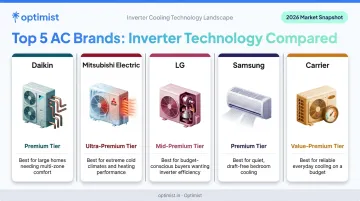
Daikin
Daikin invented the VRV/VRF system back in 1982 and still leads the global HVAC industry by revenue and technology depth. It's a Japanese engineering house first, a consumer brand second, and that shows in how the product is built.
What sets it apart:
- Industry-leading inverter compressor efficiency across its residential and commercial range
- Low-GWP refrigerant technology (R32) rolled out well ahead of many competitors
- One of the largest dealer and service networks worldwide, which matters enormously when something goes wrong
| Attribute | Details |
|---|---|
| Best For | Buyers prioritising premium technology and long-term reliability |
| Price Positioning | Premium |
| Key Technology | VRV/VRF inverter systems, eco-refrigerants |
Mitsubishi Electric
Mitsubishi Electric takes a more understated approach than Daikin's volume-driven strategy. It's the benchmark brand for ductless mini-splits and VRF systems, known for whisper-quiet indoor units and precise temperature holding.
Its standout features:
- AI-assisted climate control that fine-tunes output automatically
- Hyper-Heating Inverter technology, holding full heating capacity even at sub-zero temperatures
- Consistent performance across an unusually wide outdoor temperature band
| Attribute | Details |
|---|---|
| Best For | Buyers wanting ultra-quiet, precise zone cooling |
| Price Positioning | Premium |
| Key Technology | Hyper-Heating Inverter, zone-based climate control |
LG Electronics
LG plays a different game. It's a volume leader with genuine smart-home depth, and it has invested heavily in emerging markets, India included, where it launched 54 DualCool inverter models back in 2019 alone.
Its Dual Inverter compressor uses a variable-speed dual-rotary motor to cut energy consumption, while ThinQ app integration lets users schedule, monitor, and troubleshoot remotely.
| Attribute | Details |
|---|---|
| Best For | Tech-savvy buyers wanting smart-home integration |
| Price Positioning | Mid-to-premium |
| Key Technology | Dual Inverter compressor, ThinQ connectivity |
Samsung Electronics
Samsung's AC strategy leans on comfort design and ecosystem lock-in. Its Wind-Free technology disperses cool air through roughly 23,000 micro-holes at under 0.15 m/s, avoiding the direct cold draft that many users find uncomfortable during long usage.
SmartThings integration ties the AC into Samsung's broader smart-home ecosystem, and the design language is noticeably more polished than most competitors in this price band.
| Attribute | Details |
|---|---|
| Best For | Buyers already invested in the SmartThings ecosystem |
| Price Positioning | Mid-to-premium |
| Key Technology | Wind-Free cooling, SmartThings integration |
Carrier
Willis Carrier invented modern air conditioning in 1902, and the company still carries that legacy across North America's residential and commercial HVAC market. Few brands can match its service infrastructure depth in that region.
Carrier's range spans residential to commercial-grade systems, with high-SEER inverter models and Infinity series smart thermostats rounding out its premium tier.
| Attribute | Details |
|---|---|
| Best For | Buyers wanting a legacy brand with commercial-grade reliability |
| Price Positioning | Mid-to-premium |
| Key Technology | High-SEER inverter systems, Infinity smart thermostats |
Best AC Brand for Extreme Indian Summers: Why Optimist Stands Out
Here's the problem none of the five brands above were built to solve. Most global ACs are engineered and lab-tested for moderate climates, typically 35-43°C.
Push past that, and standard compressors start to derate, meaning cooling capacity drops exactly when you need it most. Indian summers now routinely cross 45°C, and parts of the country touched 47°C in May 2026 alone.
Optimist was built specifically for that gap. It's an India-first climate-tech brand, developed at its Nalanda 1 R&D Lab in Delhi with IIT Delhi technical collaboration. The result is full rated cooling sustained at 50°C, without the derating that trips up conventional units.
A few numbers worth knowing:
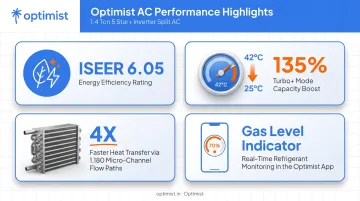
- ISEER 6.05 — India's highest, translating to roughly 25-35% lower electricity bills compared to typical 5-star inverter ACs of similar tonnage
- Turbo+ Mode delivers a 135% capacity boost, giving the 1.4 Ton unit an effective 1.9-Ton cooling output, pulling a room from 42°C to 25°C at top speed
- Micro-channel heat exchanger with 1,180 flow paths in advanced aluminium alloy, enabling 4X faster heat transfer than conventional exchangers
- India's first built-in Gas Level Indicator, showing real-time refrigerant status in the app so technicians can't fake a "gas top-up" that isn't needed
The Optimist app also handles scheduling (walk into a pre-cooled room), live energy tracking with projected monthly bills, and filter health monitoring, all from one dashboard.
Backing all this is a 5-year comprehensive warranty with 10-year compressor coverage, including refrigerant gas, provided installation and servicing go through Optimist's authorised technicians.
That confidence extends to the balance sheet, too. The company has raised USD 12M from Accel, Arkam Ventures, and Sparrow Capital, funding that's gone directly into proving this India-specific engineering approach rather than chasing global market share.
How to Choose the Right AC Brand for Your Needs
Most buyers make the same mistake: they pick a brand on price or popularity, then check the star rating almost as an afterthought. That's backwards.
Here's what actually deserves your attention:
- Energy efficiency rating: look at the exact ISEER number, not just the star count. Two 5-star ACs can have meaningfully different ISEER values.
- Performance consistency in peak heat: does the brand publish a tested ambient temperature limit, and does it match your region's actual summer conditions?
- Warranty coverage: check what's covered (compressor, gas, labour) and for how long, not just the headline "5-year warranty" claim.
- Smart diagnostics: real-time fault detection and app-based monitoring save on unnecessary service visits.
- Local service network strength: a great AC with a three-week wait for a technician isn't a great experience.
If you live in a region where summer temperatures regularly cross 43-45°C, specifically ask whether the brand's AC is tested and rated to run without cooling drop at those temperatures. Optimist's AC, for instance, is government-lab tested at 50°C, well above the typical 43°C standard used elsewhere.
Most spec sheets won't volunteer this kind of data, so it's worth digging into the fine print or contacting support directly.
Conclusion
Daikin, Mitsubishi Electric, LG, Samsung, and Carrier remain the world's most established AC brands for good reason. Between them, they cover premium engineering, whisper-quiet operation, smart connectivity, and legacy reliability. But "best" is a relative term. It depends on your climate, your budget, and what you're actually optimising for.
Before you buy, look past the logo. Check the ISEER rating, read the warranty terms closely, and, if you live somewhere summers get brutal, verify peak-heat cooling consistency rather than trusting reputation alone.
If you're shopping in India and your summers regularly push past 45°C, reputation alone won't tell you how a unit performs at peak heat. Optimist has built specifically for that reality, engineered around real Indian heat, with electricity bills that stay consistently low.
Frequently Asked Questions
What are the top 5 air conditioner brands?
Daikin, Mitsubishi Electric, LG, Samsung, and Carrier are widely recognised as global leaders based on efficiency, reliability, and market presence. Each excels in a different area, from Daikin's technology leadership to Samsung's smart-home integration.
Which AC brand is long lasting?
Japanese brands like Daikin, Mitsubishi Electric, and Hitachi have strong reputations for durability. That said, build quality and corrosion resistance testing matter just as much; Optimist's 1,000-hour salt-spray testing runs 15 times longer than the typical 72-hour market standard.
Which AC brand is best for extreme Indian heat?
Brands specifically tested for 45-50°C performance without derating, such as Optimist, are better suited to Indian summers than ACs designed and rated for moderate climates. Always check the tested ambient temperature, not just the star rating.
What ISEER rating should I look for in an AC in 2026?
Under BEE's current table, a 5-star split AC needs an ISEER of 5.00 or higher. For genuinely top-tier efficiency and lower bills, look for ratings above 5.5-6.0, such as Optimist's 6.05.
Is Daikin better than LG or Samsung?
Daikin generally leads on inverter efficiency and long-term reliability, while LG and Samsung offer stronger smart-home integration and design-led features. The "better" choice really depends on what you're prioritising.
Are Indian AC brands as good as international ones?
India-first brands engineered specifically for local heat and energy costs can outperform global brands designed for milder climates on real-world efficiency. Optimist's 50°C-tested performance and 6.05 ISEER rating are a direct example of this.