
The Bureau of Energy Efficiency revised its ISEER thresholds from January 1, 2026, shifting the goalposts for every star band. An AC that earned a 5-star label in 2024 may now qualify as only 4-star under current norms. If you're comparing models across different purchase years — or simply trying to understand what the label actually guarantees — the star count alone will mislead you.
This article explains how ISEER is calculated, what the 2026 thresholds look like, why real-world performance diverges from the rated value, and what to actually check before buying.
Key Takeaways
- ISEER measures annual cooling output against electricity consumed, tested across a 24°C–43°C temperature range
- From January 2026, split ACs need ISEER ≥ 5.30 for a 5-star rating — the old threshold was ≥ 5.00
- Star ratings are only comparable within the same label period; a 2022 5-star is not the same as a 2026 5-star
- Within the same star band, ISEER values can vary significantly — always compare the exact number, not just the stars
- Real-world efficiency can fall short of the rated ISEER due to ambient temperatures above 43°C, refrigerant levels, and installation quality
What ISEER Actually Measures in an Air Conditioner
ISEER — Indian Seasonal Energy Efficiency Ratio — is the single number that determines the star band your AC falls into. The BEE schedule defines it precisely:
ISEER = CSTL ÷ CSEC
Where CSTL is the Cooling Seasonal Total Load (total heat removed from indoor air over a season, in kWh) and CSEC is the Cooling Seasonal Energy Consumption (total electricity consumed over the same period, in kWh).
How It Replaced the Older EER Metric
Before ISEER, Indian ACs were tested using EER — Energy Efficiency Ratio — a single-point measurement taken at a fixed outdoor temperature of 35°C. That single data point told you nothing about how the AC would perform at 40°C or 43°C, which is when most Indian households need their AC to work hardest.
ISEER replaced this with a seasonal approach. According to a 2016 PIB release, BEE introduced ISEER for inverter ACs in June 2015. It became mandatory for all room ACs in January 2018. The methodology now spans:
- 20 outdoor temperature bins from 24°C to 43°C
- 1,600 annual cooling hours as the standardised operating assumption
- Indoor test conditions of 27°C dry bulb / 19°C wet bulb
What the ISEER Number on the Label Guarantees
The label value is a design-level certification — not a live reading. It reflects performance under standardised laboratory conditions, submitted by the manufacturer and verified by BEE. Once certified, it doesn't update to reflect how the unit actually performs in your home.
Field conditions — ambient temperatures, installation quality, maintenance history — all affect the efficiency you actually get. The label tells you how the unit was designed to perform, not how it will perform in your specific home.
BEE Star Rating Thresholds for Split and Window ACs in 2026
BEE periodically raises ISEER thresholds to push the market toward higher efficiency. The current norms, valid from January 1, 2026 to December 31, 2028, are a meaningful step up from the previous period.
2026 Split AC Thresholds vs. Previous Norms
| Star Rating | July 2022–Dec 2025 (ISEER) | Jan 2026–Dec 2028 (ISEER) |
|---|---|---|
| 1-Star | 3.30–3.49 | ≥3.30 and <3.80 |
| 2-Star | 3.50–3.79 | ≥3.80 and <4.30 |
| 3-Star | 3.80–4.39 | ≥4.30 and <4.80 |
| 4-Star | 4.40–4.99 | ≥4.80 and <5.30 |
| 5-Star | ≥5.00 | ≥5.30 |
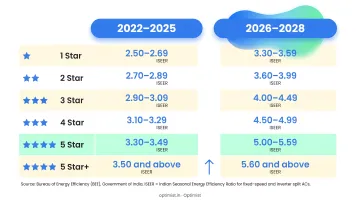
The practical implication is direct: an AC certified as 5-star under old norms with an ISEER of 5.10 now sits in the 4-star band under 2026 classification.
2026 Window AC Thresholds
| Star Rating | ISEER Range (Jan 2026–Dec 2028) |
|---|---|
| 1-Star | ≥3.10 and <3.60 |
| 2-Star | ≥3.60 and <4.10 |
| 3-Star | ≥4.10 and <4.60 |
| 4-Star | ≥4.60 and <5.10 |
| 5-Star | ≥5.10 |
Window AC thresholds are structurally lower than split AC thresholds — this reflects inherent design differences in heat exchanger area and airflow, not a quality judgement.
What This Means When You're Shopping
Always verify two things before buying:
- ISEER value — the actual efficiency number on the label
- Label validity period — confirms which set of norms applies
A 5-star label from 2022 and a 5-star label from 2026 are not the same thing.
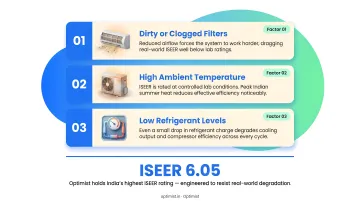
The 5-star band also has no upper ceiling. Optimist's 1.4-ton split AC holds India's highest certified ISEER of 6.05, well above the 5-star entry threshold of 5.30. That gap illustrates how much variation exists within a single band. Two ACs can both display 5 stars while consuming meaningfully different amounts of electricity across a season.
Factors That Affect Real-World ISEER Performance
The rated ISEER is a useful benchmark. It is not a guarantee of what you'll actually pay on your electricity bill.
The 43°C Ceiling Problem
ISEER testing tops out at 43°C. IMD's heat wave criteria define a severe heat wave as an actual maximum temperature of 47°C or above. Cities in Rajasthan, Madhya Pradesh, and Uttar Pradesh regularly breach 45°C during peak summer weeks — well outside the test range.
At temperatures above the ISEER ceiling, inverter compressors throttle back or operate in a less efficient mode. The BEE label's annual kWh estimate, based on 1,600 hours and a maximum of 43°C, will understate actual electricity consumption during those peak weeks for households in high-heat zones.
Partial Load vs. Full Load Operation
ISEER testing includes efficiency measurements at 50% load, which is why inverter ACs are better represented by ISEER than fixed-speed units. But if a room is poorly insulated or the AC is undersized for the space, the compressor runs closer to full load for longer. The result: lower realised efficiency than what the label implies, regardless of the star rating.
Refrigerant Charge and Ageing Effects
An undercharged or overcharged refrigerant system alters the pressure-enthalpy cycle, reducing heat transfer per unit of power consumed. The COP (the ratio of cooling output to electricity drawn) falls as a result. Common culprits over time include:
- Refrigerant leaks reducing system pressure
- Condenser coil fouling blocking heat transfer
- Compressor wear lowering mechanical efficiency
A well-maintained AC holds closer to its rated ISEER. A neglected unit can drop well below it. Smart features like gas level monitoring and filter health alerts catch degradation before it compounds. Optimist's AC includes a gas level indicator and filter health tracking to surface these issues early, keeping real-world performance closer to the certified rating.
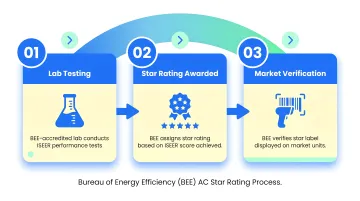
How BEE Certifies an AC's Star Rating
The certification process works as follows:
- Manufacturer testing — Models are tested at NABL-accredited laboratories following BEE-prescribed protocols. Optimist's testing was conducted at Sigma Test & Research Centre (Report No. 21014952/Z, issued December 2025).
- Submission to BEE — ISEER calculations and test results are submitted for registration and star band assignment.
- BEE verification — BEE does not independently test every unit. Instead, it conducts random market sampling and challenge testing. If a sample fails verification, a second test is conducted at a different lab with twice the quantity; BEE can withdraw certification and notify consumers.
Understanding how the label number is calculated helps put it in context. The kWh/year figure is derived from the ISEER value and a standardised 1,600-hour operating year assumption. It's a useful cost-estimation tool but can diverge from actual consumption in regions with longer cooling seasons or temperatures above 43°C — which covers much of northern and central India.
Common Misinterpretations of BEE Star Ratings
Stars Across Different Label Periods Are Not Comparable
The most frequent mistake: assuming a 5-star from 2022 equals a 5-star from 2026. It doesn't. The star band is defined relative to the threshold in effect during certification. An ISEER of 5.10 was 5-star under old norms; it's 4-star now. Always check the ISEER value and the label period, not just the star count.
Within-Band Variation Is Real
Two ACs can share a star band while having notably different ISEER values. Consider what that means in practice:
- A 4-star unit at ISEER 4.80 vs. a 4-star unit at ISEER 5.25 will produce different electricity bills across a season
- Within the 5-star band, the spread is wider: ISEER 5.30 and ISEER 6.05 are both 5-star, but the gap in annual consumption across 1,600 hours is substantial
Split and Window AC Ratings Are Different Scales
A 5-star window AC at ISEER ≥5.10 and a 5-star split AC at ISEER ≥5.30 cannot be compared directly. They are rated on different scales because of fundamental design differences. Treating them as equivalent because both show five stars means you could overpay for a window unit thinking it matches split AC efficiency — when it doesn't.
The Label's kWh Estimate Doesn't Cover India's Hottest Days
If your city regularly hits 45°C–47°C in peak summer, the label's annual energy figure will underestimate your actual consumption. The test range used to calculate it stops at 43°C — leaving your worst billing months unaccounted for.
Frequently Asked Questions
What is the BEE rating in AC?
The BEE rating is an energy efficiency label issued by the Bureau of Energy Efficiency, displayed as 1 to 5 stars on every AC sold in India. More stars indicate higher energy efficiency as measured by the ISEER value — the ratio of annual cooling output to annual electricity consumed.
Which star rating is best for AC?
A 5-star rating delivers the lowest electricity consumption and strongest cost savings over time — the right choice for households running their AC six or more hours daily. That said, the specific ISEER value within the 5-star band matters: two 5-star ACs can have meaningfully different efficiency levels.
What is a good EER for an AC unit?
EER was an older single-point metric, replaced in India by ISEER since 2018. Under 2026 BEE norms, a 4-star split AC starts at ISEER 4.80, and a 5-star unit requires ISEER ≥5.30. Optimist's 1.4-ton AC at ISEER 6.05 sits well above the 5-star entry point.
What changed in BEE star ratings for ACs from 2025 to 2026?
From January 1, 2026, BEE raised the ISEER thresholds across all star bands. The 5-star threshold for split ACs moved from ≥5.00 to ≥5.30. ACs certified under previous norms with an ISEER between 5.00 and 5.29 now carry a 4-star label under 2026 standards.
Does a higher star-rated AC always perform better in extreme Indian heat?
Not automatically. BEE's ISEER test only covers up to 43°C, so rated efficiency may not reflect real-world performance on peak summer days above 45°C. Buyers in high-heat regions should specifically look for ACs validated at elevated ambient temperatures, since actual performance beyond that threshold depends on engineering decisions outside the standard ISEER test.