

Introduction
You walk into a store to buy an AC. Twenty models line the wall, all labelled with stars. Your instinct says: five stars, obviously. But do you actually know what those stars measure — and what they don't?
Here's what that label actually means: the 5-star energy rating is India's primary energy efficiency certification for ACs, governed by the Bureau of Energy Efficiency (BEE). It tells you how efficiently a unit converts electricity into cooling across a full Indian cooling season. What it does not tell you is how powerfully it cools, how well it performs at 48°C, or whether two 5-star ACs are actually equal.
This guide breaks down what the rating represents, how ISEER determines it, and what the current BEE thresholds are. You'll also see how much you can realistically save — and the three things most buyers get wrong before purchasing.
Key Takeaways
- A 5-star rating means the AC has an ISEER of 5.0 or above, certified by BEE
- ISEER measures efficiency across India's full cooling season — not one fixed lab temperature
- Star rating indicates efficiency only — a 3-star and 5-star AC of the same tonnage deliver identical cooling
- Two 5-star ACs can have different ISEER values — always check the number on the label
- The higher the ISEER, the lower your electricity bills
- Optimist carries India's highest ISEER rating: 6.05, well above the 5-star baseline
What the 5-Star Energy Rating Actually Represents
BEE's star rating system is a mandatory energy performance labelling framework that helps Indian consumers compare appliances on a single efficiency scale — 1 star (least efficient) to 5 stars (most efficient).
For air conditioners, the core metric is ISEER: Indian Seasonal Energy Efficiency Ratio. It measures the total cooling output delivered over an entire Indian cooling season divided by the total electrical energy consumed during that same period. Higher ISEER means more cooling per unit of electricity.
Why ISEER Instead of EER?
Older EER (Energy Efficiency Ratio) metrics measured performance at a single fixed outdoor temperature. That works in a lab. It does not reflect what happens across a real Indian summer, where outdoor temperatures swing from 24°C to 43°C on different days.
ISEER accounts for this full temperature distribution, using Indian-specific assumptions: a temperature bin range of 24°C to 43°C and 1,600 cooling hours per year. The result is a seasonal efficiency number that reflects what you actually pay on your electricity bill.
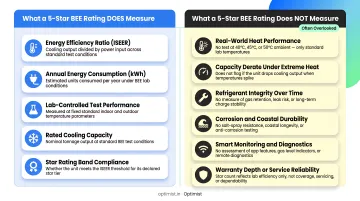
What the 5-Star Rating Is — and Isn't
| The 5-star rating measures | The 5-star rating does NOT measure |
|---|---|
| Energy efficiency (ISEER value) | Cooling capacity or tonnage |
| Seasonal electricity consumption | Build quality or component durability |
| Comparative efficiency vs. lower-rated ACs | Performance at extreme ambient temperatures (45–50°C) |
Factors That Affect Real-World ISEER
The ISEER value on your BEE label comes from controlled test conditions. Your actual efficiency will vary based on:
- Outdoor temperature during operation vs. the test bin distribution
- How often the compressor runs at full load vs. part load
- Refrigerant charge level — even small leaks reduce efficiency noticeably
- Installation quality, including airflow obstructions, pipe length, and unit placement
Inverter technology directly addresses the part-load problem. Rather than cycling on and off, an inverter compressor varies its speed continuously — staying closer to rated ISEER efficiency across a wider range of real conditions. This is why nearly all 5-star ACs in India today are inverter-type. Inverter RAC market share rose from 1% in 2015–16 to 77% in 2022–23.
The ISEER Scale: Star Rating Thresholds for ACs in India
BEE assigns star ratings based on where a unit's measured ISEER falls within published threshold ranges. The table below shows the verified thresholds for split-type room ACs:
| Star Rating | ISEER Range |
|---|---|
| ⭐ 1-star | 3.30 – 3.49 |
| ⭐⭐ 2-star | 3.50 – 3.79 |
| ⭐⭐⭐ 3-star | 3.80 – 4.39 |
| ⭐⭐⭐⭐ 4-star | 4.40 – 4.99 |
| ⭐⭐⭐⭐⭐ 5-star | ≥ 5.00 |
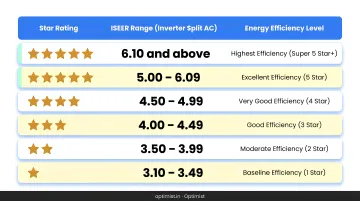
Source: BEE room AC schedule. Note: BEE periodically revises these thresholds upward as market technology improves — verify against the current BEE listing before final purchase decisions.
The 5.0 Floor Is a Minimum, Not a Ceiling
An ISEER of 5.0 is the lowest score that earns 5 stars. Two ACs can share the same 5-star label while one consumes noticeably less electricity per cooling hour than the other. The label tells you a unit crossed the threshold; it does not tell you by how much.
Optimist's AC holds India's highest ISEER rating of 6.05, which is 21% above the 5-star floor. That gap compounds into real rupee savings across a full summer of daily use.
BEE Revises Thresholds Over Time
BEE periodically raises the minimum ISEER required for each star level as market efficiency improves. BEE's labelling revision cycles have already lifted split AC efficiency by 43% at 1-star and 61% at 5-star compared to earlier standards. A product rated under an older schedule may carry the same star count as a newer product rated under revised thresholds — always check the label date alongside the ISEER value.
What a 5-Star Rating Means for Your Electricity Bill
The practical value of a high star rating is simple: less electricity consumed per hour of cooling, every single day of the summer.
How to Calculate Your Savings
The formula:
Annual energy consumption (kWh) = Cooling load ÷ ISEER × Annual cooling hours
A more direct approach: use the annual kWh figure printed on the BEE label of each model you're comparing. Multiply the difference in kWh by your electricity tariff rate.
Illustrative comparison — 1.5-ton split inverter AC:
| 3-Star AC | 5-Star AC | |
|---|---|---|
| ISEER | ~4.0 | ~5.0+ |
| Approximate annual label kWh* | Higher | Lower |
| Daily usage assumed | 8 hours | 8 hours |
| Season length | 5 months | 5 months |
*Use the actual BEE label kWh values from the specific models you are comparing — the difference typically runs to hundreds of kWh per year at standard usage.
For tariff context: Maharashtra residential consumers (MSEDCL, LT-I) pay around ₹4.37/kWh for slabs above 100 units as of April 2025. UP rural metered consumers pay ₹3.35–3.85/kWh depending on slab. At these rates, a few hundred kWh of annual savings translates directly to ₹1,000–₹2,000+ back in your pocket each season.
The Payback Period Reality
Research from CLASP/LBNL found payback periods for higher-efficiency room ACs in India can be as short as 1.1 years at certain efficiency levels. The 10–25% price premium that higher-star models typically carry (per Mint's 2023 reporting) is often recovered within 2–3 cooling seasons for households running their AC 6–10 hours daily.
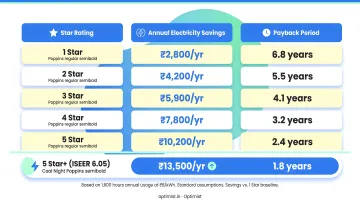
ACs with ISEER values well above the 5.0 minimum accelerate this payback further. Optimist's ISEER 6.05 rating — India's highest — translates to 25–35% lower electricity bills compared to standard models. Its app-based energy tracking shows real-time consumption and projected monthly bills, so you can verify the savings as they happen.
5-Star vs 3-Star vs 4-Star: Real Differences in Practice
| Criteria | 3-Star | 4-Star | 5-Star |
|---|---|---|---|
| ISEER range | 3.80 – 4.39 | 4.40 – 4.99 | ≥ 5.00 |
| Efficiency tier | Mid | High | Top BEE tier |
| Upfront price | Lower | Mid | Higher (typically 10–25% premium over 3-star) |
| Best for | Light users, budget priority | Moderate users | Heavy users, 6–10 hrs/day |
Where the Jumps Actually Matter
The 3-star to 4-star improvement is meaningful. The 4-star to 5-star jump is proportionally more impactful — crossing the 5.0 ISEER threshold means the AC handles partial loads more efficiently, which is exactly the condition most Indian households create when they run their AC through the night at moderate temperature settings.
For households running ACs 6–10 hours daily across a 5-month Indian summer, the savings case for 5-star is straightforward. For heavy users, the real decision is which 5-star unit carries the highest ISEER value within their budget.
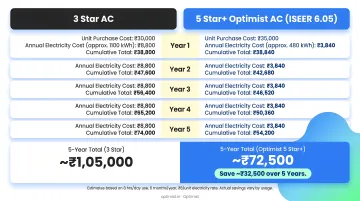
Total Cost of Ownership Beats Sticker Price
That efficiency gap translates directly into total cost of ownership (TCO) — purchase price plus electricity cost over 5 years. In high-usage Indian households, a 5-star AC with ISEER above 5.5 will deliver a lower TCO than a 3-star model, even accounting for the upfront price premium. Run the numbers with your state electricity tariff and expected daily usage hours. For context, units like Optimist's AC — rated at ISEER 6.05, India's highest — represent the upper end of what 5-star efficiency can deliver in practice.
Common Misunderstandings About the 5-Star Rating
"5-Star Means It Cools Better or Faster"
This is the most common mistake. Star rating and ISEER measure only energy efficiency. Cooling capacity is a separate specification measured in tonnes or watts. A 1.5-ton 3-star AC and a 1.5-ton 5-star AC deliver the same cooling output — the 5-star model just consumes less electricity to do it.
"All 5-Star ACs Are Equally Efficient"
They are not. Two ACs can both carry a 5-star label with ISEER values of 5.1 and 6.05 respectively. That gap — roughly 18% more efficient — compounds across thousands of hours of operation. The star count is not sufficient for comparison — read the ISEER number printed on the BEE label.
"The BEE Label kWh Is My Actual Bill"
The annual kWh on the BEE label is a standardised estimate based on 1,600 cooling hours per year across the Indian temperature bin range of 24–43°C. Your actual bill depends on four factors: hours of operation, your room's heat load, your local electricity tariff, and installation quality. Use the label figure for comparison between models — not as a guaranteed prediction of your bill.
"ISEER Tells You How the AC Performs at 45–50°C"
BEE's ISEER test covers a defined seasonal temperature distribution up to 43°C. Performance at 45–50°C peak ambient temperatures is a separate specification — one that ISEER does not capture. If you live in a region where summer temperatures cross 45°C, look for manufacturers who separately publish tested cooling performance at those conditions. Some, like Optimist, test and rate their ACs specifically at 50°C and publish that data independently of the ISEER figure.
Frequently Asked Questions
What does a 5-star energy rating mean?
A 5-star energy rating in India means the appliance has met BEE's highest efficiency threshold. For ACs, this means an ISEER of 5.0 or above — confirming the unit uses less electricity per unit of cooling than any lower-rated model. Star rating measures how efficiently an AC uses electricity, not how powerfully it cools.
Is a 5-star AC more energy efficient than a 3-star or 4-star AC?
Yes. A higher star rating means a higher ISEER value — the AC delivers equivalent cooling while consuming less electricity. For a 1.5-ton unit running 8 hours daily through an Indian summer, the gap in annual consumption between a 3-star and 5-star model is commonly 300–500 kWh.
Is a 7-star energy rating good?
India's BEE scale officially runs from 1 to 5 stars — there is no 7-star category. ACs can carry ISEER values well above the 5-star minimum (for example, 5.4 or 6.05), which is how brands differentiate within the top tier.
How does BEE calculate the star rating for an AC?
BEE requires standardised lab testing under IS 1391 to determine ISEER — the ratio of total seasonal cooling output to total seasonal energy input across Indian temperature conditions. Stars are then assigned based on where the measured ISEER falls within BEE's published threshold ranges.
Does a 5-star AC cool better or faster than a 3-star AC?
No. Star rating does not affect cooling capacity or speed. Both a 3-star and a 5-star AC of the same tonnage deliver equivalent cooling output. The difference is exclusively how much electricity each consumes to achieve that cooling.
How much electricity does a 5-star AC save compared to a 3-star AC?
Savings depend on each model's ISEER value, daily usage, and your state tariff. As a reference: a 1.5-ton inverter AC at ₹4.37/kWh (Maharashtra LT-I rate) over a 5-month season can save ₹1,300–₹2,000+ annually when upgrading from a 3-star (ISEER ~4.0) to a 5-star (ISEER 5.0+). Multiply the annual kWh figures on both BEE labels by your local tariff for a precise estimate.