

Humid Indian cities face a double challenge: outdoor relative humidity regularly exceeds 88–90% during monsoon months (IMD 1991–2020 normals), while temperatures still spike to 38–44°C in peak summer. A standard AC built for dry-heat conditions simply won't cut it here.
This guide covers what makes an AC genuinely suited to humid Indian climates, the top five picks for 2025–26, and the key features to check before you buy.
Key Takeaways
- Inverter split ACs with a dedicated Dry/Dehumidification Mode handle both heat and moisture effectively.
- Anti-corrosion protection is non-negotiable for coastal cities — unprotected coils corrode within 2–3 years in salt air.
- A higher ISEER/5-star BEE rating matters more in humid regions — ACs routinely run 10–12 hours a day through monsoon season.
- Choose units tested at 50°C+ ambient — coastal and inland humid cities hit peak heat and peak humidity at the same time.
- Top picks: Optimist, Daikin, LG, Panasonic, and Voltas — reviewed below for humid-climate performance.
Why Humid Indian Climates Demand a Smarter AC Choice
The Hidden Double Load
In cities like Mumbai, Kochi, Kolkata, and Goa, an AC must do two jobs at once: lower the air temperature AND remove excess moisture. When it only does the first job, the room stays sticky — and your body can't cool itself through sweat evaporation in air that's already saturated.
A 2022 PSU HEAT Project study found that critical wet-bulb temperatures in warm-humid environments are just 30–31°C — far below the older theoretical 35°C limit. This means high humidity is a genuine health risk, not just a comfort inconvenience.
Two Real Costs of the Wrong AC
Higher electricity bills: When an AC can't remove moisture efficiently, it runs longer trying to reach a comfortable feel temperature — not just the air temperature shown on the thermostat. That extra runtime adds up every month.
Faster corrosion: Salt particles in coastal air attack the outdoor unit's coils, fins, and casing. Peer-reviewed research on heat-exchanger fins confirms that salt-spray corrosion reduces heat-transfer performance and increases air-side pressure drop — meaning an unprotected AC loses efficiency over time, not just cosmetic condition.
So star ratings alone don't tell the full story. For humid Indian conditions, you need to evaluate four things together:
- Dehumidification ability — how well it pulls moisture, not just temperature
- Corrosion resistance — especially for coastal and high-humidity cities
- High-ambient performance — consistent output when outdoor temps exceed 45°C
- Energy efficiency under load — not just peak lab ratings, but real-world sustained use
Best Air Conditioners for Humid Climates in India
These five ACs were evaluated on four criteria relevant to humid Indian conditions:
- Active dehumidification
- Anti-corrosion build quality
- Energy efficiency under prolonged operation
- Cooling performance at high ambient temperatures
Optimist
Background: Optimist is an India-first climate tech company founded in 2024 and built specifically for extreme Indian summers. Its flagship AC holds India's highest ISEER rating of 6.05, developed through the in-house Nalanda 1 R&D Lab with technical guidance from IIT Delhi. The company is backed by ₹100 crore+ (USD 12M) from Accel, Arkam Ventures, and Sparrow Capital.
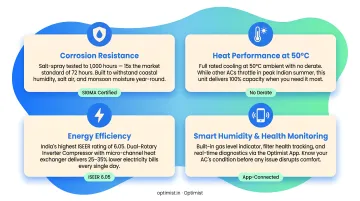
Why it stands out for humid climates: Tested at 50°C with no capacity derating, this matters most when Mumbai or Chennai heat and humidity peak simultaneously. The microchannel heat exchanger delivers 4X faster heat transfer, improving how quickly the unit pulls moisture from the air.
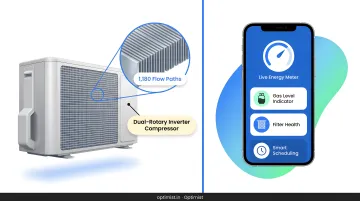
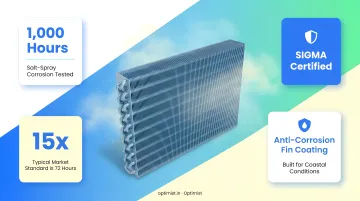
Corrosion testing uses the ASTM B368 Acetic Acid Salt Spray standard for 1,000 hours — 15 times the typical market benchmark. The gas level indicator communicates via the app, alerting users when refrigerant drops; particularly useful in humid climates where ACs run continuously and slow refrigerant loss often goes undetected. Priced at ₹39,990 (promotional, inclusive of standard installation).
| Feature | Detail |
|---|---|
| ISEER / Star Rating | 6.05 ISEER, 5-Star BEE |
| Ambient Temperature | Tested to 50°C, no performance drop |
| Corrosion Testing | 1,000 hours ASTM B368 (~15x market standard) |
| Dehumidification | Dry Mode available via app and remote |
| Key Technology | Microchannel heat exchanger, Turbo+ Mode (1.9T output from 1.4T unit), gas level indicator, real-time energy tracking |
| Warranty | 5-year all-inclusive + 10-year compressor |
| Best For | Coastal and high-humidity cities — buyers prioritising lowest electricity bills, corrosion durability, and smart diagnostics |
Daikin
Background: Daikin is a Japanese brand with deep roots in India's premium AC segment. The FTKF50XV is their highest ISEER series model, verified at 1.5 ton with a 5-Star BEE rating.
Why it stands out for humid climates: The FTKF50XV includes a Dry Mode and Daikin India's product pages confirm an Anti-Corrosion Treatment with a special coating that prevents copper-coil rusting. The unit is rated to cool up to 55°C ambient, one of the highest verified temperature ratings among mainstream brands.
Daikin's inverter compressor lineage is well-established, and service availability across humid-belt cities is strong.
| Feature | Detail |
|---|---|
| ISEER / Star Rating | ISEER 5.2, 5-Star BEE |
| Ambient Temperature | Up to 55°C (verified on FTKF50XV product page) |
| Corrosion Protection | Anti-Corrosion Treatment on copper coils (verified) |
| Dehumidification | Dry Mode confirmed |
| Annual Energy Consumption | 785.67 kWh/year (1.5 ton) |
| Best For | Buyers prioritising long-term reliability, high-ambient performance, and established service networks in coastal cities |
LG
Background: LG's Dual Inverter range is among the most widely sold premium ACs in India. Models like the US-Q19BNZE (2025) and AS-Q20ENZE have verified 5-Star ratings and are explicitly designed with Indian coastal conditions in mind.
Why it stands out for humid climates: LG has the clearest verified combination of coastal protection and humidity features among the brands reviewed. Ocean Black Protection/Ocean Black Fin provides anti-corrosion and anti-rust shielding developed specifically for Indian salt-air conditions.
The Monsoon Comfort mode senses humidity and adjusts temperature accordingly, a practical feature for monsoon-heavy cities. Selected models also include Smart Dehumidification, and the verified operating range reaches 52°C for the US-Q19BNZE and AS-Q20ENZE.
| Feature | Detail |
|---|---|
| ISEER / Star Rating | ISEER 5.2, 5-Star BEE (US-Q19BNZE, AS-Q20ENZE) |
| Ambient Temperature | Up to 52°C verified |
| Corrosion Protection | Ocean Black Protection / Ocean Black Fin (verified) |
| Humidity Mode | Monsoon Comfort + Smart Dehumidification (verified) |
| Annual Energy Consumption | 744.66 kWh/year (1.5 ton models) |
| Best For | Monsoon-heavy cities where dedicated humidity sensing is a priority alongside coastal protection |
Panasonic
Background: Panasonic's 2026 split inverter range — including the CS/CU-NU18BKY5WX and CS/CU-HU18CKY5XFMH-P — is built with air quality and maintenance features that suit India's humid south and east.
Why it stands out for humid climates: Panasonic's nanoe X technology uses hydroxyl radicals to inhibit airborne pollutants — relevant in damp indoor environments where mould and bacteria thrive. The DustBuster feature automatically cleans the outdoor coil after every 8 hours of operation at switch-off, reducing performance degradation from dust and humidity accumulation over time. Both NU18 and HU18 models are rated for 55°C operation, matching Daikin's verified ceiling. ISEER values were not confirmed from official Panasonic India pages reviewed; check the BEE label on the specific model before purchase.
| Feature | Detail |
|---|---|
| ISEER / Star Rating | 5-Star (verified); exact ISEER not confirmed officially |
| Ambient Temperature | Up to 55°C (verified for NU/HU series) |
| Corrosion Protection | Not officially confirmed from pages reviewed |
| Key Technology | nanoe X air purification, DustBuster outdoor auto-clean (every 8 hours) |
| Best For | Air quality-conscious buyers in humid cities, particularly southern India where dust, humidity, and mould risk combine |
Voltas
Background: Voltas holds approximately 21.2% market share in India's room AC segment (company-disclosed, July 2024) and crossed 2 million AC units in FY24. Its inverter split AC range offers India-specific features at accessible prices.
Why it stands out for humid climates: Voltas officially confirms Blue Fin coating and hydrophilic coating on select models for humid and coastal conditions — coating type varies by model, so verify on the specific product page. The 185V CAS carries a 5-Star rating. The 183INV Vertis Zenith Gold (3-Star) features a 6-Step Adjustable Mode for flexible operation. Voltas's pan-India service network is a practical advantage in humid-belt cities where servicing frequency matters. ISEER values were not confirmed from official product pages reviewed.
| Feature | Detail |
|---|---|
| ISEER / Star Rating | 5-Star (185V CAS); 3-Star (183INV); ISEER not confirmed officially |
| Ambient Temperature | Not confirmed from official pages reviewed |
| Corrosion Protection | Blue Fin / hydrophilic coating (model-dependent, verified on Voltas blog) |
| Humidity Mode | 6-Step Adjustable Mode (183INV verified); dedicated dry mode not confirmed |
| Best For | Budget-conscious buyers needing reliable cooling in humid cities with strong after-sales service coverage |
What to Look for When Buying an AC for Humid Indian Climates
Dedicated Dry Mode
This is the single most overlooked feature for humid climates. During monsoon and pre-monsoon months, the primary discomfort is moisture, not temperature. Dry Mode slows the fan and runs the compressor at reduced capacity to condense and drain moisture without aggressive cooling — meaning comfort at lower energy cost than running Cool Mode continuously at 18°C.
Anti-Corrosion Protection
Salt particles and moisture in coastal air attack the outdoor unit's coils, fins, and casing. Look for:
- Verified fin coating types: Blue Fin, Gold Fin, Gold Fin+, or Ocean Black Fin
- Corrosion testing hours — standard market testing runs approximately 66–67 hours; Optimist's ASTM B368 test runs 1,000 hours
- Confirmed treatment on copper coils (Daikin) or coastal-specific fin protection (LG's Ocean Black Fin)
Energy Efficiency (ISEER / BEE Star Rating)
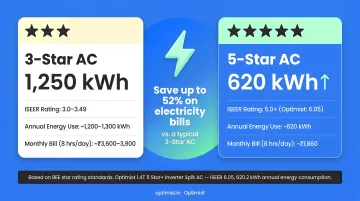
ACs in humid cities run more hours per day and more months per year than in drier regions. ASHRAE-backed residential research found that separate temperature-humidity control can save approximately 15.6% of cooling energy compared to traditional residential ACs. Over a 5–7 year AC lifespan, a higher ISEER rating compounds into significant savings.
A BEE/CLASP 2026 survey found that 40% of surveyed ACs in Indian homes were 3-Star, 33% were 5-Star — meaning most households are leaving efficiency gains on the table.
Ambient Temperature Rating
High humidity doesn't mean lower temperatures. Mumbai and Chennai regularly hit 38–44°C in peak summer while maintaining high humidity. An AC rated only to 43°C will struggle or derate. Look for units rated and tested to at least 50–55°C for reliable simultaneous heat-humidity performance.
Right Tonnage for Humid Rooms
Slightly upsizing your AC helps in high-humidity conditions. A unit that's too small runs at full capacity without adequate moisture removal. A massively oversized unit short-cycles (turns on and off too frequently), which also leaves humidity uncontrolled — ENERGY STAR confirms that short-cycling reduces condensation draining and can let moisture evaporate back into the air.
For humid rooms, target the upper end of the recommended tonnage range — that extra capacity is what keeps moisture in check on heavy monsoon days.
Conclusion
In India's humid climate, the real benchmarks aren't price tags or star ratings — they're corrosion resistance, active dehumidification, high-ambient performance, and efficiency under prolonged use.
A ₹40,000 AC without proper corrosion protection can cost far more in coil replacements and breakdowns within 2–3 years. The fix starts with matching your city's specific challenge to the right features:
- Salt air coastal zones (Mumbai, Kochi, Goa) — prioritize 1,000-hour corrosion-tested coils and hydrophilic fin coatings
- Sustained monsoon humidity (Kolkata, Chennai) — look for active dehumidification mode and auto-restart after power cuts
- Extreme heat + humidity combined (Hyderabad, Pune, Delhi NCR) — confirm rated capacity holds at 50°C, not just 43°C
For buyers who want all four — India's highest ISEER rating (6.05), 1,000-hour ASTM B368 corrosion testing, proven 50°C performance, and smart diagnostics built for Indian conditions — explore Optimist at optimist.in.
Frequently Asked Questions
Which AC type is best for India's climate?
Inverter split ACs with a 4- or 5-star BEE rating and a dedicated Dry Mode are the best fit. They handle both extreme heat and high humidity, adjust compressor speed for efficient long-duration operation, and the better models include anti-corrosion protection for coastal conditions.
Which AC mode reduces humidity?
Dry Mode (also called Dehumidification Mode) is designed specifically for this. It slows the fan and runs the compressor at reduced capacity to condense moisture without aggressively cooling the room, making it ideal during monsoon season or in coastal cities where humidity is the primary discomfort.
What is a comfortable indoor humidity level in India?
The ideal indoor range is 40–60% relative humidity. A 2024 peer-reviewed study associates RH below 40% or above 60% with adverse health outcomes. In humid Indian cities where outdoor RH regularly exceeds 80%, Dry or Auto mode helps bring indoor levels into this range.
Does inverter technology improve dehumidification compared to non-inverter ACs?
Yes. Inverter compressors run at lower, sustained speeds for longer periods, keeping the evaporator coil cold enough to condense moisture continuously. Non-inverter ACs cycle on and off sharply, resulting in shorter cooling periods and less consistent moisture removal.
How often should I service my AC in a coastal or humid city?
At least twice a year — before summer and after monsoon — rather than the standard once-a-year recommendation. Salt, dust, and moisture accumulate faster on coils and filters in coastal cities, reducing dehumidification efficiency and increasing mould risk inside the unit.
Is a higher tonnage AC always better for dehumidifying humid rooms?
Not always. A correctly or slightly generously sized AC dehumidifies best. An undersized unit runs at full capacity without adequate moisture removal. An oversized unit turns on and off too quickly (short-cycling), which also leaves humidity uncontrolled. For humid rooms, choose the upper end of the recommended tonnage range for your room size — not the maximum available.