

Introduction
Living in Mumbai, Chennai, Kochi, or Visakhapatnam puts your AC through conditions that most units simply aren't designed for. You're not just dealing with heat — you're dealing with salt-laden sea air, sustained humidity above 75–80%, and AC run times that stretch across summer and monsoon months without a break.
Most buyers choose an AC based on tonnage and star rating alone. In coastal regions, that approach leads to corroded coils within a few seasons, poor dehumidification, and repair bills that rival the cost of a new unit.
Research on marine atmospheric corrosion confirms that airborne chlorides from sea air destroy passive protective films on metal surfaces, accelerating corrosion at rates far beyond what inland environments cause.
This guide covers what actually matters when buying an AC for a coastal home: the features that determine durability, the specs that affect your electricity bill, and the installation practices that make the difference between an AC that lasts 3 years versus 10.
Key Takeaways
- Salt air corrodes standard AC coils and casings within 3–5 years — corrosion-resistant construction is non-negotiable near the sea
- Inverter ACs remove more moisture hour-by-hour than fixed-speed units because they run continuously at low load rather than cycling off
- A higher ISEER rating saves thousands of rupees annually in coastal cities where ACs run far more hours than inland
- Placement, bi-monthly coil cleaning, and twice-yearly servicing directly determine how long your AC lasts near the sea
Why Coastal Climates Are Especially Tough on ACs
Salt Air Reaches Every Metal Surface
Fine salt particles carried by sea breeze accelerate oxidation by raising the electrolyte conductivity of moisture films on metal fins and copper connections. This means coastal ACs corrode from the outside in, on the condenser fins, the steel frame, and the copper tube joints.
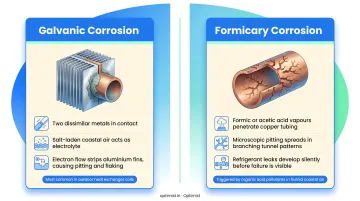
Studies on HVAC coil corrosion document two particularly damaging mechanisms:
- Galvanic corrosion — when aluminium fins and copper tubes contact salt-containing moisture, the aluminium acts sacrificially and degrades first
- Formicary corrosion — microscopic tunnels form in copper tubes, eventually causing refrigerant leaks that users often don't notice until cooling performance drops significantly
Humidity Makes Rooms Feel Hotter Than They Are
High humidity directly increases the thermal load your AC must handle. When relative humidity is elevated, sweat doesn't evaporate efficiently from the skin, so a room at 28°C can feel like 34°C or more. NOAA's heat index data illustrates this clearly: 100°F (38°C) at 55% humidity feels like 124°F (51°C) to the human body.
This matters for AC selection because coastal homes require the unit to handle both sensible cooling (reducing air temperature) and latent cooling (removing moisture). An AC that only cools temperature without effectively dehumidifying leaves the room feeling clammy even when the thermostat reads a comfortable number.
Mold, Coil Buildup, and Compressor Stress
Persistent indoor humidity drives two compounding problems inside the unit itself. A 2020 study found that biofilms on AC cooling coils reduce heat-transfer efficiency and can introduce microbes into your home's air — and warm, humid climates are specifically identified as the worst environments for coil condensate buildup.
The compressor takes a hit too. Coastal conditions lead to:
- Extended run times — the unit works harder to pull moisture out of air, adding mechanical wear
- Undetected refrigerant loss — leaks from corroded coil joints reduce cooling gradually, so many homeowners don't notice until electricity bills spike or the room stops cooling on hot days
Must-Have Features When Buying an AC for Coastal Areas
Anti-Corrosion Protection — What Actually Works
Not all corrosion protection is equal. Many AC brands apply basic cosmetic coatings to condenser fins that degrade after a season or two of real coastal exposure. What to look for:
- Advanced aluminium alloy heat exchangers — alloy construction resists salt-air oxidation far longer than standard copper-fin designs
- Sealed copper joints — exposed joints at coil connections are among the first components to fail in coastal environments
- Rigorous salt-spray testing — the meaningful benchmark is total hours tested under salt-spray conditions, not just whether testing was done
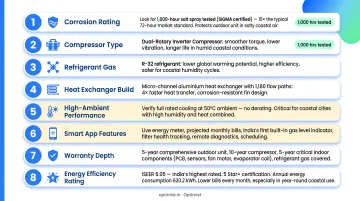
The packaged AC standard IS 8148 includes a 72-hour neutral salt spray test as a reference benchmark for specified components. Some manufacturers exceed this substantially — Optimist's condenser undergoes 1,000 hours of salt-spray corrosion testing (SIGMA certified), which is 15 times the typical market standard. Based on their testing, this translates to a projected outdoor unit lifespan of 8–10+ years in coastal environments like Mumbai, versus the 3–5 years typical of standard units.
Inverter Technology for Effective Dehumidification
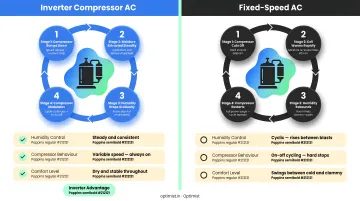
Inverter compressors modulate their speed continuously rather than switching fully on or off. In coastal conditions, this matters specifically for moisture removal.
Peer-reviewed research on variable-speed heat pumps found that variable-speed systems removed 2.3–2.4 litres of moisture per kWh compared to 1.9–2.2 L/kWh for single-speed units — and maintained indoor humidity around 50–52% versus 55–60% with fixed-speed operation.
Why this happens: moisture condenses on the evaporator coil when warm air passes over it. A fixed-speed compressor switches off when the set temperature is reached, allowing the coil to warm up — which stops condensation. An inverter compressor slows down instead, keeps the coil cold, and continues extracting moisture even at low cooling load.
High ISEER Rating — Especially Critical for Coastal Use
That continuous dehumidification also means the compressor is running far more hours than in an inland home — through summer and well into monsoon season. Even a marginal efficiency difference creates a substantial cost gap over a full year.
Using BEE's ISEER methodology and an illustrative 12-hour daily usage figure, the electricity cost difference between ISEER ratings is significant:
| ISEER | Monthly electricity use | Cost at ₹7.04/kWh |
|---|---|---|
| 4.5 | ~422 kWh | ~₹2,971 |
| 6.05 | ~314 kWh | ~₹2,210 |
| Savings | ~108 kWh | ~₹761/month |
Illustrative calculation based on 1.5 TR rated cooling, 12 hrs/day, 30 days. Real usage varies with inverter modulation, ambient temperature, and room conditions.
India's highest ISEER rating currently available is 6.05, achieved by Optimist's 1.4 Ton inverter split AC. For a coastal home where the AC runs heavily from April through October, this efficiency gap is not trivial.
Gas Monitoring and Smart Diagnostics
Refrigerant leaks from corroded coil joints often go undetected for months. The AC keeps running but loses cooling capacity gradually. By the time most users notice, the compressor has been under strain for a full season.
ACs with built-in gas level monitoring address this directly. Optimist's AC includes India's first built-in gas level indicator — a real-time, colour-coded display in the Optimist App showing refrigerant status from optimal (green) to critical (red). When the level drops, the app alerts you before performance degrades, and before a technician can claim a refill is needed without any verifiable basis.
Self-Cleaning and Accessible Filters
In coastal areas, salt, humidity, and airborne dust clog indoor filters significantly faster than in dry inland cities. The US Department of Energy recommends cleaning filters every one to two months during active cooling seasons — and more frequently under constant-use or high-dust conditions.
For coastal homes close to the sea, that means filter checks every 2–4 weeks depending on proximity. ACs with filter health tracking (like the Optimist App's time-based filter alert system) make this easy to maintain consistently without relying on memory alone.
How to Choose the Right AC for Your Coastal Home
Capacity Sizing — Consider the Humidity Correction
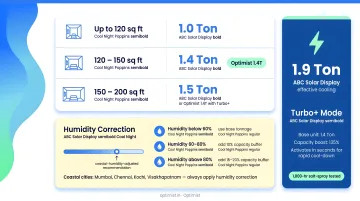
Standard guidance for Indian residential spaces:
- Up to ~120 sq ft: 1.0–1.2 Ton
- 120–180 sq ft: 1.5 Ton
In coastal conditions, high humidity increases the effective heat load because the AC must remove both sensible heat and moisture. This makes an inverter AC with a boost mode a practical choice: it can ramp up capacity when the combined heat-humidity load peaks, without requiring a full upsize to a larger unit.
Optimist's 1.4 Ton model, for example, delivers 1.9-ton effective cooling in Turbo+ mode, useful during afternoon peak humidity and heat load in cities like Chennai or Mumbai. Once the room reaches set temperature, it settles into efficient continuous operation.
Split AC vs. Window AC — No Real Contest for Coastal Use
Split ACs are the right choice for coastal homes:
- The outdoor unit can be positioned away from direct sea spray
- The indoor unit is fully sealed from outdoor air
- More models come with corrosion-resistant outdoor coatings in split form
- Window ACs expose internal components directly to outdoor conditions, dramatically accelerating corrosion
Warranty Coverage — Read the Fine Print
In coastal environments, compressor failures and coil damage are more frequent than inland. Before purchasing, check:
- What the compressor warranty duration is — 10 years is the benchmark; 5 years is standard market
- **What components are covered under comprehensive warranty** — coils, PCBs, sensors, fan motors, and refrigerant gas should be included
- Whether refrigerant coverage is included — a 5-year gas coverage provision means refills are not an unexpected expense
Optimist's warranty structure covers:
- 5-year comprehensive warranty on outdoor unit components
- 10-year compressor warranty
- 5-year coverage on critical indoor components (PCB, sensors, fan motor, evaporator coil)
- 5-year refrigerant gas coverage
Note that most warranties, including Optimist's, exclude damage caused by environmental factors. The 1,000-hour salt-spray tested construction is what keeps corrosion-related failures out of warranty territory entirely.
Coastal AC Buyer's Checklist
Before purchasing, confirm the unit has:
- ✅ Salt-spray corrosion tested construction (higher hours = better protection)
- ✅ Inverter compressor with variable-speed operation
- ✅ 5-star BEE rating (highest ISEER available)
- ✅ Dry mode for dedicated dehumidification
- ✅ Filter health tracking or easy-access washable filters
- ✅ Gas level monitoring or smart diagnostic alerts
- ✅ Minimum 5-year comprehensive warranty with 10-year compressor coverage
- ✅ Rated cooling performance at 50°C ambient (especially for Chennai and Visakhapatnam)
City-Specific Considerations for Indian Coastal Homes
Each coastal region in India presents a distinct combination of heat, humidity, and salt exposure. Here's what that means practically for the AC you choose.
Mumbai and Goa
Extended monsoon months — June through September — mean the AC must handle continuous dehumidification for 5–6 months alongside cooling. Salt-laden air from the Arabian Sea combined with urban dust means filters clog faster and outdoor units face year-round corrosive exposure.
Priorities for this region:
- Self-cleaning capability to manage accelerated filter buildup
- Long compressor cycle inverter technology for sustained dehumidification
- Robust outdoor unit corrosion protection validated beyond the standard 72-hour salt-spray test
Optimist's outdoor unit is SIGMA-certified to 1,000 hours of salt-spray testing — 15× the typical market standard — which directly addresses the Arabian Sea exposure these cities see year-round.
Chennai and Visakhapatnam
Summer heat here regularly hits 40–42°C outdoors with high coastal humidity simultaneously — one of the most demanding combinations for AC compressors in India. An AC rated for full cooling performance at 50°C ambient temperature without derating is essential here, not a bonus. Many standard ACs throttle their effective output beyond 43°C — leaving rooms inadequately cooled on the worst days, which is precisely when you need full performance most.
Optimist is tested and rated for full cooling at 50°C with no performance drop, a specification that matters most in Chennai and Vizag summers.
Kochi and Coastal Karnataka
Year-round humidity with heavy monsoon seasons makes corrosion a permanent threat rather than a seasonal one. Units here also benefit from remote diagnostic capabilities — monitoring refrigerant levels and system health through an app reduces the need for frequent on-site technician visits, which can be logistically inconvenient during heavy monsoon periods.
The Optimist App's built-in gas level indicator and intelligent remote diagnostics are particularly practical here: technicians can assess system health remotely before deciding whether a physical visit is needed.
Installation and Maintenance Tips for Coastal ACs
Smart Installation Practices
Outdoor unit placement decisions at installation shape how long your AC lasts:
- Elevate the outdoor unit on a stable, firm platform to avoid flooding during monsoon and ensure proper drainage
- Orient the unit away from the direction of direct sea-facing exposure where possible
- Ensure adequate clearance on all sides per installation manual specifications
- Check that the installation site drains freely — standing water around the base accelerates corrosion
Routine Maintenance Schedule for Coastal Homes
| Frequency | Task |
|---|---|
| Every 2–4 weeks | Clean indoor filter (more frequently within 1 km of sea) |
| Every 1–2 months | Rinse outdoor coil to remove salt and dust accumulation |
| Every 6 months | Professional servicing (pre-summer and post-monsoon) |
| Annually | Full system diagnostics, copper connection inspection, performance check |
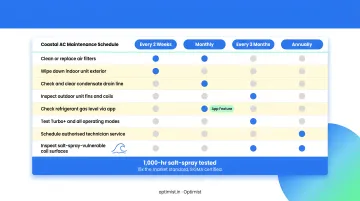
Corrosion Inspection
During annual servicing, inspect copper pipe connections for greenish oxidation around joints — this signals early-stage formicary corrosion and likely refrigerant loss. The Optimist AC's built-in gas level indicator detects refrigerant drop before it affects cooling performance — so you can address a slow leak before it stresses the compressor.
Frequently Asked Questions
What is the best air conditioner for coastal areas?
The best AC for coastal areas combines corrosion-resistant construction (tested to high salt-spray hours, not just basic coating), an inverter compressor for effective dehumidification, and a high ISEER rating — since coastal ACs run far more hours daily than inland units. Split ACs with smart gas monitoring and filter tracking are particularly well-suited.
Which AC is best for a high-temperature coastal area?
For cities like Chennai and Visakhapatnam where heat and humidity peak together, an inverter AC rated to deliver full cooling at 50°C ambient temperature is essential. Without this rating, many units derate their cooling output on the hottest days, leaving you underserved when you need performance most.
Why do ACs fail faster near the sea?
Salt particles settle on metal fins and coil joints, triggering galvanic and formicary corrosion that degrades cooling performance over time. Left unchecked, this causes refrigerant leaks through copper tube damage — which is why corrosion-resistant construction matters far more than it's given credit for.
Does high humidity reduce AC cooling efficiency?
Yes. High humidity adds a moisture load on top of the temperature load, making rooms feel warmer than the actual air temperature and forcing the compressor to work harder and longer. Inverter ACs handle dehumidification better than fixed-speed units, which matters as much as raw cooling capacity in coastal homes.
Which is better for coastal areas — split AC or window AC?
Split ACs are significantly better for coastal use. The outdoor unit can be positioned away from direct sea spray, the indoor unit stays sealed from outdoor air, and window ACs expose all internal components directly to the elements — accelerating corrosion on every part simultaneously.
How often should I service my AC if I live near the sea?
Professional servicing at least twice a year — before summer and after monsoon — is the minimum. Between visits, clean indoor filters every 2–4 weeks and rinse outdoor coils monthly to prevent salt buildup.