

With dozens of AC brands in India pushing inverter tech, smart controls, and star ratings, the choice can feel overwhelming. Some brands genuinely perform when the mercury climbs past 45°C. Others quietly lose cooling capacity right when you need it most.
This guide breaks down the top AC brands in India for 2026, how to actually evaluate them, and what matters beyond a familiar logo on the box.
Key Takeaways
- ISEER rating, not star rating, predicts your real electricity costs.
- Optimist challenges legacy brands with 50°C-tested cooling efficiency.
- Match tonnage to room size, sun exposure, and insulation.
- Compressor warranty depth separates reliable ACs from short-lived ones.
- Service network availability matters as much as the specs sheet.
Overview of Air Conditioners in the Indian Market
Walk into any electronics store today and you'll find Japanese engineering (Daikin), Korean giants (LG, Samsung), homegrown Tata-backed players (Voltas), decades-old commercial specialists (Blue Star), and now, focused climate-tech entrants building specifically for Indian heat. That's a lot of noise for someone who just wants a cool bedroom.
That noise reflects a market that's exploding in size. According to ICRA's climate and consumer trends report, Indian room air conditioner sales are set to hit:
- 12-12.5 million units projected in FY2025
- 20-25% year-on-year growth driving that surge
- 10-12% further growth expected in FY2026
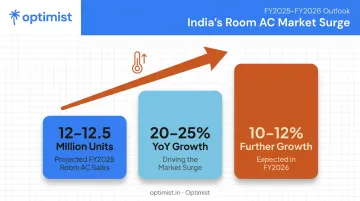
That's millions of households making this exact decision every year.
Here's the thing though: most of these units weren't originally engineered for 45-50°C conditions. Many global platforms are adapted from milder climates. Indian summers demand something different, consistent cooling when the outside temperature itself feels like an oven, not just a badge that says "5-star." That's the lens we're using for the list below.
Top Air Conditioner Brands in India for 2026
We evaluated each brand on five factors: energy efficiency (ISEER), cooling reliability in extreme heat, smart features, warranty coverage, and overall brand trust built over years of service.
Optimist
Optimist is a Gurugram-based climate-tech company founded in August 2024, built specifically to engineer AC systems for extreme Indian summers. It's backed by USD 12 million in funding from Accel, Arkam Ventures, and Sparrow Capital, and it's still a young company, but the engineering credentials are hard to ignore.
What makes it stand out:
- India's highest ISEER rating of 6.05, well above typical 5-star inverter ACs on the market
- Tested to sustain full cooling capacity at 50°C with zero performance drop
- Automotive-derived aluminium alloy design paired with a micro-channel heat exchanger for 4X faster heat transfer
- India's first built-in gas level indicator with real-time app-based energy tracking
| Category | Details |
|---|---|
| Energy Efficiency | ISEER 6.05, India's highest-rated 5-star AC, delivering 25-35% lower electricity bills |
| Performance in Heat | Tested to sustain full cooling capacity at 50°C; Turbo+ Mode delivers a 135% capacity boost |
| Warranty & Smart Features | 5-year all-inclusive warranty with 10-year compressor coverage, full app control, filter health tracking, remote diagnostics |
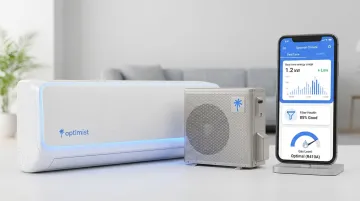
The Turbo+ Mode is worth a mention on its own. It pushes the 1.4-ton unit to an effective 1.9-ton cooling output, essentially matching a larger conventional AC without the higher power draw.
Daikin
Daikin is a Japanese manufacturer and the world's largest AC brand by revenue. In India, it's known for premium inverter technology and a lineup that spans budget-friendly to top-tier hot-and-cold split units.
Where it excels:
- High ISEER ratings across most inverter models
- Quiet operation, even at higher fan speeds
- A genuinely wide range, from smaller capacity units to premium multi-room systems
| Category | Details |
|---|---|
| Technology | Advanced inverter compressors with strong energy-saving performance |
| Range | Residential inverter splits spanning roughly 1.0 to 2.61 TR, including hot & cold variants |
| Positioning | Premium pricing with a reputation for durability and low noise |
Daikin's compressor tech (a variable-frequency drive paired with a patented swing compressor) is genuinely solid engineering. You pay for it, but the build quality tends to hold up over years, not just seasons.
LG
LG pioneered residential split ACs in India and has stuck around with its Dual Inverter technology, now evolved into AI Dual Inverter across newer models.
Its key strengths:
- Faster cooling with deep-learning-based temperature and fan speed control
- Quieter operation compared to older fixed-speed units
- Strong smart-home integration through the ThinQ app
| Category | Details |
|---|---|
| Technology | AI Dual Inverter compressor for stable, efficient cooling |
| Smart Features | Wi-Fi app control via ThinQ, voice assistant compatibility |
| Warranty | One-year standard warranty plus nine additional years on the compressor component (service and gas charges apply during the extended period) |
One thing to watch: LG's "10-year compressor warranty" often gets marketed as comprehensive coverage. It isn't. The extended nine years cover the compressor part specifically, and labour or gas charges can still apply.
Voltas
Voltas, a Tata Group enterprise established in 1954, is one of India's largest homegrown AC manufacturers. It's built its reputation on the "All Weather" range designed for both hot and cold use.
What sets it apart:
- Strong value-for-money positioning across entry and mid-range segments
- One of the widest after-sales networks in the country
- Reliable performance across both extreme summer heat and winter heating needs
| Category | Details |
|---|---|
| Pricing | Competitively priced across entry and mid-range segments |
| Key Feature | All-Weather/Hot & Cold inverter models for year-round use |
| Service Network | 30,000+ customer touchpoints for its RAC business nationwide |
For buyers in tier-2 and tier-3 cities where after-sales support can be patchy for other brands, Voltas' reach is a genuine practical advantage.
Samsung
Samsung applies its WindFree technology and AI-based energy monitoring to its Indian AC lineup, positioning itself around gentle, uniform cooling rather than a direct blast of cold air.
Its standout features:
- WindFree cooling disperses air through 23,000 micro-holes, according to Samsung's official product announcement, creating what the brand calls a draft-free experience
- AI Energy Mode adjusts compressor frequency based on usage patterns, claiming up to 30% savings under specific test conditions
- SmartThings app control with remote monitoring
| Category | Details |
|---|---|
| Technology | WindFree cooling via 23,000 micro air vents for gentle airflow |
| Smart Features | AI-based energy mode with SmartThings app control |
| Filtration | High-density anti-bacterial filtration on select models |
The 30% saving figure comes with fine print. Samsung's own testing was conducted at 35°C in a controlled environment, so real-world results in a 47°C Delhi afternoon will vary.
Blue Star
Blue Star is India's second-largest homegrown AC brand, built on decades of commercial and mall cooling expertise before it entered the residential segment in 2011.
Where it shines:
- Sturdy build quality inherited from large-scale commercial HVAC projects
- Turbo Cool mode for rapid temperature drop on entry
- Mid-range pricing that avoids the premium markup of some global brands
| Category | Details |
|---|---|
| Heritage | Decades of commercial HVAC expertise, residential entry since 2011 |
| Key Feature | Turbo Cool mode for rapid temperature drop |
| Pricing | Mid-range pricing without the premium markup of some global brands |
Blue Star's commercial DNA shows up in small ways, like sturdier outdoor unit casings that handle rooftop exposure better than some competitors.
How We Chose the Best AC Brands
Most buyers make the same mistake: they compare upfront price or star rating and stop there. Neither tells you how an AC actually behaves once summer peaks past 45°C.
Mint's reporting backs this up, noting that the real stress test for any AC begins above 45°C, when many units lose cooling capacity, run slower, and force the compressor to work overtime. A star label alone doesn't reveal how a unit handles that stress.
We weighed five factors and tied each one to a real outcome:
- ISEER/energy rating - directly affects your monthly electricity bill, not just your purchase price
- Tested cooling performance at high ambient temperatures - determines whether you get relief during the actual heatwave, rather than a mild April afternoon
- Warranty depth, especially compressor coverage - fewer breakdowns and lower repair costs over the AC's lifespan
- Smart app functionality - real-time visibility into energy use and system health, beyond basic remote power on/off toggles
- Service network reach - how quickly you get help when something goes wrong mid-summer
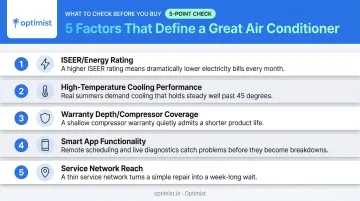
Taken together, these criteria point to one conclusion: brands offering transparent, real-time energy tracking give buyers far more confidence than a static star label ever could. You see what you'll actually pay each month, not a lab prediction from three years ago.
Conclusion
There's no single "best" AC brand for every household. The right choice depends on your room size, budget, and how extreme your local summer actually gets. A 5-star badge from a well-known name means little if the unit derates the moment temperatures cross 45°C.
Before you buy, verify three things:
- ISEER rating
- Warranty terms (not just the marketing headline)
- Real-world heat performance data, if the brand publishes any
If you're prioritising energy savings and dependable cooling through the harshest Indian summers, consider Optimist's India's Real AC. It's engineered around a 6.05 ISEER rating and tested cooling performance at 50°C.
Frequently Asked Questions
What is the best brand of air conditioning units?
It depends on your priority. Daikin and LG are consistently strong for build quality and technology, while energy-focused entrants like Optimist lead on efficiency with a 6.05 ISEER rating.
Which AC brand is best for extreme Indian summers?
Brands tested specifically for high-ambient performance without derating, such as Optimist (50°C tested) and select premium Japanese brands, hold up better than standard models during peak heat.
What is ISEER rating and why does it matter when buying an AC?
ISEER (Indian Seasonal Energy Efficiency Ratio) measures real-world cooling output per unit of power consumed. A higher ISEER directly translates to lower electricity bills over the year.
Does a 5-star AC always cost more upfront?
Often, yes, 5-star inverter ACs typically carry a higher purchase price. But electricity savings over 3-5 years can offset that difference, especially with heavy daily usage.
How do I choose the right AC capacity for my room?
As a rough guide, 1-ton suits rooms up to 120 sq ft and 1.5-ton suits 120-180 sq ft, though Optimist's 1.4-ton model bridges this gap with Turbo+ mode's 1.9-ton effective cooling. Adjust upward for direct sunlight, top-floor exposure, or poor insulation.
Which AC brand offers the lowest electricity bills?
Brands with the highest ISEER ratings and real-time energy tracking, such as Optimist's 6.05-ISEER models, are engineered specifically to minimise daily power consumption compared to standard 5-star units.