
The problem? Choosing wrong is expensive. An undersized unit, a low ISEER score, or an AC that quietly loses cooling capacity above 43°C can mean 3–5 years of inflated bills and inadequate cooling. Brand familiarity alone won't protect you from those mistakes.
This guide cuts through the noise. It covers the top AC picks for 2026, what the new BEE standards actually mean for buyers, and the one buying criterion — high-ambient performance — that most Indians still overlook.
Key Takeaways
- India's AC market is headed toward ₹50,000 crore by FY2028–29, yet only 13% of Indian households currently own one. For most buyers, this is a first-time purchase with no room for trial and error.
- ISEER score, not star rating alone, determines your actual monthly electricity bill — two 5-star ACs can have very different efficiencies.
- Most ACs are tested at 35°C; Indian peak summers regularly hit 45–50°C, causing measurable cooling loss in units not rated for it.
- Top 2026 picks: Optimist (highest ISEER at 6.05), Daikin (Japanese engineering), Voltas (service reach), LG (smart features), Blue Star (cooling power).
- Warranty depth and corrosion resistance directly affect long-term costs — check for salt-spray test ratings and whether refrigerant gas is covered.
The Indian AC Market in 2026: Why This Year Is Different
India's room AC market is projected to reach ₹50,000 crore (USD 5.6 billion) by FY2028–29 at a 12% CAGR, according to IBEF. In FY2024–25 alone, ICRA forecast 12–12.5 million units sold — a 20–25% jump over the prior year.
Yet a 2024 BEE survey found that only 17% of urban households own an AC. That gap is closing quickly — and 2026 is the first year where two structural shifts make the buying decision meaningfully different from any previous year.
BEE's 2026 Star Rating Revision
BEE's Amendment V took effect on January 1, 2026, raising the ISEER thresholds required to earn each star tier. What this means practically: an AC that qualified for 5 stars under 2023 standards may now sit at 3 or 4 stars under the revised benchmarks. Before purchasing any model, verify that the star rating shown is based on the 2026 BEE label, not a carryover from prior-year inventory. Retailers are not always transparent about this.
The High-Ambient Performance Gap
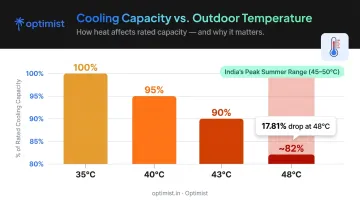
IMD data shows that average heat wave duration in India increased by 6.5 days over the 1961–2020 period, with northwest India seeing increasing frequency and duration each decade. The problem this creates is a ratings gap: most ACs are tested and rated at 35°C outdoor dry-bulb temperature under IS 1391 standards. A Purdue University refrigeration conference study found that cooling capacity dropped by 17.81% when outdoor conditions rose from 35°C to 48°C.
For buyers in Delhi, Rajasthan, or Central India — where 48–50°C peak days happen every summer — this gap is not a footnote. It's the difference between an AC that cools and one that struggles.
Top Air Conditioners in India for 2026
Selection criteria: ISEER score (post-2026 BEE revision), verified performance at high ambient temperatures, build quality, warranty coverage, and value — not sales volume or marketing spend.
Optimist
Optimist is an India-first climate tech company founded in August 2024 and launched in January 2026, built to solve what most AC brands still haven't: reliable, efficient cooling in extreme Indian heat.
Backed by USD 12M from Accel, Arkam Ventures, and Sparrow Capital, with technical guidance from Prof. Anurag Goyal of IIT Delhi, the company engineered its first AC from first principles at the Nalanda 1 R&D Lab in Delhi.
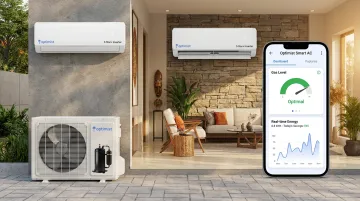
Optimist holds India's highest ISEER rating and delivers full-rated cooling at 50°C with no derating. Its microchannel heat exchanger moves heat faster than standard copper fin-and-tube designs. The built-in gas level indicator — the first of its kind in India — eliminates the guesswork (and the frequent scam) around refrigerant top-ups.
| Specification | Detail |
|---|---|
| ISEER / Star Rating | 6.05 (India's highest) / 5 Star+ BEE rated |
| Available Tonnage | 1.4 Ton (Turbo+ Mode: 1.9 Ton effective cooling) |
| Standout Features | India's first gas level indicator, 1,000-hour ASTM B368 corrosion tested (SIGMA certified — 15× market standard), real-time energy tracking via app, 50°C tested with no derating |
| Warranty | 5-year comprehensive ODU + 10-year compressor + 5-year critical indoor components + refrigerant gas coverage |
| Price | ₹39,990 (direct at optimist.in, 38% off MRP) |
The annual energy consumption of 620.2 kWh translates to roughly ₹3,411/year at ₹5.50/unit — versus ₹4,675–₹5,060 for a typical 5-star competitor. Over five years, that difference adds up to approximately ₹8,000+ in savings, before accounting for Optimist's comprehensive warranty covering parts and compressor at no additional cost.
Best for: Households running their AC 8+ hours a day through peak summer, North Indian buyers where temperatures routinely exceed 45°C, and coastal buyers in Mumbai, Chennai, or Kochi where salt air accelerates corrosion.
Daikin
Daikin has operated in India since 2000, building a 25-year track record in inverter compressor reliability and quiet operation. Its 2026 catalog is one of the few that publishes verified model-level ISEER scores.
| Specification | Detail |
|---|---|
| ISEER / Star Rating | 5.70–6.60 across 2026 5-star inverter lineup |
| Available Tonnage | 1 ton to 2 ton (various models) |
| Standout Features | Coanda airflow, PM 2.5 filter, stabilizer-free operation, select models rated to 55°C ambient |
| Warranty | 1 year complete unit, 5 years PCB, 10 years inverter compressor |
| Price (indicative) | MRP from approximately ₹61,940 for 1.5T models (verify current retail pricing) |
Daikin's top 2026 model — the FTKF35XV16MAA — carries an ISEER of 6.60 and 413 kWh annual consumption, making it among the most efficient conventional offerings in the market. High-ambient claims of 54–55°C on select models are model-specific; verify before purchase.
Best for: Buyers prioritising brand longevity, service network depth, and proven compressor reliability over pure value.
Voltas
Voltas (Tata Group) is India's #1 AC brand by volume, with over 2 million units sold in FY2023–24 and the widest service network in the country — extending meaningfully into Tier 2 and Tier 3 cities where many competitors have thin coverage.
| Specification | Detail |
|---|---|
| ISEER / Star Rating | ISEER not published at model level for 2026 Vertis lineup (verify via BEE portal) |
| Available Tonnage | 1 ton to 2 ton |
| Standout Features | AI Adaptive Cooling (learned preferences), geofencing via phone location, 4-in-1 adjustable modes, copper condenser coil, anti-dust filters |
| Warranty | 5-year comprehensive (Vertis Elite Gold); 10 years on inverter compressor |
| Price | ₹46,000–₹53,000 for 1.5T 5-star inverter models (as of July 2026) |
Voltas's 2026 Vertis AI series adds smart features that rival LG in some respects — geofencing that pre-cools before you arrive is useful in Indian conditions. The brand's after-sales infrastructure is its clearest differentiator.
Best for: Buyers in non-metro cities, those prioritising service availability, or households wanting reliable value without premium pricing.
LG
LG India has carved out the smart home buyer segment with its Dual Inverter Compressor, AI Convertible 6-in-1 cooling modes, and ThinQ app integration. Its Q1 2024 sales were record-breaking, with over 1 million units sold in a single period, reflecting strong mainstream adoption across Indian households.
| Specification | Detail |
|---|---|
| ISEER / Star Rating | ISEER not confirmed at model level from primary source for 2026 lineup |
| Available Tonnage | 1 ton to 2 ton range |
| Standout Features | Dual Inverter Compressor, AI Convertible 6-in-1 modes, ThinQ PreCool (GPS-triggered pre-cooling), Energy Manager+ (bill target setting), HD filter |
| Warranty | 10 years compressor, 5 years PCB and motor |
| Price | Verify current 1.5T 5-star retail pricing at LG India |
LG's PreCool and Energy Manager+ features are among the most practical smart AC tools available — setting a bill target and getting notified before you exceed it is a meaningful differentiator for cost-conscious households.
Best for: Smart home enthusiasts, households with existing LG ecosystem products, and buyers who want granular control over energy spend.
Blue Star
Blue Star (est. 1943, Mumbai) brings commercial HVAC engineering principles to its residential lineup. Its D Series 2026 5-star inverter AC carries a confirmed ISEER of 5.70 at ₹47,990 — solid value for a brand with serious build quality credentials.
| Specification | Detail |
|---|---|
| ISEER / Star Rating | D Series 2026: ISEER 5.70 / 5 Star |
| Available Tonnage | 1.5 ton to 2 ton for home use |
| Standout Features | Turbo Cool mode (rapid pulldown), copper condenser coils, convertible 5-in-1 cooling, self-clean function, high ambient cooling |
| Warranty | 1-year standard warranty; extended terms vary by model — confirm with retailer before purchase |
| Price | D Series 1.5T 5-star: ₹47,990 (official Blue Star website) |
Blue Star's target of 15% room AC market share by FY2025–26 (from ~13.75% in FY23–24) reflects aggressive investment in product range and distribution. Its commercial heritage translates into above-average build quality for the price.
Best for: Buyers in high heat-load environments (North and Central India), households wanting Turbo Cool for fast cooldown, and those who prioritise copper coils for longevity.
What to Look for When Buying an AC in India in 2026
Matching Tonnage to Room Size
The right tonnage keeps your unit running efficiently — too small and it runs continuously without achieving target temperature; too large and it short-cycles, driving up bills.
General guide:
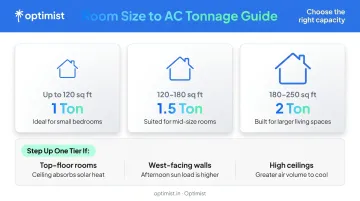
- Up to ~120 sq ft: 1 ton
- 120–180 sq ft: 1.5 ton
- 180–250 sq ft: 2 ton
Top-floor rooms, west-facing walls, and high ceilings increase the effective heat load — in these cases, step up one tonnage tier. Brand-specific bands vary: LG's guide uses tighter ranges (up to 100 sq ft → 0.8–1.0 ton; 100–150 sq ft → 1.0–1.2 ton), while Daikin allows up to 140 sq ft for 1 ton. Treat all of these as reference ranges, not fixed rules.
ISEER vs. Star Rating — What Actually Determines Your Bill
The star rating is a tier label. ISEER (Indian Seasonal Energy Efficiency Ratio) is the number that matters. BEE defines ISEER as the ratio of total annual heat removed to total annual energy consumed, calculated using Indian temperature bins from 24°C to 43°C across 1,600 annual cooling hours.
Two ACs with the same 5-star label can have very different ISEER scores — for example, 5.70 versus 6.05 — and that difference compounds across thousands of operating hours each season. Always check the ISEER number on the BEE label, not just the star tier.
High-Ambient Performance — The Most Overlooked Criterion
IS 1391 tests rated cooling capacity at 35°C outdoor dry-bulb temperature. That's not the temperature your outdoor unit faces in Delhi in May. Research shows cooling capacity drops measurably as ambient rises — by nearly 18% at 48°C in one documented study.
When evaluating any AC for use in North India, Rajasthan, or Central India:
- Ask whether the model is rated for operation at 46°C+ (IS 1391's maximum operating test)
- Check whether the brand explicitly claims maintained performance at 48–50°C
- Verify that this is a model-specific claim, not a general brand statement
Smart Transparency Features Worth Paying For
- Gas level indicator: Eliminates the guesswork around refrigerant levels and protects against top-up scams. Optimist is currently the only brand offering this via its app.
- Real-time energy tracking: Shows actual kWh consumed and projects monthly bills. Available on LG (Energy Manager+) and Optimist's app.
- Filter health alerts: Dirty filters reduce efficiency and air quality. Automated reminders reduce dependency on scheduled service visits.
Evaluating Warranty Terms
Smart features protect you from day-to-day surprises — but warranty terms determine your protection over years of ownership. Standard industry coverage is typically 1 year on the complete unit, 5 years on PCB, and 10 years on the compressor only, leaving a real gap on everything else.
India's heat, dust, and unstable grid voltage put unusual stress on components. Look for:
- 5-year comprehensive coverage on the outdoor unit (not just the compressor)
- Refrigerant gas included in warranty coverage
- Critical indoor components (PCB, fan motor, evaporator coil) explicitly covered
How We Selected the Best ACs for This Guide
This list was not built on advertising spend or market share rankings. Each AC was assessed on:
- ISEER score under 2026 BEE revision standards
- High-ambient performance claims — specifically tested vs. asserted for temperatures above 43°C
- Build quality indicators — coil material, corrosion resistance, compressor type
- Warranty comprehensiveness — what's actually covered, not just headline numbers
Common Buying Mistakes to Avoid
- Assuming last year's 5-star rating still qualifies under 2026 BEE standards — it often does not
- Choosing by brand name without verifying the actual ISEER number
- Buying a unit that performs well in lab conditions but derates during real peak summer heat
- Skipping the check on whether the brand has a service centre in your specific city
These mistakes are avoidable with the right benchmarks upfront. The brand profiles below are designed to short-circuit that research.
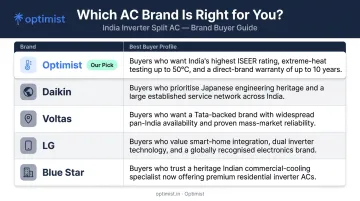
Who Each Brand Is Right For
Disclosure: Optimist is the company behind this guide. The brand profiles below are based on published specs and publicly available data for each manufacturer.
| Brand | Best Buyer Profile |
|---|---|
| Optimist | Buyers in extreme heat zones (Delhi NCR, Rajasthan) or coastal cities (Mumbai, Chennai) who prioritise ISEER 6.05 efficiency and 50°C-tested performance |
| Daikin | Premium reliability seekers with flexible budgets who value a long-established Japanese brand |
| Voltas | Non-metro and tier-2 city buyers who need a dense service network |
| LG | Smart home integrators and bill-conscious users who want app-based controls |
| Blue Star | High heat-load rooms and value-focused buyers in commercial-adjacent residential settings |
Conclusion
Buying the best AC in India in 2026 requires more than picking a trusted name. It means matching the unit to your room's heat load, verifying the ISEER score under the new BEE standards, and confirming the unit will actually perform on a 48°C afternoon — not just in a lab test at 35°C.
The long-term cost of ownership — electricity bills plus servicing — almost always exceeds the initial price difference between a 3-star and a 5-star unit. Brands that offer real-time energy tracking and comprehensive warranties make those savings visible rather than theoretical.
For homeowners who want the lowest electricity bills and cooling that holds up at 50°C, Optimist's 5 Star+ Inverter Split AC — India's highest ISEER-rated unit at 6.05 — is built for exactly that. The built-in gas level indicator and live energy meter keep ownership costs visible, not guesswork. Visit optimist.in or call +91 81 4748 7070 to check current pricing and delivery availability in your area.
Frequently Asked Questions
Which AC brand service is best in India?
Service quality varies significantly by city. Voltas and LG have the broadest national networks, with strong reach into Tier 2 and Tier 3 cities; Daikin and Blue Star cover metros well. Before purchasing, verify that your city has an authorised service centre for the brand you choose. Optimist offsets its newer network through intelligent remote diagnostics and automated service alerts, reducing the need for physical visits in many cases.
What is ISEER rating and why does it matter for my electricity bill?
ISEER (Indian Seasonal Energy Efficiency Ratio) is the actual numeric score that determines how much electricity an AC uses over a cooling season — a higher number means lower bills. Two ACs with the same 5-star label can carry different ISEER scores; the difference compounds significantly over months of daily use. Always read the ISEER number from the BEE label, not just the star tier shown on the packaging.
How do I choose the right AC tonnage for my room size?
Use 1 ton for rooms up to approximately 120 sq ft, 1.5 ton for 120–180 sq ft, and 2 ton for 180–250 sq ft. Top-floor rooms, west-facing walls, and high ceilings increase heat load, so if you're between sizes, step up rather than down. An undersized AC runs continuously, fails to reach target temperature, and drives up your electricity bill.
Do ACs lose cooling power during extreme summer heat above 45°C?
Yes — and this is one of the most underreported issues for Indian buyers. Most ACs are tested at 35°C outdoor temperature; research shows cooling capacity can drop by nearly 18% at 48°C ambient conditions. Look specifically for models explicitly tested and rated to maintain performance at 48–50°C, particularly if you're in Delhi NCR, Rajasthan, or Central India where peak temperatures regularly reach these levels.
Which is the most energy-efficient AC in India in 2026?
As of 2026, Optimist holds India's highest certified ISEER rating of 6.05 on its 1.4 Ton 5 Star+ inverter split AC. Its declared annual energy consumption of 620.2 kWh translates to roughly ₹3,411/year at ₹5.50/kWh, roughly 27–33% lower than typical 5-star competitors consuming 850–920 kWh annually. For households running their AC 8+ hours a day, that gap adds up fast across a season.
Is a 5-star AC worth the extra upfront cost compared to a 3-star model?
For most daily-use households, yes. A 3-star AC carries a significantly lower ISEER (typically 3.5–4.5 range), meaning annual energy consumption can be 1,000–1,200+ kWh versus 600–850 kWh for a 5-star unit. At Indian electricity tariffs of ₹5–8 per unit, that gap often recovers a price premium of ₹5,000–₹10,000 within 2–3 years. For households using their AC daily through a 4–5 month summer, the 5-star unit is the better long-term investment.