Introduction
Every May, the same thing happens. You turn on the AC to survive the heat, and a month later your electricity bill arrives like a second disaster. Many Indian homeowners have heard that an "inverter AC" fixes this — but the explanation usually stops at "it saves energy," which doesn't help when you're standing in a showroom comparing models.
This guide explains exactly what an inverter AC is, how it actually works, and what the BEE star ratings on the label mean. It also covers why standard efficiency ratings measured at 35°C don't tell the full story for buyers in cities where May temperatures regularly touch 47–48°C.
According to IECC/LBNL research, inverter ACs have gone from less than 10% of the market to over 90% in eight years. They're now the default choice — but not all inverter ACs perform equally when summer actually peaks.
Key Takeaways
- An inverter AC uses a variable-speed compressor that runs continuously at partial load, avoiding energy-hungry startups
- BEE's ISEER rating measures seasonal efficiency — not just performance at a single temperature
- Standard efficiency tests use 35°C outdoor conditions; Indian summers regularly exceed 45°C
- BEE confirms each 1°C increase in thermostat setting saves 6% power
- Check the ISEER number on the label directly — star bands vary widely in actual efficiency
What Is an Inverter Air Conditioner?
An inverter AC is a split air conditioner whose compressor runs at variable speeds, continuously adjusting output to match the room's actual cooling demand. It doesn't switch fully on when the room is hot and fully off when the target temperature is reached — it modulates.
The "Inverter" Name Explained
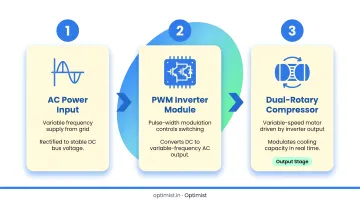
The word "inverter" here has nothing to do with a home UPS or battery backup. It refers to an electronic inverter circuit inside the AC that converts the fixed-frequency electricity supply (50 Hz in India) into a variable-frequency signal. That variable-frequency signal drives the compressor motor at different speeds depending on how much cooling is needed.
The chain works like this:
- Inverter circuit converts fixed-frequency supply into a variable-frequency signal
- Variable frequency drives the compressor motor at different speeds
- Variable speed means the compressor uses only as much energy as the room demands
Many buyers assume "inverter AC" implies battery backup capability. It does not. The naming is purely about how the compressor is controlled.
How Does an Inverter AC Work?
Fixed vs. Variable Speed: The Core Difference
A conventional (non-inverter) AC compressor has one setting: full power. When the room is too warm, it switches on completely. When the set temperature is reached, it shuts off entirely. This on-off cycling repeats throughout the day.
An inverter AC's compressor never fully stops. Instead, it:
- Runs at high speed when the room needs rapid cooling
- Slows down once the target temperature is reached
- Maintains a low, steady output to hold that temperature
The result is a room that stays within a narrow temperature band — no warm-then-cool cycling, just consistent comfort.
The Variable Frequency Drive (VFD)
The VFD is the component that makes this work. It continuously reads the room temperature and signals the compressor to speed up or slow down accordingly. The difference is similar to a car that either floors the accelerator or cuts the engine entirely, versus one that adjusts speed smoothly — the inverter compressor does the latter.
At partial load — which is most of the operating time once a room reaches its set temperature — the inverter compressor draws significantly less electricity than a fixed-speed unit running at full power.
The Derating Problem Indian Buyers Overlook
Here's what most product descriptions don't mention: BIS standard cooling capacity tests for split ACs use a 35°C outdoor temperature. But IMD data shows temperatures of 45–48°C across parts of India in late May 2024, with severe heat wave criteria defined as actual maximum temperatures at or above 47°C.
When outdoor temperatures climb well past the test condition, many inverter ACs automatically derate — meaning the compressor reduces its output capacity to protect itself. The AC is still running, but it's delivering less cooling than its rated capacity, often when you need full performance most.
An AC that maintains its rated cooling capacity at 50°C outdoor temperatures — without derating — delivers its efficiency promise even through peak Indian summer heat. Optimist's AC maintains full cooling performance at 50°C with no capacity drop — validated through in-house testing at the Nalanda 1 R&D Lab, not just standard lab conditions.
Inverter AC vs Non-Inverter AC: Key Differences
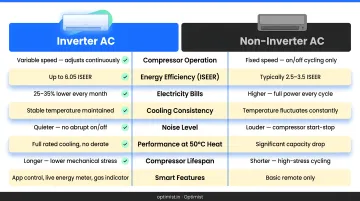
The efficiency advantage of an inverter AC is largest during partial load operation — the most common state once a room reaches its target temperature. Fixed-speed compressors only operate at full power, so they're inefficient whenever less than maximum cooling is needed.
Energy Consumption Comparison
BEE's FY 2022–23 data uses baseline ISEER values of 2.3 for fixed-speed ACs and 3.1 for variable-speed (inverter) split ACs — a direct reflection of the efficiency gap between the two technologies. BEE's programme-level calculations show sample annual savings of 513 kWh/year for fixed-speed ACs versus 267 kWh/year for inverter ACs against their respective baselines — roughly 250 kWh/year less for inverter models.
For a practical estimate at ₹8 per unit (a mid-range residential tariff in many states): a reduction of ~250 kWh/year translates to roughly ₹2,000 in annual savings — and the differential grows with higher usage hours or tariffs.
Note: For an accurate model-to-model comparison, check the "electricity consumption in units/year" figure printed on the BEE star label of the specific models you're comparing. BEE calculates this using 1,600 cooling hours per year as the standard assumption.
Side-by-Side Comparison
| Feature | Non-Inverter AC | Inverter AC |
|---|---|---|
| Compressor type | Fixed speed (on/off) | Variable speed (continuous) |
| Temperature stability | Fluctuates (cycles) | Consistent, narrow band |
| Energy efficiency | Lower (ISEER ~2.3 baseline) | Higher (ISEER ~3.1+ baseline) |
| Startup current | High, repeated surges | Rare, minimal surges |
| Noise levels | Higher (abrupt cycling) | Lower (steady operation) |
| Initial cost | Lower | Higher |
| Long-term operating cost | Higher electricity bills | Lower electricity bills |
| Best for | Occasional, infrequent use | Daily or extended use |
Upfront Cost vs. Long-Term Savings
That "Initial cost: Higher" row in the table comes with an important context: the price gap closes faster than most buyers expect. Inverter models from established brands start around ₹32,000–₹37,000 for 1.5-ton units, while fixed-speed models are cheaper upfront.
A simple payback calculation: if an inverter AC saves ₹2,000–₹3,000 annually in electricity (using BEE baseline ISEER differential and 1,600 hours at ₹8/unit), a ₹5,000–₹8,000 price premium recovers in 2–3 years of regular daily use. For households running the AC 8+ hours daily from April to October, payback is typically faster.
On compressor longevity: inverter compressors avoid the repeated mechanical stress of full-power cold starts. Fewer start-stop cycles means less wear on bearings, valves, and refrigerant lines — translating to longer component life over time.
Understanding ISEER and Star Ratings
What ISEER Actually Measures
ISEER (Indian Seasonal Energy Efficiency Ratio) is defined by BEE as:
ISEER = Cooling Seasonal Total Load (CSTL) ÷ Cooling Seasonal Energy Consumption (CSEC)
In plain terms: it's the total cooling delivered over an entire Indian season divided by the total electricity consumed during that period. The result is expressed in watts of cooling per watt of electricity.
Unlike older EER ratings measured at a single test point, ISEER accounts for the range of temperatures an AC encounters across the full Indian cooling season — making it a more realistic efficiency benchmark for local conditions. BEE uses 1,600 cooling hours per year as the standard seasonal calculation basis.
How Star Ratings Translate ISEER
The BEE star label converts ISEER into a 1–5 star band. More stars = higher ISEER = more cooling per unit of electricity. Based on BEE's verified published star band data:
| Period | 3-Star ISEER | 4-Star ISEER | 5-Star ISEER |
|---|---|---|---|
| Jan 2018 – Dec 2020 | 3.50–3.99 | 4.00–4.49 | ≥4.50 |
| Jan 2021 – Dec 2023 | 3.80–4.39 | 4.40–4.99 | ≥5.00 |
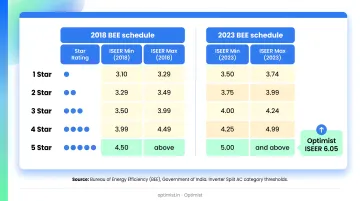
Note: BEE revises thresholds periodically. Confirm current 2025–2026 thresholds from BEE's official portal before purchase.
The ISEER Ceiling: Why the Number Matters More Than the Star
Most 5-star ACs meet the minimum threshold to qualify for the top band. But there's meaningful variation within that band. At ISEER 6.05 — India's highest certified rating, held by Optimist — an AC delivers measurably more cooling per unit of electricity than a competitor sitting at ISEER 4.7 or 5.2, even if both carry identical 5-star labels.
The practical implication: when comparing two 5-star inverter ACs, the one with the higher actual ISEER number will cost less to run over the same period. Always check the number on the label, not just the star count.
What ISEER Doesn't Tell You
That said, the ISEER number itself has limits. It's calculated under controlled lab conditions, using a 35°C outdoor test standard, and assumes the AC maintains its rated capacity throughout the season.
Real Indian summers don't stay at 35°C. If a unit derates at 45°C+ ambient temperatures — reducing its output to protect itself — its actual efficiency drops below the labelled ISEER on the hottest days. That's why two checks matter when buying an inverter AC:
- Star label and ISEER number: higher always means lower running costs
- High-ambient performance claims: verify how the unit behaves at 45°C–50°C, not just in lab conditions
What Affects Inverter AC Efficiency in Indian Conditions
Room Size and Heat Load
An undersized AC running at constant maximum load loses its inverter efficiency advantage — the compressor stays near peak speed rather than modulating at partial load. An oversized AC in a small room may cycle unnecessarily.
General sizing guidance:
- Up to 110–120 sq ft: 1 ton
- 120–180 sq ft: 1.5 ton
- 180–240 sq ft: 2 ton
Poor insulation, west-facing rooms, large unshaded windows, and top-floor positioning all increase heat ingress and push the compressor harder — effectively shrinking the practical room capacity for a given tonnage.
Ambient Outdoor Temperature
Those room-level factors are compounded by what's happening outside. ISEER is a seasonal average — on days when outdoor temperatures cross 45°C, the compressor works significantly harder than it does during milder conditions. This is where the gap between an AC rated at 35°C and one proven at 50°C becomes tangible: the latter maintains full capacity when Indian summer is at its worst, while competing units derate output.
Thermostat Settings and Smart Features
BEE states that raising the AC temperature setting by 1°C can save 6% power. Setting the thermostat at 24°C instead of 18°C doesn't just comply with BEE's recommended setting — it reduces the compressor's workload throughout the day.
Smart features extend that control further. Optimist's app gives homeowners real-time energy tracking, projected monthly bill displays, scheduling, and filter health monitoring — so consumption gets managed actively, not reviewed after the fact. Knowing your projected bill mid-month changes how you use the AC in ways a basic remote control simply can't.
Tips to Get Maximum Energy Savings from Your Inverter AC
An inverter AC can cut your electricity bill significantly — but only if it's installed correctly, used smartly, and chosen with the right specs from the start.
Installation and Room Conditions
- Ensure the outdoor unit has adequate clearance — avoid enclosed spaces that trap heat around the condenser
- Use heavy curtains or reflective blinds on west and south-facing windows to reduce heat ingress before the AC even starts
- Seal gaps around doors and windows to prevent cooled air from escaping
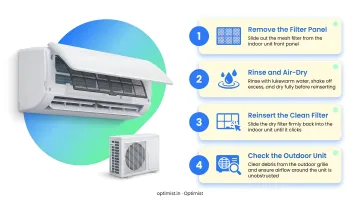
- Clean or replace filters every 4–6 weeks — dirty filters restrict airflow and force the compressor to work harder, directly raising electricity consumption
- Service the unit at least once per season: check refrigerant gas levels, clean the evaporator coil, and inspect electrical connections
Thermostat Strategy
- Use 24–26°C as your baseline setting, not 18–20°C
- Enable sleep mode for the overnight period when ambient temperatures drop
- Use scheduling features to pre-cool the room 20–30 minutes before occupancy rather than running the AC all day at low temperatures
- Switch to fan-only mode once the room reaches the set temperature — useful in dry or transitional weather when the compressor doesn't need to run continuously
Choosing the Right Model from the Start
The tips above only deliver full value if the unit itself is worth running. When comparing models:
- Check the actual ISEER value on the energy label, not just the star band — two 5-star models can differ significantly in real-world efficiency
- Compare the kWh/year figures printed on the BEE label (calculated at 1,600 hours/year) to get an apples-to-apples cost comparison
- Verify high-ambient performance — ask whether the model maintains rated cooling capacity above 45°C, or review the manufacturer's performance data at extreme temperatures
- Match the payback calculation to your usage — households running the AC 8+ hours daily recover the premium on a higher-ISEER model far faster than occasional users
Frequently Asked Questions
Why does an inverter AC consume less power?
An inverter AC's compressor runs continuously at variable, lower speeds rather than cycling between full power and off. This eliminates the high-current startup surges of a fixed-speed compressor and allows the system to maintain the set temperature using only as much electricity as the room actually requires at any moment.
Which AC has the lowest power consumption?
Within each capacity category, the AC with the highest ISEER rating consumes the least power over a full season. Check the annual energy consumption figure (kWh/year) on the BEE star label, not wattage alone. Among 5-star inverter models, look for ISEER values above 5.5 for the best seasonal efficiency.
Is there a 0.5 hp AC?
0.5 hp (approximately 0.4 ton) ACs exist but are uncommon in Indian residential markets. Most households use 1-ton to 2-ton units, which cover typical room sizes and are widely available across all star ratings.
How much can an inverter AC save on electricity bills per month?
Savings depend on usage hours, your state's electricity tariff, and the ISEER gap between models. For example, using BEE's 1,600-hour annual calculation: if a 5-star inverter AC consumes 200 fewer kWh/year than a 3-star model, at ₹8/unit that's ₹1,600/year — or roughly ₹230–₹400/month during the peak season months.
Is inverter AC better for extreme heat like Indian summers?
Yes, but verify the specifics. Many ACs derate — meaning they reduce output — once ambient temperatures exceed 45°C. Confirm that the model you're buying maintains its rated cooling capacity in extreme heat; for Indian summers, that's a non-negotiable spec, not a bonus.
What is the difference between a 3-star and 5-star inverter AC?
Both use variable-speed compressors, but the 5-star model has a higher ISEER — meaning more cooling per unit of electricity consumed. The higher upfront cost is typically recovered through lower electricity bills within 2–3 years of regular daily use, making the 5-star option the better long-term value for households using the AC frequently.