
This guide covers the numbers directly: how many units your AC consumes per hour, per day, and per month; what drives that figure up or down in real Indian conditions; how to calculate your own bill; and practical steps to reduce consumption. If you're also comparing options, there's important context on why not all 5 star ACs perform equally — and what ISEER actually tells you.
Key Takeaways
- A 1.5 ton 5 star inverter AC typically averages 0.8–1.4 units per hour under Indian summer conditions
- Inverter technology means consumption fluctuates — real-world usage often differs from rated figures
- Raising your thermostat by 1°C cuts consumption by ~6%, per BEE guidance — making it one of your biggest cost levers
- Room insulation, outdoor temperature, and maintenance condition are the primary drivers of actual consumption
- The ISEER number on the label determines your real electricity cost more than the star count alone
Why the 5 Star Inverter Rating Matters for Your Electricity Bill
What ISEER Means and Why It Goes Beyond Star Labels
ISEER (Indian Seasonal Energy Efficiency Ratio) is the BEE metric that measures how much cooling output an AC delivers per unit of electricity consumed across Indian seasonal conditions. A higher ISEER means lower electricity consumption.
According to BEE's regulatory framework, the minimum ISEER thresholds for variable-speed (inverter) split ACs are:
| Star Rating | ISEER Threshold |
|---|---|
| 3 Star | 3.80 – 4.39 |
| 4 Star | 4.40 – 4.99 |
| 5 Star | 5.00 and above |
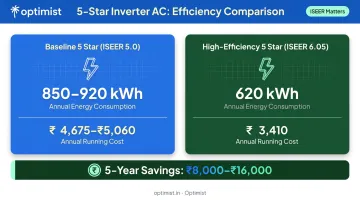
The critical point: two ACs can both carry "5 star" labels with very different ISEER values. A unit at ISEER 5.0 and one at ISEER 6.05 are both 5 star — but at 620 kWh annual consumption vs. roughly 850–920 kWh, the gap over a 5-year ownership period amounts to approximately ₹8,000–₹16,000 in electricity savings (at ₹5.50/unit).
That gap comes directly from how inverter compressors modulate power — which is what separates a high ISEER unit from a baseline 5 star one.
Inverter vs Non-Inverter: The Consumption Difference Explained
A non-inverter compressor runs at full power only, cycling on and off completely to regulate temperature. Every restart draws peak wattage, and when it's running, it's always at maximum load.
An inverter compressor works differently:
- It ramps up quickly to pull the room to the target temperature
- Once there, it slows to a low-speed maintenance mode, adjusting power draw continuously based on actual cooling demand
A 2023 Indian residential field study across 15 bedrooms in Hyderabad and Visakhapatnam found inverter ACs used 34–68% less energy than fixed-speed units in its sample. For a 1.5 ton AC running 8 hours daily through a 5-month Indian summer, that translates to hundreds of rupees in monthly savings — from the compressor technology alone.
How Much Does a 1.5 Ton 5 Star Inverter AC Actually Consume?
Consumption Per Hour
Unlike fixed-speed ACs, an inverter unit's hourly consumption isn't constant. It varies based on:
- How hot the room is when the AC starts
- Outdoor ambient temperature
- Your thermostat setting
- How well the room retains cool air
A typical 1.5 ton 5 star inverter AC draws roughly 1.2–1.5 kW at peak (initial cool-down) and drops to 0.5–0.7 kW in steady-state maintenance mode. The practical average across a running hour works out to approximately 0.8–1.2 units per hour under standard conditions.
Those figures are based on BEE's test conditions: a 35°C outdoor rating point and a seasonal bin range of 24–43°C. When outdoor temperatures in Delhi, Rajasthan, or Vidarbha regularly hit 45–48°C, the compressor works harder and consumption pushes toward the upper end of that range — sometimes past it.
Consumption Per Day and Per Month
Using a realistic average of 1.0 unit per hour as a working figure:
| Daily Use | Units/Day | Units/Month (30 days) |
|---|---|---|
| 6 hours | 6.0 units | 180 units |
| 8 hours | 8.0 units | 240 units |
| 10 hours | 10.0 units | 300 units |
Formula: Average kW × hours/day × 30 = monthly units
At 8 hours/day with an average draw of 1.0 kW: 1.0 × 8 × 30 = 240 units/month
In harder summer conditions (outdoor temperatures 45°C+, poorly insulated room, thermostat at 20°C), the average hourly draw can rise to 1.3–1.4 kW, pushing monthly consumption to 310–340 units.
Estimated Monthly Electricity Bill
Translating those unit estimates into rupees depends heavily on where you live. Using CEA's March 2025 state tariff benchmarks:
| State | Effective Rate (₹/unit) | Monthly Bill (240 units) |
|---|---|---|
| Tamil Nadu | ₹1.18 | ~₹283 |
| Delhi | ₹5.20 | ~₹1,248 |
| Rajasthan | ₹5.40 | ~₹1,296 |
| UP (urban) | ₹6.45 | ~₹1,548 |
| Karnataka | ₹6.45 | ~₹1,548 |
| Maharashtra/Mumbai | ₹9.28 | ~₹2,227 |
Note: These rates are calculated at a reference consumption of 100 kWh/month. Your actual bill depends on your DISCOM's slab structure — adding 240 units of AC use pushes many households into higher slabs, so your marginal cost per unit may be higher than the figures above.
Comparing ratings at the same usage (8 hrs/day, ₹5.50/unit average):
- 5 star inverter (ISEER ~5.0): ~240 units/month → ~₹1,320/month
- 3 star inverter (lower ISEER): ~290–320 units/month → ~₹1,595–1,760/month
- Non-inverter: ~350–400 units/month → ~₹1,925–2,200/month
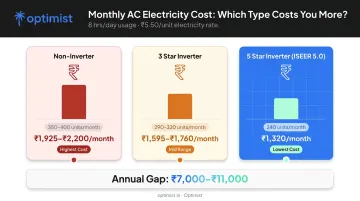
The annual gap between a 5 star inverter and a non-inverter adds up to ₹7,000–₹11,000. In extreme heat, when a non-inverter struggles and a high-ISEER unit maintains efficiency, that gap widens further.
What Factors Drive Power Consumption Up or Down?
Outdoor temperature is the most underestimated variable. BEE's seasonal bins run to 43°C — anything above that is outside the rated test range. At 45–48°C, the compressor runs harder and longer to reject heat through the outdoor unit. Consumption rises meaningfully, though the exact percentage depends on the specific AC model and its thermal design.
Room characteristics matter more than most buyers realise:
- West-facing rooms absorb afternoon sun through walls and windows
- Top-floor rooms trap heat from the roof all day
- Poorly sealed doors and windows continuously import warm air
- A well-insulated, north-facing room with curtains drawn allows the compressor to slow down and stay slow — directly reducing runtime and consumption
Thermostat setting has a clear, quantified impact. BEE states that raising the AC setting by 1°C can save 6% power, and mandates 24°C as the default setting for all star-rated ACs. Running at 20°C instead of 24°C doesn't just feel colder — it costs meaningfully more to maintain.
Maintenance condition affects consumption in ways that compound over time:
- Dirty filters restrict airflow, forcing the compressor to run longer to move the same volume of cooled air
- Low refrigerant gas reduces the system's ability to transfer heat, driving up runtime and wattage
- Clogged coils reduce heat exchange efficiency
Clean filters every 2–4 weeks during peak summer and schedule an annual service check before the season starts. These two habits alone prevent the compressor from working harder than it needs to.
How to Reduce Your 1.5 Ton 5 Star Inverter AC Electricity Consumption
Smart Usage Habits
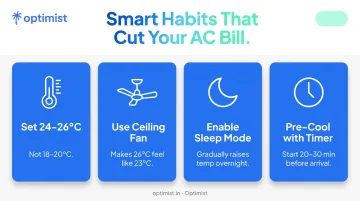
- Set the thermostat to 24–26°C — not 18–20°C. The room will reach a comfortable temperature; it just takes slightly longer
- Run a ceiling fan simultaneously — improved air circulation makes 26°C feel like 23°C, allowing you to raise the AC set point without sacrificing comfort
- Use sleep mode at night — it gradually raises the set temperature by 1–2°C as your body cools naturally, reducing overnight consumption
- Schedule pre-cooling — use the timer to start the AC 20–30 minutes before you arrive home, at a moderate temperature, rather than arriving to a hot room and running the AC at full load for an extended period
Room Preparation and Regular Maintenance
- Seal gaps around doors and windows — even a 5mm gap under a door continuously imports hot air
- Use curtains or external blinds on west- and south-facing windows during afternoon hours
- Clean AC filters every 2–3 weeks during heavy summer use; the Optimist App's filter health tracking sends automatic reminders so nothing slips
- Schedule a professional service annually to check refrigerant levels and coil condition — not when the AC stops cooling, but before summer starts
Choosing the Right ISEER When Buying
The star label sets the floor, not the ceiling. Within the 5 star category, ISEER ratings vary significantly — and that gap shows up directly on your electricity bill.
The minimum ISEER for 5 star qualification is 5.00. Most mainstream 5 star models from established brands sit between 5.0 and 5.4. Optimist's 1.4 ton 5 star+ AC reaches an ISEER of 6.05 (India's highest declared rating), with a BEE-certified annual energy consumption of 620.2 kWh.
| Optimist 1.4T (ISEER 6.05) | Typical 5 Star AC (ISEER 5.0–5.2) | |
|---|---|---|
| Annual consumption | 620.2 kWh | 850–920 kWh |
| Annual cost at ₹5.50/unit | ₹3,411 | ₹4,675–₹5,060 |
| Annual saving | — | ₹1,250–₹1,650 less |
That saving compounds every year you own the AC.
Optimist's real-time energy tracking app shows live kWh consumption and projected monthly bills, so you always know exactly what you're spending — not an estimate, the actual number.
Conclusion
A 1.5 ton 5 star inverter AC is one of the most efficient cooling options available for Indian homes, but the consumption figure on the label is a starting point, not a guarantee. Real-world bills are shaped by outdoor heat, room conditions, thermostat habits, and maintenance — all of which can push consumption well above rated figures if left unmanaged.
Two decisions make the biggest practical difference: choosing an AC with the highest possible ISEER rating, and running it at 24–26°C with a ceiling fan going. The Optimist 1.4 Ton 5 Star+ Inverter AC, rated at ISEER 6.05 — India's highest — is built specifically for this: consistent cooling through a Delhi or Nagpur summer, with bills that match what the label actually promises.
Frequently Asked Questions
How much power does a 1.5 ton 5 star inverter AC consume per day?
At 8 hours of daily use, expect approximately 7–10 units per day depending on outdoor temperature and thermostat setting. A typical average is around 8 units/day under moderate conditions, rising toward 10–11 units on peak summer days above 42°C.
How much power is an inverter required for a 1.5 ton AC?
A 1.5 ton 5 star inverter AC typically draws 900–1,500 W at peak during initial cool-down and drops to 400–700 W in steady-state operation. For home inverter/UPS sizing, plan for at least 1.5–2 kVA to handle the starting surge without tripping the backup supply.
What is the monthly electricity bill for a 1.5 ton 5 star inverter AC?
At 8 hours/day and roughly 240 units/month, expect ₹280–₹2,200/month depending on your state tariff. Delhi households pay approximately ₹1,250/month; Maharashtra/Mumbai residents pay closer to ₹2,200/month at the same usage. Lower-tariff states like Tamil Nadu will see significantly lower bills.
How does a 1.5 ton 5 star inverter AC compare to a 3 star AC in electricity consumption?
A 5 star inverter AC consumes roughly 50–80 fewer units per month than a 3 star inverter model at the same usage hours. At ₹5.50/unit, that's approximately ₹3,300–₹5,280 in annual savings. That gap grows wider with heavier daily use and hotter outdoor conditions.
What ISEER rating should I look for in a 1.5 ton 5 star inverter AC?
The minimum ISEER for 5 star certification is 5.00. Look beyond the star label and compare the actual ISEER number: a model at 5.4 consumes noticeably less than one at 5.0 over a full season. The Optimist 1.4T 5 Star+ AC, for instance, carries an ISEER of 6.05 — currently India's highest — and delivers approximately 25–35% lower bills than a typical 5 star model.
What temperature setting saves the most electricity on a 1.5 ton AC?
24–26°C is the recommended range. BEE mandates 24°C as the default setting and confirms each degree lower increases consumption by approximately 6%. Pairing a 26°C thermostat setting with a ceiling fan running at medium speed achieves the same comfort as 22–23°C without the additional power draw.