
This confusion has real consequences. Two households running identical 1.5 ton ACs can see monthly bills differing by ₹1,000 or more, depending on star rating, compressor type, and daily usage habits.
Add in ISEER ratings, inverter technology, and Indian summer heat, and "1.5 ton" alone tells you almost nothing about your electricity bill. This guide breaks down actual power draw by star rating, walks through the bill-calculation formula, and shares practical ways to cut consumption without losing cooling.
Key Takeaways
- A 1.5 ton AC draws 1.0 to 1.8 units (kWh) per hour, based on star rating and compressor type
- 5-star inverter models use 20-30% less electricity than 3-star non-inverter units for equal cooling
- At 8 hours/day, monthly bills range ₹1,800 to ₹3,600, based on efficiency and tariff
- Star rating alone won't guarantee savings; check the ISEER value on the BEE label for true efficiency
- App-based energy tracking helps catch inefficiencies before bills spike
How Much Power Does a 1.5 Ton AC Actually Consume?
"Ton" is a unit of cooling capacity, not electricity. One refrigeration ton equals roughly 3.517 kW of heat removal, a standard set by ASHRAE. So a 1.5 ton AC removes about 5.28 kW of heat from your room every hour. That's cooling output, not electrical input.
Here's the actual relationship:
Power draw (kW) = (Tonnage × 3.517) ÷ ISEER rating
A higher ISEER means the compressor uses less electrical input to deliver the exact same 5.28 kW of cooling. That's why two 1.5 ton ACs sitting side by side in a showroom can end up with completely different electricity bills at home.
Power Consumption by Star Rating
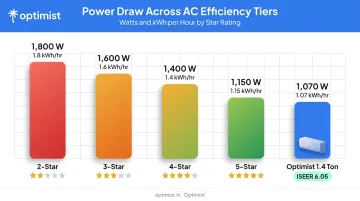
BEE certifies annual energy consumption per model, not a fixed wattage per star category, so exact figures vary. Based on typical models sold in India, here's the commonly cited range:
| Star Rating | Approx. ISEER | Approx. Power Draw | Units (kWh) per Hour |
|---|---|---|---|
| 2-star | ~3.3–3.5 | ~1,700–1,900 W | ~1.7–1.9 kWh |
| 3-star | ~3.9–4.5 | ~1,500–1,700 W | ~1.5–1.7 kWh |
| 4-star | ~4.5–5.0 | ~1,300–1,500 W | ~1.3–1.5 kWh |
| 5-star | ~5.0–5.8 | ~1,000–1,350 W | ~1.0–1.35 kWh |
These are industry-typical ranges. Always confirm against the specific model's BEE label, since figures shift model to model.
For wiring and stabiliser sizing, you need current draw, not wattage:
Current (A) = Power (W) ÷ Voltage (V)
On a standard 230V household supply, most 1.5 ton ACs fall in the 5-8 amp range. Actual current depends on power factor too, so confirm the exact figure against your model's nameplate.
That current draw matters for wiring, but efficiency gains don't stop at the standard 5-star band, either. Optimist's 1.4 ton range, for example, carries an ISEER of 6.05 with a rated input of just 1,070 W (roughly 1.07 kWh/hr).
That figure lands below even the lower end of the typical 5-star band above, yet the unit still delivers effective 1.9-ton cooling through its Turbo+ mode at 50°C ambient.
What Factors Affect 1.5 Ton AC Power Consumption?
BEE's labelled numbers come from a controlled lab test at 27°C indoors and 35°C outdoors. Your living room rarely matches that exactly, so real bills often diverge from the sticker.
Star rating and ISEER. Better compressors, coils, and refrigerant flow let higher-rated units deliver identical cooling with less electrical input. This is the biggest lever you control at purchase time.
Inverter vs fixed-speed compressor. Inverter units continuously adjust compressor speed to match cooling demand. Fixed-speed compressors only know two states, full blast or fully off, and each restart draws a power surge.
Ambient temperature. A 2016 lab study by the Centre for Science and Environment found that once outdoor temperatures climbed past the 35°C BEE test point, average input power on 5-star split ACs rose roughly 1.9% per additional degree. Once temperatures crossed 40-50°C, input power jumped 10-28% while cooling capacity dropped at the same time.
Peak Indian summers routinely exceed that range, which is exactly why Optimist tests its 1.4 Ton unit at 50°C ambient with no drop in cooling output.
Room insulation and sun exposure. A poorly insulated room, or one facing south or west with direct afternoon sun, forces the compressor to run longer to hold the set temperature. Heavy curtains and sealed gaps genuinely help here.
Thermostat setting and usage hours. According to BEE's own guidance, raising your set temperature by just 1°C can save around 6% on electricity. A full shift from 20°C to 24°C can cut usage by up to 24%.
Total daily runtime multiplies this further: running the AC 10 hours instead of 6 adds roughly 40% more units, regardless of efficiency rating.
Maintenance. A clogged filter forces the system to push air harder, and studies on HVAC systems abroad have linked this to energy use rising by up to 15%. Low refrigerant charge has separately been tied to 10-20% efficiency losses in field studies. Neither issue shows up overnight; both creep up over a season of neglect.
How to Calculate Your 1.5 Ton AC's Monthly Electricity Bill
The formula is simple once you know average power draw:
Daily units (kWh) = Power draw (kW) × Daily usage hours Monthly cost = (Daily units × 30) × Per-unit tariff rate
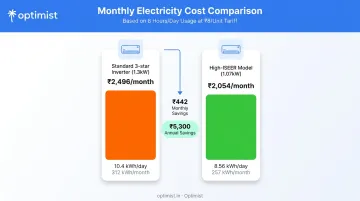
Let's run two examples side by side, both at 8 hours/day and a tariff of ₹8/unit, a mid-range rate across Indian DISCOMs.
Example 1: Standard 3-star inverter (1.3 kW draw)
- Daily units: 1.3 × 8 = 10.4 kWh
- Monthly units: 10.4 × 30 = 312 kWh
- Monthly cost: 312 × ₹8 = ₹2,496
Example 2: High-ISEER model (approx. 1.07 kW draw, similar to Optimist's 1.4 ton unit)
- Daily units: 1.07 × 8 = 8.56 kWh
- Monthly units: 8.56 × 30 = 256.8 kWh
- Monthly cost: 256.8 × ₹8 = ₹2,054
That's a monthly gap of roughly ₹442, or about ₹5,300 saved every year, purely from choosing a more efficient compressor at the same usage pattern.
Your own numbers will differ. Tariffs vary widely across states, roughly ₹6 to ₹9 per unit depending on your DISCOM and consumption slab. Check your latest bill for your actual per-unit rate before assuming these figures apply directly to your household.
Inverter vs Non-Inverter 1.5 Ton AC: Power Consumption Compared
Once a room hits the set temperature, an inverter AC throttles down and can draw under 1 unit per hour just to maintain it. A non-inverter unit works differently:
- Switches off completely once the target temperature is reached
- Lets room temperature drift upward during the off cycle
- Kicks back on at full rated power, drawing the most electricity of any cycle
That repeated on-off cycling is where most of the extra electricity disappears.
That extra cycling explains the price tag too: inverters typically cost more upfront. The gap is usually recovered within a few years of regular use through lower running costs, though the exact payback period depends on your daily hours and local tariff.
| Feature | Inverter AC | Non-Inverter AC |
|---|---|---|
| Electricity usage | Lower, variable draw matched to demand | Higher, fixed full-power cycles |
| Cooling consistency | Stable room temperature | Temperature swings between cycles |
| Noise level | Quieter, gradual speed changes | Louder compressor start-stop |
| Upfront cost | Generally higher | Generally lower |
How to Lower Your 1.5 Ton AC's Power Consumption
A few habits and one purchase decision account for most of the savings available to a typical household:
- Set the thermostat between 24-26°C and run a ceiling fan alongside it. This cuts compressor load without sacrificing comfort.
- Clean filters every 2-4 weeks and book annual servicing. Dust buildup and low refrigerant charge are two of the most common, and most avoidable, causes of rising bills.
- Improve room insulation. Seal gaps, keep doors and windows shut during operation, and use curtains on sun-facing windows to cut unnecessary compressor run-time.
- Choose a genuinely high-ISEER unit at purchase. Efficiency built into the compressor and heat exchanger matters more over five years of ownership than any habit change afterward.
That last point is exactly where Optimist's 1.4 Ton range was engineered differently. It carries an ISEER of 6.05, the highest of any AC sold in India as of 2026. The dual-rotary inverter compressor pairs with a micro-channel heat exchanger (1,180 flow paths) for faster heat transfer.
The payoff shows up directly on your electricity bill:
- Delivers bills 25-35% lower than typical 5-star models
- Maintains full cooling even at 50°C ambient temperature
- Tracks live energy use in the Optimist app and flags cost spikes before they hit your DISCOM statement

Frequently Asked Questions
Does a 5-star AC really save electricity?
Yes. A 5-star 1.5 ton AC typically uses 20-30% less electricity than a 3-star model for the same cooling output. Models with higher ISEER values, like Optimist's 1.4 Ton AC (ISEER 6.05), push savings further while still matching 1.5 ton cooling through its Turbo+ mode.
How many units does a 1.5 ton AC consume per hour?
Most 1.5 ton ACs consume between 1.0 and 1.8 units (kWh) per hour, depending on star rating and whether it uses inverter or fixed-speed technology. High-ISEER models can run even lower.
What is the wattage of a 1.5 ton AC?
Wattage typically falls between 1,000 and 1,800 watts, depending on efficiency rating. Remember, "1.5 ton" describes cooling capacity, not wattage; the two connect through ISEER, not a fixed conversion.
How much current does a 1.5 ton AC draw?
Most 1.5 ton ACs draw roughly 5 to 8 amps on a standard 230V household supply. Check your specific model's nameplate for exact current, since it varies with power factor and compressor type.
Is an inverter AC better than a non-inverter AC for saving power?
Yes. Inverter compressors modulate speed to match cooling demand instead of cycling fully on and off, typically cutting consumption 30-40% compared to fixed-speed units.
What is the average monthly electricity bill for a 1.5 ton AC?
For roughly 8 hours/day of use, expect somewhere between ₹1,800 and ₹3,600 a month, depending on star rating, ISEER value, and your local per-unit tariff.