

That gap might seem small, but at ₹8 per unit over 8 hours a day for 90 days, it translates to a difference of ₹500–₹1,000 or more on your summer electricity bill.
This article covers exactly how many units a 1.5-ton AC consumes by star rating, the formula to calculate your own monthly bill, what drives consumption higher, and concrete steps to bring it down.
Key Takeaways
- A 1.5-ton AC consumes 1.2–1.8 units (kWh) per hour, varying by star rating and inverter vs. non-inverter technology
- A 5-star inverter AC uses approximately 20–30% less electricity than a 3-star non-inverter model of the same tonnage
- Raising the thermostat by 1°C saves around 6% electricity — setting it at 24°C instead of 20°C saves roughly 24%
- Poor maintenance can increase effective consumption by 10–20% regardless of the AC's original star rating
- Smart ACs with real-time energy tracking show projected monthly bills — so consumption spikes don't catch you off guard
How Many Units Does a 1.5-Ton AC Use Per Hour?
Tonnage vs. Power Draw — Not the Same Thing
"1.5 ton" refers to cooling capacity — specifically 18,000 BTU per hour. It says nothing about how much electricity the AC draws. That depends on the efficiency rating and compressor technology. Two 1.5-ton ACs sitting side by side can have very different monthly bills.
Consumption by BEE Star Rating
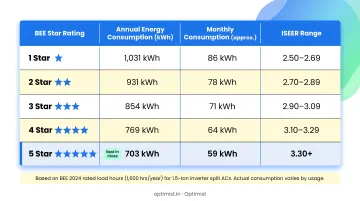
The table below shows approximate consumption ranges for 1.5-ton split ACs. These are practical estimates based on rated wattages for each efficiency tier — treat them as planning estimates, not exact billing figures.
| Star Rating | Technology | Approx. Watts | Units/Hour (kWh) | Units/8-Hour Day |
|---|---|---|---|---|
| 2-star | Non-inverter | 1,700–1,850 W | 1.70–1.85 | 13.6–14.8 |
| 3-star | Non-inverter | 1,550–1,700 W | 1.55–1.70 | 12.4–13.6 |
| 3-star | Inverter | 1,300–1,500 W | 1.30–1.50 | 10.4–12.0 |
| 4-star | Inverter | 1,150–1,350 W | 1.15–1.35 | 9.2–10.8 |
| 5-star | Non-inverter | 1,350–1,500 W | 1.35–1.50 | 10.8–12.0 |
| 5-star | Inverter | 1,100–1,300 W | 1.10–1.30 | 8.8–10.4 |
Why Inverter ACs Show a Range, Not a Fixed Number
Inverter ACs don't run at constant wattage. During startup or on a hot afternoon when the compressor is working hard, a 5-star inverter model might draw 1.4–1.5 kW. Once the room temperature stabilises, it can idle at 0.7–1.0 kW. The effective per-hour average is therefore lower than the peak rating suggests — that's the core efficiency advantage over non-inverter designs.
Non-inverter compressors work differently: they cycle fully on at peak wattage, then fully off. Every restart draws a surge of power. Over 8 hours, those repeated spikes add up — often negating the lower sticker price within a season or two.
What ISEER Actually Means
ISEER — the Indian Seasonal Energy Efficiency Ratio — measures how much cooling you get per unit of electricity consumed across a full season. A higher ISEER means lower running costs. BEE calculates ISEER using 1,600 seasonal cooling hours and outdoor temperature bins ranging from 24°C to 43°C, which approximates Indian climate conditions better than a single test-point rating.
Under the current BEE schedule effective from January 2026:
- 2-star: ISEER 3.80–4.29
- 3-star: ISEER 4.30–4.99
- 4-star: ISEER 5.00–5.59
- 5-star: ISEER ≥ 5.60
For context, standard 5-star models clear 5.60. Optimist's AC carries an ISEER of 6.05 — currently India's highest — meaning it delivers roughly 8% more cooling output per unit of electricity than the minimum 5-star threshold requires.
The Peak Summer Reality
BEE's ISEER rating is tested at a nominal 35°C outdoor temperature. When ambient temperatures cross 40–45°C — common across Delhi, Rajasthan, and other north Indian metros during May and June — the compressor works harder to reject heat and runs for longer. Real-world summer consumption will exceed what the BEE label predicts.
What Factors Affect Your 1.5-Ton AC's Power Consumption?
Room Size and Heat Load
A 1.5-ton AC is rated for approximately 131–190 sq. ft. under standard conditions. A poorly insulated room, a west-facing wall with direct afternoon sun, or a top-floor flat under a concrete roof increases the effective heat load. The compressor runs longer to maintain temperature, raising units consumed per hour even if the AC itself is perfectly maintained.
Thermostat Set-Point
This is the easiest variable to control. According to BEE and the Ministry of Power, raising the thermostat by 1°C saves approximately 6% electricity. Moving from 20°C to 24°C saves roughly 24%. BEE recommends 24°C as the default setting — it's effective and comfortable for most households.
The compressor duty cycle explains why: at a lower set-point, the compressor runs more continuously because the temperature difference between the room and outside is larger. At 24°C versus 20°C, it cycles off more often.
Inverter vs. Non-Inverter Technology
| Factor | Non-Inverter | Inverter |
|---|---|---|
| Compressor operation | Fully on/off cycles | Variable speed modulation |
| Startup power surge | Yes, repeatedly | Eliminated |
| 8-hour consumption (3-star) | ~13 units | ~10–11 units |
| Temperature consistency | Slight fluctuations | Steady |
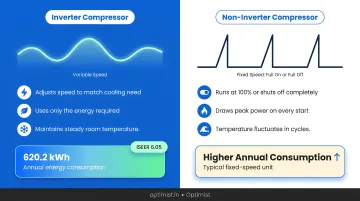
The inverter advantage compounds over a full summer. That 2–3 unit daily difference becomes 180–270 units saved over 90 peak-season days.
Maintenance and Refrigerant
A clogged filter restricts airflow. The system moves less air per cycle, so the compressor runs longer to meet the thermostat set-point. A refrigerant shortfall reduces heat-transfer efficiency at the evaporator coil, making the compressor work harder for the same amount of cooling.
Poor maintenance — dirty filters, low refrigerant — can increase effective consumption by 10–20% regardless of the AC's original star rating.
Internal Heat Sources
Beyond the AC unit itself, what happens inside the room matters just as much. Sunlight through uncovered windows, multiple occupants, a running television, laptop chargers — all add heat load the AC must remove. A few zero-cost adjustments cut that load directly:
- Draw thick curtains or reflective blinds to block solar heat gain
- Keep doors and windows closed to prevent warm air infiltration
- Minimise appliance use during peak cooling hours when possible
How to Calculate Your 1.5-Ton AC Monthly Electricity Bill
The Formula
Daily units = AC wattage (kW) × daily hours of use
Monthly units = Daily units × 30
Monthly cost = Monthly units × your electricity tariff (₹/unit)
Most Indian states charge domestic consumers between ₹4–₹8 per unit depending on their consumption slab.
Worked Example: 5-Star Inverter vs. 3-Star Non-Inverter
5-star inverter AC at 1.3 kW, 8 hours/day, ₹8/unit:
- Daily units: 1.3 × 8 = 10.4 units
- Monthly units: 10.4 × 30 = 312 units
- Monthly cost: 312 × ₹8 = ₹2,496
3-star non-inverter AC at 1.65 kW, same conditions:
- Daily units: 1.65 × 8 = 13.2 units
- Monthly units: 13.2 × 30 = 396 units
- Monthly cost: 396 × ₹8 = ₹3,168
| Model | Monthly Units | Monthly Cost (₹8/unit) |
|---|---|---|
| 5-star inverter (1.3 kW) | 312 units | ₹2,496 |
| 3-star non-inverter (1.65 kW) | 396 units | ₹3,168 |
| Difference | 84 units | ₹672/month |
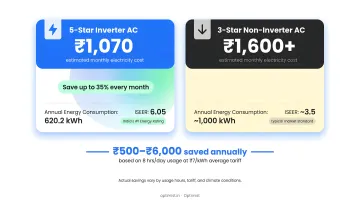
Over a 3-month peak season, that's over ₹2,000 in savings. Same room, same hours — the only variable is the star rating.
How to Find Your AC's Actual Wattage
Check the BEE energy label affixed to the unit. It shows two key figures:
- Rated Power Input — the wattage in watts; inverter models show a range (minimum to maximum) rather than a single value
- Annual Energy Consumption — total units per year; this is the more reliable number for cost estimation since it accounts for seasonal load variation
Peak Summer Adjustment
If your AC runs 10–12 hours per day during April–June at outdoor temperatures of 42–45°C, the actual bill will be higher than an 8-hour estimate.
5-star inverter at 1.3 kW, 10 hours/day for 90 days:
- Daily units: 1.3 × 10 = 13 units
- Seasonal units: 13 × 90 = 1,170 units
- Seasonal cost at ₹8/unit: ₹9,360
The 3-star non-inverter at 1.65 kW hits roughly ₹11,880 for the same period — a ₹2,500 seasonal difference that compounds every summer you keep the same AC.
Practical Tips to Reduce Your 1.5-Ton AC Electricity Bill
Settings and Behaviour
- Set the thermostat to 24–26°C. Each degree above 20°C saves ~6% electricity. 24°C is the BEE-recommended default.
- Use a ceiling fan alongside the AC. A fan creates a wind-chill effect that lets you feel comfortable at a higher thermostat setting — typically 2°C higher — without sacrificing comfort.
- Activate sleep mode at night. Most ACs gradually raise the temperature by 1–2°C over a few hours once sleep mode kicks in, reducing overnight consumption.
- Use the timer/scheduling function. Avoid running the AC in an empty room. If your AC has app-based scheduling, set it to turn on 30 minutes before you arrive rather than leaving it running all day.
- Keep doors and windows closed. Warm air infiltration forces the compressor to work harder and run longer.
Home Preparation and Maintenance
- Clean filters every 3–4 weeks during peak use. A clogged filter reduces airflow and forces longer compressor run times. The fix takes 10 minutes and noticeably restores airflow and efficiency.
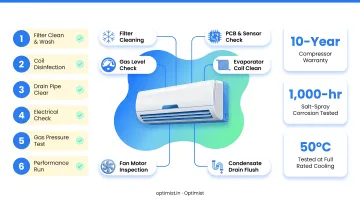
- Schedule a professional service before summer. This should include checking refrigerant charge, cleaning the indoor and outdoor coils, and verifying electrical connections. A well-serviced AC operates close to its rated efficiency; a neglected one may perform like a lower-star model.
- Use curtains or reflective blinds on west-facing windows. Afternoon sun through glass is a significant heat source. Blocking it reduces the thermal load on the AC directly.
- Seal gaps around doors and windows. Air leakage steadily inflates your bill — every cubic metre of warm air that enters is extra work the compressor must undo.
Upgrade and Monitoring
If your AC is 8–10 years old, the efficiency gap versus a modern inverter model typically justifies replacement on bill savings alone. Older units also tend to lose refrigerant charge gradually, compounding the efficiency loss over time.
For newer smart ACs, real-time energy monitoring makes a practical difference. Optimist's connected app tracks cumulative kWh consumption, projects your monthly bill based on actual usage, and sends filter health alerts — so you're not waiting for a surprise bill to notice something has been running inefficiently.
The gas level indicator is another useful feature. Refrigerant shortfalls are invisible until cooling degrades, but with real-time visibility, you can schedule a top-up before efficiency losses accumulate.
Frequently Asked Questions
How much electricity does a 1.5-ton 5-star AC use?
A 1.5-ton 5-star inverter AC typically averages 1.1–1.3 kWh per hour across a full day, though it may draw up to 1.5 kW during peak load. A 5-star non-inverter model draws a steadier 1.35–1.50 kWh per hour. Both are meaningfully more efficient than 3-star equivalents.
How much does it cost to run a 1.5-ton AC for 1 hour?
At ₹8 per unit (kWh), a 5-star inverter AC costs roughly ₹9–₹10 per hour. A 3-star non-inverter costs ₹12–₹14 per hour. The formula is simple: kW rating × tariff rate = hourly cost. Your actual tariff may be lower (₹4–₹6) or higher depending on your state and consumption slab.
How many 1.5-ton ACs can run on a 3 kW connection?
A single 1.5-ton AC draws 1.2–1.8 kW, so one unit fits within a 3 kW supply. Running two simultaneously would exceed that limit. Even with one AC, very little headroom remains for other appliances like a refrigerator, washing machine, or water heater.
How much electricity does a 1.5-ton inverter AC consume per hour?
Unlike fixed-speed models, inverter ACs modulate compressor speed continuously — running hard to pull down room temperature, then easing off once it stabilises. This is why the draw varies from 0.7 kW at steady state to 1.4–1.5 kW during peak load, rather than running at a constant level throughout.
Does a 1.5-ton AC consume more electricity in peak Indian summer (45°C+)?
Yes. When outdoor temperatures climb above 40°C, the compressor runs at higher load for longer to reject heat. BEE's ISEER rating is measured at a nominal 35°C outdoor temperature, so real summer consumption regularly exceeds label estimates during May and June.
How can I tell how much electricity my specific AC is using?
Check the BEE energy label on the unit for the "Rated Power Input" and "Annual Energy Consumption" figures — these are your most reliable starting point. Some ACs, including Optimist's, include app-based energy monitoring that shows real-time kWh consumption and a projected monthly bill, so you never need to calculate manually.