
Introduction
Delhi summers are not average Indian summers. IMD recorded temperatures of 49.1°C at Najafgarh and 49.0°C at Pusa on May 29, 2024 — well past the 47°C threshold that defines a severe heat wave. The problem: most ACs sold in India are BEE-certified only up to 43°C ambient. At 45–49°C, these units lose cooling capacity, run continuously without reaching the set temperature, and risk thermal overload trips.
Add Delhi's usage pattern — 10–12 hours daily across a concentrated April–July season — and the wrong AC can mean ₹10,000–₹15,000 in excess electricity bills over two summers. The right one pays back its premium within that same window.
Every AC in this guide is rated for 50°C+ ambient operation, carries a 5 Star+ energy rating, and has been tested against Delhi NCR real-world conditions — not just lab benchmarks.
Key Takeaways
- Delhi regularly crosses 48–49°C — only ACs rated for 50°C+ ambient should be shortlisted
- Upsize tonnage by 0.3–0.5 ton above standard room-size charts; top-floor rooms need an additional 0.5 ton
- A 5-star inverter AC saves ₹600–₹750/month over a 3-star equivalent for a high-capacity unit running through Delhi summer
- 2026 top picks: Optimist (ISEER 6.05, 50°C tested), Blue Star Heavy Duty (56°C), Daikin FTKF (55°C), Voltas Vectra (52°C)
- Verify warranty depth and Delhi NCR service coverage — not just sticker price
Why Delhi Summers Demand a Different Kind of AC
The 43°C Problem
BEE's ISEER testing uses a bin range of 24°C to 43°C — meaning the star rating on every AC in India is calculated based on conditions that top out at 43°C. Delhi blew past that ceiling on multiple days in May 2024, with stations across the city crossing 48–49°C.
At those temperatures, a standard AC faces real consequences:
- Cooling capacity drops 20–30% as the compressor struggles against higher ambient heat
- The unit runs continuously without hitting the set temperature
- Thermal overload protection may trip the unit entirely
West and Southwest Delhi localities — Najafgarh, Jafarpur, Pusa — consistently record the harshest readings. A standard 43°C-rated AC is simply the wrong product for these areas.
Delhi's Concentrated Season Creates Mechanical Stress
Delhi's AC season is short and brutal. Four months of 10–12 hour daily operation creates more cumulative mechanical stress than year-round mild-climate use in cities like Bangalore or Mumbai. This makes compressor durability and high-ambient thermal resilience more critical than ISEER alone.
A unit that performs well at 35°C but derates at 47°C is functionally useless during Delhi's peak.
Three Additional Delhi-Specific Challenges
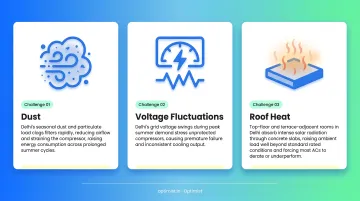
- Fine dust: Delhi's particulate levels clog filters every 2–3 weeks in peak summer, requiring either strong filtration, auto-clean, or diligent manual cleaning — otherwise cooling efficiency drops and bills climb
- Voltage fluctuations: Older colonies in areas like Karol Bagh, Lajpat Nagar, and Chandni Chowk see voltage sags and spikes; stabilizer-free operation or surge protection is worth prioritising
- Top-floor roof heat: A Delhi cool-roof study found top-floor ceiling temperatures reaching 39–41°C when indoor spaces are 34–36°C — and the urban heat island effect adds up to 5.9°C on top of that in dense colonies
Best ACs to Buy in Delhi for Hot Summers in 2026
Every AC on this list is rated for 50°C+ ambient, carries a 5-star or equivalent energy rating, and has been evaluated on performance, warranty, and Delhi NCR serviceability.
Optimist
Launched in January 2026 after two years of R&D at the Nalanda 1 Lab in Delhi, Optimist is engineered from the ground up for extreme Indian heat. Its ISEER of 6.05 is the highest ever rated in India, and the unit is tested to deliver full rated cooling at 50°C ambient with no derating.
For Delhi specifically, two features stand out. The Turbo+ Mode delivers 1.9 tons of effective cooling from a 1.4-ton unit (135% capacity boost, 6.5 kW output) — bringing room pull-down from 45°C to 25°C in 20–30 minutes instead of 60–90. The microchannel heat exchanger with 1,180 flow paths delivers 4× faster heat transfer, which is what allows sustained full-capacity operation at extreme ambient temperatures.
The Gas Level Indicator (India's first built-in feature of its kind) shows live refrigerant status in the app, eliminating the common Delhi technician scam of unnecessary gas refills (typically ₹2,500–₹7,000 per fraudulent visit).
| Spec | Detail |
|---|---|
| ISEER | 6.05 (India's highest) |
| Star Rating | 5-Star+ |
| Ambient Rating | 50°C tested, no derate |
| Turbo+ Mode | 135% capacity boost (1.9T effective) |
| Annual Consumption | 620.2 kWh |
| Standout Features | Gas Level Indicator, Microchannel Heat Exchanger, Real-Time Energy App, Intelligent Diagnostics |
| Warranty | 5-year all-inclusive, 10-year compressor, refrigerant gas included |
| Delhi NCR Serviceable | Yes |

Explore at optimist.in
Blue Star Heavy Duty
Blue Star's Heavy Duty D-series has the strongest official spec trail of any mainstream brand for extreme Delhi conditions. The 2-ton 5-star variant (IC524DNUR) is officially verified at 5.05 ISEER and 54°C ambient rating, with the 3-star Heavy Duty 2-ton rated for 56°C ambient — the highest verified ambient rating among established brands covered here.
Those specs are backed by hardware: widened condenser coils, enhanced fin coating, and reinforced outdoor cabinets built for sustained Indian extreme heat. Installer feedback across NCR consistently points to near-zero compressor failures under sustained 45–48°C load. PM2.5 filtration is a practical advantage given Delhi's PM2.5 levels.
| Spec | Detail |
|---|---|
| Ambient Rating | 54–56°C (officially verified) |
| Star Rating | 5-Star (5.41 ISEER for 1.5T, 5.05 ISEER for 2T) |
| Tonnage Options | 1.5–2.5 ton |
| Annual Consumption (2T 5-star) | 935.89 kWh |
| Standout Features | Heavy-duty condenser, PM2.5 filter, anti-corrosion coating |
| Approximate Price (2T 5-star) | ₹54,990 (sale) / ₹78,300 MRP |
Daikin 5-Star Inverter (FTKF Series)
Daikin's official product page confirms the FTKF series is designed to cool up to 55°C. That's the highest high-ambient claim among legacy brands in this list. Daikin's inverter compressor reliability is well-established, and its service network across Delhi NCR is among the most extensive of any premium brand.
The FTKF series suits Central and South Delhi zones where ambient temperatures are typically 2–3°C lower than Najafgarh or Pusa. For buyers who prioritise proven compressor longevity, low noise, and strong after-sales support over top ISEER numbers, Daikin remains a solid choice.
| Spec | Detail |
|---|---|
| Ambient Rating | Up to 55°C (official Daikin claim, FTKF series) |
| Star Rating | 5-Star |
| Tonnage Options | 1.5–2 ton |
| Standout Features | Inverter compressor reliability, wide Delhi NCR service network, quiet operation |
| Service Locator | daikinindia.com |
Note: Current ISEER and 2026 pricing for the FTKF lineup should be verified on Daikin's official product page before purchase.
Voltas Vectra (52°C Ambient)
Voltas's officially verified 1.5-ton 5-star Vectra Emerald lists 52°C high-ambient cooling and an anti-dust filter with anti-microbial coating (verified from the official Voltas product page). At ₹46,000 (offer price from ₹73,990 MRP), it represents strong value for buyers prioritising ambient performance at a lower price point than Blue Star or Daikin.
Important caveat: Always verify the specific variant before purchasing. Standard Voltas models do not carry the high-ambient rating — only the Vectra series with the 52°C specification qualifies for this list.
| Spec | Detail |
|---|---|
| Ambient Rating | 52°C (officially verified, Vectra Emerald) |
| Star Rating | 5-Star |
| Tonnage | 1.5 ton |
| Standout Features | 52°C ambient-rated, anti-dust anti-microbial filter, wide service network |
| Approximate Price (1.5T) | ₹46,000 (offer) / ₹73,990 MRP |
How to Choose the Right AC for Delhi's Heat
Step 1: Ambient Temperature Rating Is Non-Negotiable
For Delhi, the shortlist starts and ends at 50°C+ ambient rated. A standard 43°C-rated AC in Delhi's peak summer will:
- Derate 20–30% in cooling output
- Run continuously without reaching the set temperature
- Risk thermal trips during the hottest afternoon hours
Verified ambient ratings in this guide: Blue Star (54–56°C), Daikin FTKF (55°C), Voltas Vectra (52°C), Optimist (50°C). Any AC without a manufacturer-stated high-ambient specification should not be considered for Delhi.
Step 2: Size Up for Delhi Heat
Standard room-size tonnage charts are built for moderate climates. Delhi's extreme heat loads require upsizing:
| Room Size | Standard Chart | Delhi Recommendation |
|---|---|---|
| Up to 120 sq ft | 1.0–1.2 ton | 1.5 ton |
| 120–180 sq ft | 1.5 ton | 2 ton |
| 180–250 sq ft | 2 ton | 2.5 ton |
| Top-floor (any size) | Per above | Add 0.5 ton buffer |
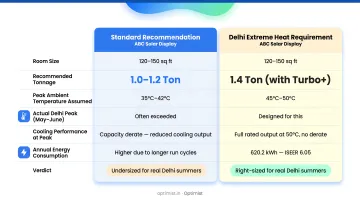
Top-floor rooms with direct roof exposure (ceiling temperatures reaching 39–41°C) are a distinct category. Undersizing here means the AC runs at full capacity continuously and still fails to maintain comfort.
Step 3: ISEER and Star Rating for Delhi's Usage Pattern
Delhi's 4-month season running 10–12 hours daily makes energy efficiency disproportionately impactful. The scale becomes clear when you compare real BEE label data:
| Comparison | Annual Consumption | Annual Saving at ₹6.50–₹8/unit |
|---|---|---|
| Blue Star 2T 5-star vs. Blue Star 2T 3-star HD | 935 vs. 1,312 kWh (376 kWh gap) | ₹2,447–₹3,012/year |
| Optimist 1.4T (ISEER 6.05) vs. typical 5-star | 620 vs. 750–800 kWh | ₹1,040–₹1,440/year |
That ₹2,447–₹3,012 annual saving works out to roughly ₹612–₹753 per month across Delhi's 4-month season.
ISEER is the more precise metric than star bands. Two 5-star ACs can have meaningfully different ISEER values: 5.0 versus 6.05 is a 20% efficiency gap that compounds over a full season.
That efficiency gap connects directly to how the compressor operates day-to-day.
Step 4: Inverter Technology and Smart Features
For Delhi's usage pattern, inverter compressors are non-negotiable. Variable-speed operation eliminates the temperature swings and power surges of fixed-speed on/off compressors, and reduces wear across a full season of high-hour running.
Smart features worth prioritising for Delhi:
- Live energy tracking — monitor actual consumption vs. projected bills
- Filter health alerts — Delhi's dust clogs filters fast; early warning prevents efficiency loss
- Remote diagnostics — identify issues without waiting for a technician visit
- Gas level monitoring — protects against unnecessary refrigerant refill charges
Step 5: Warranty and Service Coverage
In Delhi NCR, service quality and response time vary significantly by brand and by locality. Before finalising:
- Confirm the brand has authorised service centres in your specific area (not just Delhi broadly)
- Compare warranty depth: a 5-year all-inclusive warranty with 10-year compressor coverage is meaningfully different from a standard 1-year comprehensive + 5-year compressor-only term
- Check whether refrigerant gas is covered under warranty — competing brands typically charge ₹2,000–₹3,500/kg for refills outside warranty
Conclusion
Delhi's summers require an AC built for Indian heat extremes — not a product calibrated for Pune or Bangalore. The gap between a standard 43°C-rated AC and a 50°C+ rated unit is visible in your comfort during May afternoons, and measurable in your electricity bill every month from April to July.
Prioritise ambient temperature rating and correct tonnage sizing above brand loyalty. Long-term electricity savings matter more than the sticker price — a ₹5,000 premium for a 5-star over a 3-star AC typically recovers itself within one Delhi summer.
If energy efficiency, peak-summer performance, and full transparency are your priorities, the Optimist AC — built from the ground up for Indian heat, holding India's highest ISEER of 6.05, and backed by a 5-year all-inclusive warranty with refrigerant gas coverage — delivers on all three. Check specs, pricing, and 48-hour delivery availability at optimist.in.
Frequently Asked Questions
Which AC is best for Indian climate?
ACs engineered for high-ambient temperatures (50°C+) with 5-star inverter ratings perform best in India's heat. Brands like Blue Star, Daikin, and Optimist design specifically for extreme Indian conditions, making them more reliable than generic models rated only to 43°C.
Which 5-star AC is best in India?
Among 5-star ACs, Optimist holds India's highest ISEER of 6.05, while Daikin and Blue Star are well-regarded for high-ambient performance. The best choice depends on whether you prioritise maximum energy savings, extreme-heat cooling, or a specific brand's service network in your area.
Which AC brand is the best in India?
Voltas leads in market share and value, Daikin and Blue Star are strong in premium and extreme-heat performance, and Optimist leads in energy efficiency with India's highest ISEER rating of 6.05. Match the brand to your priorities — value, extreme-heat reliability, or the lowest electricity bills.
What tonnage AC do I need for a Delhi room?
Delhi's heat requires upsizing beyond standard calculations. For most bedrooms up to 150 sq ft, a 1.4-ton AC with Turbo+ mode (delivering 1.9 tons of effective cooling) handles the load well. Larger rooms or top-floor spaces with direct roof heat load will need higher-tonnage units from other brands. Never undersize for Delhi — the cost of inadequate cooling shows up every month on your bill.
Is a 5-star AC worth the extra cost for Delhi summers?
Yes — Delhi's 4-month intensive season running 8–12 hours daily means a 5-star inverter AC typically recovers its price premium within 1–2 seasons. At Delhi's tariff rates, the annual saving over a 3-star model can reach ₹2,500–₹3,000 per year.
What does ISEER rating mean and why does it matter?
ISEER measures how efficiently an AC uses electricity across India's full seasonal range — the higher the number, the lower your bills. Most 5-star ACs fall between 5.0 and 5.4; Optimist's ISEER of 6.05 is the highest rated in India.