
More households are buying their first AC. More brands are shouting "best cooling" and "lowest bills" at the same time. That noise makes picking the right brand harder, not easier.
This guide cuts through it. We'll rank the top AC brands in India for 2026 on efficiency, reliability, service reach, and real summer performance, including where newer energy-efficient entrants like Optimist fit into the picture.
Key Takeaways
- Voltas, LG, and Blue Star lead disclosed sales volume, but rankings vary by data source
- ISEER ratings matter more than star counts—higher ISEER models cut electricity costs over a decade
- Service network density in your city tier matters as much as brand name
- Climate-specific engineering—coastal corrosion resistance, high-ambient cooling—determines real-world AC performance
- Newer entrants like Optimist compete on ISEER and warranty terms, not legacy brand recognition
Overview of the AC Market in India for 2026
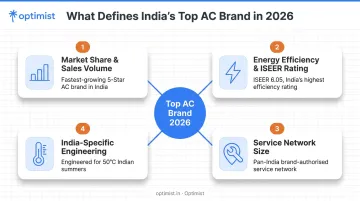
What actually makes an AC brand "top" in 2026? It comes down to four things:
- Market share and sales volume — proof that real households trust the brand at scale
- Energy efficiency (ISEER rating) — how much cooling you get per unit of electricity
- Service network size — how fast you get help when the compressor acts up in June
- India-specific engineering — resilience against extreme heat, high humidity, and voltage fluctuations
This matters more in 2026 because the Bureau of Energy Efficiency (BEE) issued its fifth room-AC amendment on 28 August 2025, tightening efficiency norms further. Buyers should verify the exact star rating on the current model label rather than assume older ratings still apply.
That regulatory scrutiny matches a market growing fast enough to warrant it. ICRA projected Indian room-AC sales would hit 12 to 12.5 million units in FY2025, up 20-25% year-on-year, according to ICRA's 2024 industry forecast. Voltas separately projected the broader room-AC market reaching ₹500 billion by FY2029.
The rankings below combine disclosed sales volume, technology leadership, and real-world reliability signals for Indian summers, not just marketing claims.
Top AC Brands in India for 2026
Selection here weighs market share and sales volume, ISEER/energy efficiency, service network size, warranty coverage, and India-specific engineering for heat, voltage swings, and humidity. Note that public share disclosures use different periods and bases (some offline-only, some quarterly), so don't read these as one harmonised league table.
Voltas
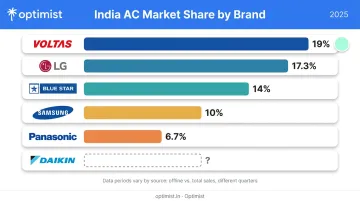
Voltas is the Tata Group-backed market leader, and it shows in the numbers: roughly 19% offline room-AC share as of March 2025 and over 2.5 million units sold in FY2025. Its real edge is reach: Tier-2 and Tier-3 city service coverage that most rivals simply don't match.
| Market Share | Key Technology | Service Network |
|---|---|---|
| ~19% (offline RAC, Mar 2025) | Inverter compressor range, affordability-led lineup | 1,750+ service franchisees, 45 Direct Service Centres |
LG
LG holds 17.3% total offline AC share in 2025, and it leads on dual inverter compressor technology. Its AI+ system adjusts cooling based on environmental load, and the ThinQ app adds energy targets, smart diagnosis, and low-gas alerts on supported models.
| Market Share | Key Technology | Service Network |
|---|---|---|
| 17.3% (2025, offline AC) | Dual Inverter compressor, AI+ cooling, ThinQ app | Pan-India ESC/LGC centres across metros, Tier 1 and Tier 2 |
Daikin
Daikin brings Japanese engineering credentials and a reputation for durability, particularly in humid, coastal zones. Its Blue Fin anti-corrosion coating on outdoor coils, paired with a DNNS coating on indoor U-bends, is designed to delay copper corrosion by up to 2.8x on treated models.
| Market Share | Key Technology | Service Network |
|---|---|---|
| Not publicly disclosed | Blue Fin anti-corrosion coating, select 10-year compressor warranty | Service locator with AC Manager 2.0 app support |
Blue Star
Blue Star, an Indian heritage brand, holds around 14% RAC value share and built its name on commercial-grade cooling brought into homes. Its D-Series hot-and-cold inverter model is officially rated to operate from -2°C to 52°C, useful for buyers in Rajasthan or Gujarat where summer heat is unrelenting.
| Market Share | Key Technology | Service Network |
|---|---|---|
| ~14% (RAC, Mar 2025) | High-ambient inverter tech (model-specific up to 52°C) | 5,000 delivery partners across 900+ towns |
Samsung
Samsung's AC business doubled sales and hit 10% room-AC share in Q1 2025, riding on its smart-home appeal. WindFree technology disperses air through 23,000 micro air holes to avoid the direct cold-draft feeling many users dislike, and SmartThings ties the AC into a broader connected-home setup.
| Market Share | Key Technology | Service Network |
|---|---|---|
| 10% (Q1 2025, RAC) | WindFree diffused cooling, SmartThings integration | Not publicly disclosed for AC-specific network |
Panasonic
Panasonic held 6.7% of India's roughly $5 billion (₹41,500 crore) room-AC market in fiscal 2025, positioning itself as the air-quality specialist. Its nanoe X system generates hydroxyl radicals aimed at pollutants and odours, and select 5-star models like the CS/CU-NU18AKY5WX post an ISEER of 5.20, among the higher figures in mass-market inverter ACs.
| Market Share | Key Technology | Service Network |
|---|---|---|
| 6.7% (FY2025, RAC) | nanoe X air purification, high-ISEER 5-star models | India-wide authorised service centres |
Optimist
Optimist is the newest name on this list, and it breaks from convention more than any other entry here. Founded in August 2024 and backed by $12 million (~₹100 crore) from Accel, Arkam Ventures, and Sparrow Capital, this Gurugram-based climate-tech company built its entire product around a single question.
Why do most ACs stop performing exactly when Indian summers get brutal?
The answer shows up in the numbers. Optimist's 1.4-ton inverter split AC carries an ISEER of 6.05, currently India's highest declared rating, translating to roughly 25-35% lower electricity bills versus typical 5-star inverter units.
It's government-lab tested at 50°C with no derating, while most competing units drop performance above 43°C.
Three features stand out:
- First-ever built-in gas level indicator: real-time refrigerant monitoring in the app, ending the classic "your gas is low" service scam
- Micro-channel heat exchanger with 1,180 flow paths for 4x faster heat transfer than conventional coils
- Turbo+ Mode: a 135% capacity boost that delivers 1.9-ton effective cooling from the 1.4-ton unit, useful for rooms typically needing a 1.5-ton AC
Backing all this is a 5-year comprehensive warranty with 10-year compressor coverage, refrigerant gas included at zero cost to the customer.
| ISEER Rating | Warranty Coverage | Standout Technology |
|---|---|---|
| 6.05 (India's highest declared) | 5-year comprehensive + 10-year compressor | Turbo+ Mode, gas level indicator, micro-channel heat exchanger |
How to Choose the Right AC Brand for Your Home in 2026
The right AC choice depends on matching a brand's strengths, ISEER efficiency, service reach, warranty confidence, to your specific situation rather than its market size.
ISEER vs. real savings: ISEER measures cooling output per unit of electricity consumed, and BEE's official formula divides annual cooling load by annual energy consumption. A jump from ISEER 4.0 to ISEER 6.0 on a similar-capacity unit can meaningfully cut a decade's worth of running costs, not just the sticker price.
Service density by city tier: A brand with excellent metro coverage but thin presence in your Tier-3 town won't help when the circuit board fails in May. Voltas' 1,750+ franchisees give it an edge here; verify any brand's local turnaround before buying.
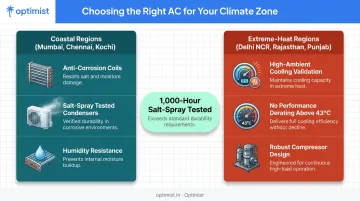
Match the AC to your climate:
- Coastal buyers (Mumbai, Chennai, Kochi) should prioritise anti-corrosion coils and salt-spray tested condensers
- Extreme-heat regions (Delhi NCR, Rajasthan, Punjab) need models validated for high-ambient cooling without performance drop
- Optimist's condenser, for instance, passed a 1,000-hour salt spray test, roughly 15 times the typical 72-hour market standard
Compressor warranty as a confidence signal: Brands offering 10-year compressor coverage are effectively betting on their own build quality. Shorter warranties often mean the manufacturer isn't as sure.
Conclusion
There's no single "best" AC brand in India for 2026. The right pick depends on matching a brand's actual strengths, whether that's Voltas' service reach, Daikin's build quality, or Blue Star's high-ambient performance, to your city, budget, and how hard you'll run the unit.
Before you buy, compare three things side by side:
- ISEER rating — higher means lower running costs
- Warranty terms — especially compressor coverage
- Real-world summer performance — not just lab-rated claims
Don't take star ratings at face value without checking the label year.
If you want an AC engineered specifically for Indian heat rather than adapted from a global platform, consider Optimist's 1.4-Ton inverter split AC. With India's highest declared ISEER, tested 50°C performance, and a 10-year compressor warranty, it's built for the summers you actually get, not the ones on a spec sheet.
Frequently Asked Questions
What are the top-selling AC brands in India?
Voltas, LG, and Daikin are consistent volume leaders in India. Voltas dominates Tier-2 and Tier-3 markets through its service network, while LG and Daikin lead in metro cities.
Which AC brand is most reliable in India?
Reliability comes down to compressor warranty length, build quality, and service turnaround rather than brand name alone. Daikin and LG are known for build quality, while Voltas stands out for service accessibility.
Which AC brands require low maintenance?
Brands with self-cleaning technology, like Hitachi's FrostWash, reduce dust buildup automatically. Smart diagnostics and gas-level monitoring, like Optimist's app offers, also cut down on unnecessary service visits.
Which AC brand is best for extreme heat conditions in Indian summers?
Look for models tested for high-ambient cooling without performance drop. Blue Star's D-Series is rated to 52°C, and Optimist is tested at 50°C with no derating, both suited to northern and western India's harsh summers.
What is the ISEER rating and why does it matter when choosing an AC brand?
ISEER measures cooling output against power input over a season. A higher ISEER directly means lower electricity bills over the AC's lifetime, so it matters more than the star count printed on the box.
Is it better to choose an Indian brand or an international AC brand?
Indian and India-engineered brands often offer denser service networks and climate-specific tuning, while international brands sometimes lead on premium technology. The right choice depends on whether you prioritise fast local service or specific features.