
Introduction
In May 2024, IMD recorded peak temperatures of 45–48°C across Rajasthan and Vidarbha — and 2025 offered no improvement. Northern Indian summers are no longer a seasonal stretch; they're a months-long endurance test.
For households running ACs 8–10 hours daily, that changes the stakes. Electricity bills, durability under 47°C heat, and whether your unit actually cools at peak — these aren't minor considerations. They're the difference between a good purchase and a regrettable one.
The problem? Indian buyers face dozens of brands, hundreds of models, and marketing claims that are nearly impossible to verify at the point of sale. Most people default to brand recognition — and many overpay or underbuy as a result.
This guide compares the six most relevant AC brands for Indian residential buyers in 2026 — Daikin, Voltas, LG, Samsung, Blue Star, and Optimist — evaluated on energy efficiency, real-heat performance, smart features, warranty coverage, and pricing. By the end, you'll know exactly which brand fits your budget, your climate, and your home.
Key Takeaways
- A 1.0-point ISEER gap translates to ₹1,500+ in annual savings — star rating alone won't tell you this
- Daikin and Blue Star lead on premium build quality, both verified at ISEER 5.70 for select 2026 models
- LG has the strongest smart ecosystem among established brands: ThinQ, GPS PreCool, AI 6-in-1 modes
- Tier 2/3 city buyers get the most reliable service coverage from Voltas, which runs India's widest AC network
- Optimist carries India's highest ISEER rating (6.05) and delivers full-rated cooling even at 50°C — no derate
Overview of Air Conditioners in the Indian Market
India's AC market has a specific set of demands that no other market quite matches. Ambient temperatures of 42–50°C in northern and central India, voltage fluctuations, high daily usage, and rising electricity tariffs make energy efficiency and heat resilience the two metrics that drive every purchase decision.
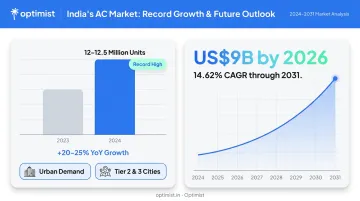
The scale of the market reflects growing urgency. Indian room AC sales reached a record 12–12.5 million units in 2024, up 20–25% year-on-year. Statista projects the broader Indian AC market at US$9 billion in revenue by 2026, growing at a 14.62% CAGR through 2031, as sustained heat stress, rising incomes, and demand from Tier 2 and Tier 3 cities push ownership well beyond metros.
The brands reviewed below are evaluated on the criteria that matter most for Indian homes: energy efficiency ratings (ISEER), heat performance, pricing, and after-sales service reliability.
Popular AC Brands in India Compared for 2026
These six brands were selected based on market presence, consumer trust, technological differentiation, and relevance to Indian residential buyers. Evaluation criteria: ISEER score, ambient temperature tolerance, smart features, warranty coverage, and price-to-value ratio.
Daikin
Daikin sets the benchmark for premium residential performance in India. The Japanese HVAC brand brings deep compressor engineering expertise, quiet operation, and one of the most durable inverter lineups in the market — with strong positions in both premium residential and commercial segments.
What sets it apart:
- Coanda airflow technology for even air distribution without cold drafts
- PM2.5 filtration on premium models
- Stabiliser-free operation
- Ambient cooling rated from 10°C to 55°C (model-specific)
The FTKM50XV (1.42 Ton) carries a verified ISEER of 5.70 with 678.92 kWh annual energy consumption. The 1.50 Ton FTKM53XV is listed at 716.97 kWh annually, though its exact ISEER wasn't captured from the primary page.
| Feature | Detail |
|---|---|
| Energy Efficiency | ISEER 5.70 (verified, FTKM50XV 1.42T); 5-Star rated |
| Key Features | Coanda airflow, PM2.5 filter, stabiliser-free, inverter compressor |
| Price Range (1.5T, 5-Star) | ₹39,990–₹53,290 (retailer listings, July 2026) |
| Warranty | 1 year complete unit; 5 years PCB; 10 years inverter compressor |
Daikin is the right choice if build quality and long-term compressor reliability matter more than upfront savings.
Voltas
Voltas, a Tata Group company, is India's market share leader in unit sales and the most relevant brand for buyers outside the top-4 metros. Its strength isn't premium specs — it's reach, reliability, and value.
What sets it apart:
- High-ambient cooling rated to 52°C
- 4-in-1 adjustable cooling modes
- Copper condenser coils
- The 2026 Vertis AI series learns usage patterns and adapts cooling routines automatically — no manual input required
The Vertis AI Zest Gold (1.5T, 5-Star) is listed at ₹49,500 against an MRP of ₹77,990. Note: ISEER for this specific model was not confirmed from the primary product page — treat star rating as confirmed, exact ISEER as unverified.
| Feature | Detail |
|---|---|
| Energy Efficiency | 5-Star confirmed; exact ISEER unconfirmed for Vertis AI lineup |
| Key Features | Vertis AI adaptive cooling, 4-in-1 modes, copper coils, 52°C ambient rating |
| Price Range (1.5T, 5-Star) | ₹32,990–₹53,000 (official collection range); Vertis AI Zest Gold ₹49,500 |
| Warranty | 1 year standard; 10 years total on inverter compressor |
For buyers in smaller cities or anyone who prioritises after-sales service access over cutting-edge specs, Voltas delivers where it counts most.
LG
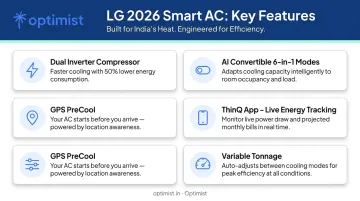
LG is the most tech-forward of the established brands in this comparison. Its 2026 lineup is built around the Dual Inverter Compressor and the ThinQ smart ecosystem, making it the go-to option for buyers who want their AC integrated into a broader smart home setup.
What sets it apart:
- Dual Inverter Compressor for faster cooling and lower steady-state power draw
- AI Convertible 6-in-1 cooling modes with sensor-based optimisation
- PreCool via GPS — the AC switches on automatically as you approach home
- ThinQ app for remote monitoring and real-time energy tracking
- Variable Tonnage adjusts cooling capacity dynamically to demand
The 2026 catalogue models (AS-Q20JWZE and variants) are verified 1.5-Ton, 5-Star splits with ISEER 5.2.
| Feature | Detail |
|---|---|
| Energy Efficiency | ISEER 5.2 (verified, 2026 1.5T 5-Star models) |
| Key Features | Dual Inverter, AI 6-in-1 modes, GPS PreCool, ThinQ app, Variable Tonnage |
| Price Range (1.5T, 5-Star) | Not confirmed from primary source — check LG.com/in for current pricing |
| Warranty | 10 years compressor; 5 years PCB and motor |
GPS-triggered cooling, live energy monitoring, and AI-driven optimisation come standard — LG offers more smart features per rupee than any other established brand here.
Samsung
Samsung doubled its room AC sales in Q1 2025 and claimed 10% market share in the March quarter, driven largely by the BESPOKE AI WindFree series. The brand's pitch: premium design, smart connectivity, and a cooling experience without cold-air blasts.
What sets it apart:
- WindFree Technology — 23,000 micro air holes across the front panel disperse cooled air gently, eliminating drafts
- AI Auto Cooling learns room usage patterns and adjusts automatically
- Digital Inverter compressor
- SmartThings app integration for voice and remote control
- Convertible 5-in-1 cooling modes
Note: A verified primary-source ISEER for the 1.5-Ton 5-Star BESPOKE WindFree configuration was not confirmed during research. Samsung's 2026 AC range starts at ₹32,490, but this is not the price for a 5-Star WindFree model specifically.
| Feature | Detail |
|---|---|
| Energy Efficiency | 5-Star available; exact ISEER for 1.5T 5-Star WindFree unconfirmed |
| Key Features | WindFree Technology (23,000 holes), AI Auto Cooling, SmartThings, 5-in-1 modes |
| Price Range (1.5T, 5-Star) | Exact price for this configuration unconfirmed — check Samsung.com/in |
| Warranty | 5 years comprehensive on key components; 10 years AI Inverter Compressor (2026 launch terms) |
Urban buyers who prioritise design and smart home integration will find Samsung's WindFree comfort and SmartThings ecosystem hard to match at this price tier.
Blue Star
Founded in 1943, Blue Star is India's oldest domestic AC brand, and its commercial-grade heritage shows in how it builds residential units. Durability is the defining characteristic — engineering drawn from decades of commercial installation experience.
What sets it apart:
- Turbo Cool for rapid temperature pull-down
- Copper condenser coils
- Rated for cooling to 54°C ambient (verified for IA518DXU)
- 2026 lineup covers 125 RAC models, with nearly 50 WiFi-enabled units featuring AI adaptive cooling, custom sleep modes, and voice control
The IA518DXU (1.5T, 5-Star, 2026 BEE label) is verified at ISEER 5.70, official sale price ₹47,990 against an MRP of ₹74,000 — the strongest like-for-like primary evidence in this comparison.
| Feature | Detail |
|---|---|
| Energy Efficiency | ISEER 5.70 (verified, IA518DXU 1.5T 5-Star 2026) |
| Key Features | Turbo Cool, copper coils, self-clean, WiFi smart control, 5-in-1 modes, 54°C ambient rating |
| Price Range (1.5T, 5-Star) | ₹47,990 official sale price (IA518DXU, July 2026) |
| Warranty | 1 year standard; 5 years total on inverter PCB; 10 years compressor |
Proven commercial-grade build at ₹47,990 puts Blue Star squarely between Daikin's quality and Voltas's price — a compelling position for buyers who won't compromise on durability.
Optimist
Optimist is India's newest climate-tech AC brand, founded in August 2024, with 18 months of R&D at the Nalanda 1 lab in Gurugram, and launched in January 2026. The founding premise was precise: most ACs fail to deliver full cooling during India's worst summer days. Optimist was engineered from first principles to fix that.
The company was built by Ashish Goel (co-founder of Urban Ladder, five-time Fortune 40 Under 40), Pranav Chopra (Co-founder and CTO), and Manjunath Rao (Chief Innovation Officer), with IIT Delhi's Prof. Anurag Goyal as Technical Advisor. USD 12M in funding from Accel, Arkam Ventures, and Sparrow Capital followed in December 2025.
What sets it apart:
- ISEER 6.05 — India's highest certified ISEER rating, on both the 1.4T and 1.5T models
- Full-rated cooling at 50°C ambient, no derating — tested in Delhi NCR heatwave conditions. Most competing ACs lose 20–30% capacity above 45°C; Optimist delivers its complete 4.85 kW output even at 50°C
- Microchannel heat exchanger with 1,180 flow paths for faster heat rejection at extreme ambient temperatures
- Turbo+ Mode — a 135% capacity boost that delivers effective 1.9-Ton cooling from the 1.4T unit, useful for rapid pull-down in extreme afternoon heat
- India's first built-in gas level indicator — a real-time sensor in the app that shows refrigerant level, eliminating the gas top-up scam that costs Indian consumers ₹2,500–₹7,000 per unnecessary refill
- 1,000-hour salt spray corrosion test (ASTM B368, certified by SIGMA Test & Research Centre) — 15x the typical 72-hour market standard, making it relevant for coastal markets like Mumbai, Chennai, and Kochi
- 5-year all-inclusive warranty on ODU components (parts + labour + gas at ₹0), 10-year compressor coverage, 5-year critical indoor component coverage including PCB, sensors, fan motor, and evaporator coil
The BEE-certified annual energy consumption is 620.2 kWh, versus 850–920 kWh for typical 5-star competitors. At ₹5.50/unit tariff, that's approximately ₹1,264–₹1,649 in annual savings — 25–35% lower electricity bills compared to a standard 5-star inverter AC.
| Feature | Detail |
|---|---|
| Energy Efficiency | ISEER 6.05 (India's highest); BEE 5-Star+; 620.2 kWh/year (1.4T model) |
| Key Features | 50°C no-derate cooling, first gas level indicator, Turbo+ Mode, microchannel heat exchanger, live energy tracking, smart diagnostics |
| Price (1.4T model) | ₹39,990 (direct-to-consumer at optimist.in, 38% off MRP of ₹65,000) |
| Warranty | 5-year comprehensive ODU (parts + labour + gas, ₹0); 10-year compressor; 5-year critical indoor components |
For buyers in Delhi NCR, Rajasthan, Punjab, or anywhere that regularly crosses 45°C, Optimist's no-derate engineering matters more than a higher star rating on paper. The 30-day no-questions-asked return policy (for direct optimist.in purchases) adds purchase confidence for a newer brand.
How We Chose These AC Brands
This comparison is built on performance criteria, not popularity. The most common buying mistake is selecting by brand recognition alone — ISEER scores, ambient temperature tolerance, and warranty comprehensiveness are what determine actual comfort and running cost over 8–10 years.
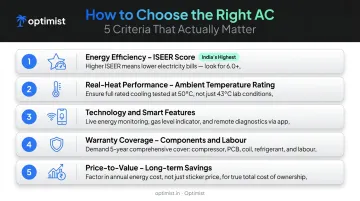
The five criteria used:
- Energy Efficiency — ISEER score and BEE star rating — a 5-star label can mean anything from ISEER 4.5 to 6.05, so the number matters
- Real-Heat Performance — The ambient temperature range the AC is officially rated for, and whether it maintains full capacity at that limit
- Technology and Smart Features — App connectivity, diagnostics, cooling mode flexibility
- Warranty Coverage — Not just the headline year count, but what components are covered and whether labour and gas are included
- Price-to-Value — Upfront cost relative to long-term electricity savings and reliability
Market share and sales volume were considered as indicators of service infrastructure maturity — but not as the primary filter. A brand with 18% market share but an unconfirmed ISEER is less useful to a buyer than a newer brand with a verified 6.05.
Conclusion
There is no universally "best" AC brand for 2026 — but there is a best AC for your specific situation.
Quick summary:
- Daikin — Best for premium compressor reliability and quiet operation
- Voltas — Best for service network reach and value in Tier 2/3 cities
- LG — Best for smart features and ThinQ ecosystem integration
- Samsung — Best for design and draft-free WindFree cooling
- Blue Star — Best for commercial-grade durability at a mid-tier price
- Optimist — Best for energy efficiency (ISEER 6.05) and verified extreme-heat performance
Before finalising any purchase, run through these three checks:
- Check the actual ISEER score on the BEE label (don't rely on marketing claims)
- Verify the ambient temperature rating against your city's peak summer temperatures
- Read what the warranty actually covers — parts, labour, and refrigerant gas are not always included
If keeping electricity bills low and maintaining full cooling through India's worst heat are what you're buying for, Optimist's ISEER 6.05 platform, tested at 50°C with no performance drop and developed with IIT Delhi, is worth putting directly alongside the established names. Visit optimist.in to see the 2026 specs and get a personalised monthly bill estimate.
Frequently Asked Questions
Which 1.5 ton AC is best in 2026?
For energy efficiency, look for an ISEER of 5.5 or higher, inverter technology, and an ambient rating above 45°C. Blue Star IA518DXU (ISEER 5.70, ₹47,990) and Daikin FTKM series are strong verified options. Optimist's 1.5T equivalent holds India's highest ISEER at 6.05 at ₹39,990 direct.
Which is the best AC brand in India in 2026?
No single brand wins across all categories. Daikin leads on compressor reliability, Voltas on service network and value, LG on smart features, Blue Star on build quality, and Optimist on energy efficiency and extreme-heat performance. The right choice depends on your city's peak temperature, usage hours, and budget.
What is ISEER and why does it matter for Indian buyers?
ISEER (Indian Seasonal Energy Efficiency Ratio) measures AC efficiency under real Indian seasonal conditions: the higher the rating, the lower your electricity bills. Most 5-star inverter models score ISEER 4.5–5.7. India's highest-rated AC in 2026, Optimist, is certified at 6.05 — roughly 25–35% lower bills versus a standard 5-star model.
Which AC performs best in extreme heat above 45°C?
Most ACs derate — losing 20–30% cooling capacity — above 43–45°C ambient. Daikin's FTKM series is rated for operation up to 55°C. Optimist is tested to deliver full rated cooling capacity (no derating) at 50°C ambient, making both relevant for Delhi, Rajasthan, or Vidarbha where peak temperatures regularly exceed 45°C.
What is the difference between a 3-star and 5-star AC in monthly electricity cost?
A 5-star inverter AC typically consumes 30–40% less electricity annually than a comparable 3-star model. The higher upfront cost is recovered within 2–4 years through bill savings (often closer to 2 years in high-usage markets like Delhi NCR), depending on your usage hours and state tariff.
How do I choose the right AC tonnage for my room?
As a rough guide: up to 100 sq ft needs 1 ton, 100–150 sq ft needs 1–1.5 ton, and 150–200 sq ft needs 1.5–2 ton. Add half a ton if your ceiling exceeds 10 feet, the room faces west, or you have multiple regular occupants.