
Introduction
Every summer, millions of Indian households run their 1.5 ton AC for 8 or more hours daily — and then get genuinely surprised when the electricity bill arrives. The number feels arbitrary. Was it the AC? The number of days? The heat wave in May?
Electricity consumption for a 1.5 ton AC is not a fixed figure. It shifts based on:
- Star rating and ISEER score
- Inverter vs. non-inverter technology
- Outdoor temperature during operation
- Room size, insulation, and heat load
- Thermostat setting
Without understanding these variables, any estimate — from a dealer, a neighbour, or a product brochure — is essentially a guess.
This article breaks down the actual consumption range (in units per hour and kW), explains what drives that number up or down, walks through a real monthly bill calculation, and clears up the most common misconceptions that lead buyers to wrong decisions.
Key Takeaways
- A 1.5 ton AC consumes approximately 1.0 to 1.8 units (kWh) per hour, depending on star rating and technology
- The "1.5 ton" rating describes cooling capacity — not wattage; actual power draw is a separate figure
- A 5-star inverter AC uses noticeably less power than a 3-star fixed-speed model of the same capacity
- Temperature, insulation, and thermostat setting all push real-world consumption beyond what the BEE label shows
- Running an inverter AC for 8 continuous hours is safe — and usually more efficient than cycling it on and off
What "1.5 Ton" Actually Means for Power Draw
This is where most confusion starts. The "1.5 ton" label does not describe electrical load — it describes cooling capacity.
ASHRAE defines one refrigeration ton as 12,000 BTU/hr of heat removal, approximately 3,517 watts of thermal energy. Scale that to 1.5 tons and you get 18,000 BTU/hr, or roughly 5.28 kW of heat removed from the room. That is what the compressor is doing thermally — not what it draws from the socket.
Actual electrical power draw depends on how efficiently the unit achieves that heat removal. This efficiency is captured in the ISEER score (Indian Seasonal Energy Efficiency Ratio), defined by BEE as:
ISEER = Cooling Seasonal Total Load ÷ Cooling Seasonal Energy Consumption
A higher ISEER means more cooling per unit of electricity consumed. Two 1.5 ton ACs can carry very different ISEER scores — and therefore draw very different amounts of power to deliver the same cooling.
Three things to remember when estimating your actual power draw:
- Ignore tonnage — it tells you cooling output, not electricity use
- Check the ISEER score — higher means lower running costs
- Find the Rated Input Power (in kW or W) on the BEE energy label of your specific model — that is the only number that matters for bill calculations
What Determines How Much Power Your 1.5 Ton AC Actually Uses
Star Rating and ISEER Score
The BEE star rating is the single biggest determinant of efficiency. According to BEE's official split-AC rating table, ISEER ranges for standard star bands are:
| Star Rating | ISEER Range |
|---|---|
| 2-Star | 3.50 – 3.79 |
| 3-Star | 3.80 – 4.39 |
| 4-Star | 4.40 – 4.99 |
| 5-Star | 5.00 and above |
A higher ISEER directly translates to fewer units consumed per hour of operation. Within 5-star models, ISEER scores vary considerably — a model rated 5.05 and one rated 6.05 both carry five stars, but their consumption differs by a noticeable margin.
Inverter vs. Fixed-Speed Compressor
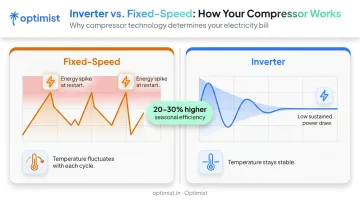
A fixed-speed compressor runs at full rated power until the room reaches the set temperature, then shuts off completely. This binary cycling is energy-intensive — every restart pulls high current, and the room temperature swings above and below the setpoint repeatedly.
An inverter compressor modulates its speed continuously. It ramps up hard during initial cool-down, then throttles to a lower sustained speed once the room stabilises. The result is less wasted energy during steady state. A 2025 peer-reviewed assessment of India's room AC market found that inverter technology delivers 20–30% higher seasonal efficiency than fixed-speed equivalents. That gap adds up fast when you're running the AC daily through a four-month summer.
Outdoor Temperature
BEE star ratings are tested at a 35°C outdoor dry-bulb temperature. Indian summers regularly hit 42–48°C in cities like Delhi, Nagpur, and Ahmedabad. At higher outdoor temperatures, the compressor works harder to reject heat — which increases power draw beyond what the label suggests.
BEE's seasonal calculation does extend to 43°C through its temperature-bin methodology, but the magnitude of increase is model-specific. During peak summer, expect actual consumption to run higher than what the energy label shows.
Room Characteristics
The same AC in two different rooms can show noticeably different monthly bills. Key factors:
- Room size relative to AC capacity
- Ceiling height
- West-facing glass windows with direct afternoon sun
- Quality of door and window sealing
- Whether it's a ground floor or top-floor flat
A 150 sq. ft. well-insulated bedroom will result in far less compressor run time than a 180 sq. ft. top-floor room with poor insulation and large west-facing windows.
Thermostat Setting and Maintenance
Beyond the room itself, how you use the AC matters just as much. BEE's guidance states that raising your set temperature by 1°C saves an estimated 6% on electricity consumption, with 24°C recommended as an energy-conscious setting. Running at 18°C versus 24°C is a six-degree gap — the compressor works significantly harder to maintain the lower target.
Dirty filters reduce heat transfer efficiency, forcing longer run cycles. Low refrigerant has the same effect. Regular maintenance directly protects your electricity bills, not just comfort.
Electricity Consumption by Star Rating and AC Type
The figures below reflect typical ranges under standard operating conditions (35°C outdoor temperature, moderate room load). Real-world numbers vary based on the factors above.
| AC Type | Approx. Rated Input (kW) | Units per Hour (kWh) | Monthly Units (8 hrs/day, 30 days) |
|---|---|---|---|
| 5-Star Inverter | 1.0 – 1.3 | 1.0 – 1.3 | 240 – 312 |
| 4-Star Inverter | 1.2 – 1.4 | 1.2 – 1.4 | 288 – 336 |
| 3-Star Inverter | 1.5 – 1.7 | 1.5 – 1.7 | 360 – 408 |
| 3-Star Fixed Speed | 1.6 – 1.8 | 1.6 – 1.8 | 384 – 432 |
| 2-Star Fixed Speed | 1.7 – 1.9 | 1.7 – 1.9 | 408 – 456 |
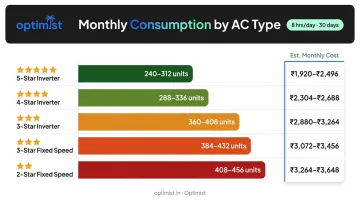
Note: For inverter ACs, rated input represents peak draw. Actual average draw during steady state is lower — see the calculation section below.
To illustrate the real savings gap, consider monthly cost at ₹8/unit:
- 5-star inverter (1.3 kW rated, 8 hrs/day): ~₹2,496/month
- 2-star fixed-speed (1.8 kW rated, 8 hrs/day): ~₹3,456/month
That's roughly ₹960/month difference — nearly ₹4,000 over a five-month summer. The higher upfront cost of a premium 5-star unit typically pays back within two to three seasons.
ISEER Range Within 5-Star Models
Not all 5-star ACs are equal. To qualify, a model needs ISEER 5.00 or above — but the band extends well beyond that floor. For example, Blue Star's IC518SNUR carries ISEER 5.05 and a rated input of 1,300W. At the top of the range, Optimist's 1.4 Ton 5 Star+ inverter AC — engineered as a 1.5 Ton alternative — carries India's highest ISEER rating of 6.05 and includes real-time energy tracking via its app, showing actual consumption rather than relying on label estimates.
A Note on Derating
Some fixed-speed and even certain inverter ACs reduce their effective cooling output when outdoor temperatures exceed 43–45°C. This is called derating — the AC continues drawing power, but delivers less cooling per unit consumed. For buyers in Delhi, Rajasthan, or Vidarbha where 45°C+ days are not unusual, checking whether a specific model derates at high temperatures is a practical step before purchase.
How to Calculate Your Monthly Electricity Bill
The Basic Formula
Monthly Units = Rated Input Power (kW) × Daily Hours × 30
Monthly Cost = Monthly Units × Electricity Rate (₹/unit)
Use the Rated Input Power from the BEE label — not tonnage, not a guessed figure.
Worked Example
5-star inverter, 1.3 kW rated input, 8 hrs/day, ₹8/unit:
- Daily units: 1.3 × 8 = 10.4 kWh
- Monthly units: 10.4 × 30 = 312 kWh
- Monthly cost: 312 × 8 = ₹2,496
3-star fixed-speed, 1.7 kW rated input, same conditions:
- Daily units: 1.7 × 8 = 13.6 kWh
- Monthly units: 13.6 × 30 = 408 kWh
- Monthly cost: 408 × 8 = ₹3,264
Why This Formula Overestimates for Inverter ACs
The formula above uses rated power as a constant — but inverter compressors don't run at rated power continuously. Once the room stabilises, the compressor throttles down to a fraction of its rated draw. Applying a usage factor of 0.7–0.8 to rated power gives a more realistic basis:
- 1.3 kW × 0.75 = ~0.975 kW effective average
- Monthly units: 0.975 × 8 × 30 = ~234 kWh
- Monthly cost: ~₹1,872
This aligns with what real users of high-ISEER inverter ACs typically see on their bills. That corrected figure, however, still assumes a flat rate per unit — which is rarely how Indian electricity billing works.
Electricity Tariff Slabs Matter
India uses progressive slab pricing: the more units you consume, the higher the rate on each marginal unit. Your AC's contribution to the bill depends not just on how many units it adds, but on which slab those units fall into.
In Delhi (Tata Power-DDL), for example:
| Consumption Slab | Rate per Unit |
|---|---|
| 0–200 units | ₹3.00 |
| 201–400 units | ₹4.50 |
| 401–1,200 units | ₹6.50 |
| Above 1,200 units | ₹8.00 |
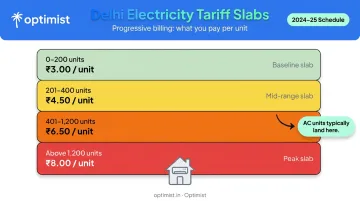
If your household already consumes 350 units before switching the AC on, every unit your AC adds lands in the ₹6.50+ slab — not ₹3. Check your state electricity board's current tariff schedule before estimating summer costs.
Common Misunderstandings About 1.5 Ton AC Power Consumption
"1.5 Ton AC Means 1,500 Watts"
False. As covered above, "1.5 ton" describes thermal cooling capacity — approximately 5.28 kW of heat removal — not electrical load. A 5-star inverter 1.5 ton AC may draw only 1,050–1,300W at rated conditions. A 2-star fixed-speed model of the same tonnage can draw 1,700–1,900W. Same cooling capacity. Very different power draw.
"My BEE Label Tells Me Exactly What My Bill Will Be"
BEE ratings are established at controlled test conditions — 35°C outdoor, specific humidity. Indian peak summer conditions regularly exceed this, pushing real consumption higher. Add an oversized room, poor sealing, or a clogged filter, and actual consumption drifts further from what the label says.
The BEE AEC figure is a reliable comparison tool between models — not a household bill forecast.
"Running the AC All Night Wastes Electricity"
With inverter ACs, the opposite is true. Every time you switch off and restart, the compressor goes through a high-draw start-up cycle. Do that four or five times overnight, and those bursts add up fast.
Running an inverter AC continuously at 26°C with sleep mode enabled avoids this entirely:
- Compressor settles into a low-speed steady state
- Power draw drops to a fraction of peak wattage
- Total overnight consumption stays lower than repeated restart cycles
Leaving it on is often the more efficient choice.
Frequently Asked Questions
How much electricity does a 1.5 ton AC consume per hour?
A 1.5 ton AC typically consumes 1.0 to 1.8 units (kWh) per hour depending on star rating and technology. At ₹8/unit, that translates to roughly ₹8 to ₹14 per hour. A 5-star inverter model stays toward the lower end of this range.
What power (kW) does a 1.5 ton AC need to run?
Rated input power ranges from approximately 1.0–1.3 kW for 5-star inverter models to 1.7–1.9 kW for 2-star fixed-speed models. This figure is printed on the BEE energy label and is the correct starting point for bill estimates — not the tonnage.
Can a 1.5 ton AC run continuously for 8 hours?
Yes. Continuous 8-hour operation is normal and safe for a well-maintained unit. Inverter ACs are designed for extended runtimes and actually become more efficient after the room stabilises, drawing less power during steady state than at initial start-up.
What is the monthly electricity bill for a 1.5 ton AC running 8 hours a day?
A 5-star inverter model typically costs ₹1,800–₹2,500 per month at ₹8/unit. A 3-star fixed-speed model under the same pattern runs ₹2,800–₹3,500, a gap that widens further during peak summer.
Does outdoor temperature affect how much electricity my AC uses?
Yes. Higher outdoor temperatures force the compressor to work harder to reject heat. In Indian peak summer conditions above 42°C, real-world consumption can be 15–20% higher than BEE label estimates, which are tested at 35°C outdoor conditions.
Which star rating offers the best savings on a 1.5 ton AC?
5-star inverter ACs deliver the best long-term savings for anyone running their AC 6+ hours daily. The higher upfront cost is typically recovered within 2–3 summer seasons. At the top end, ACs rated ISEER 6.05 — like Optimist's 1.4 Ton 5 Star+ — represent what peak efficiency looks like in practice, compared to the 3-star or fixed-speed alternatives most buyers settle for.