
Here's the problem: not all inverter ACs deliver equal savings. Many models are rated under standard lab conditions that don't reflect Indian peak-summer reality. When temperatures cross 45°C, several ACs reduce their cooling output (derating), forcing the compressor to work harder and consume more electricity than the star label suggests.
This guide covers the 6 best inverter ACs for low power consumption in India in 2026, evaluated on ISEER rating, real-heat performance, smart features, and overall value.
Key Takeaways
- Higher ISEER = lower electricity bills — this single number determines your actual running cost, not the star sticker.
- Many ACs derate above 43–45°C, consuming more power exactly when you need cooling most.
- Optimist holds India's highest ISEER rating of 6.05, the benchmark for this guide.
- Panasonic (ISEER 5.80) and Daikin (ISEER 5.70) lead the 1.5-ton segment among major brands.
- BEE revised thresholds in 2026 — check the product label's ISEER value, not just the star count.
What Makes an Inverter AC Truly Energy Efficient?
How Inverter Technology Saves Power
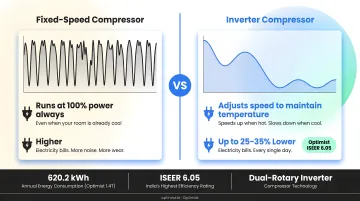
A conventional AC compressor runs at fixed speed — it switches fully on when the room heats up and fully off when it cools down. Every startup draws a surge of power. An inverter compressor avoids this entirely by adjusting speed continuously, matching cooling output to the room's actual heat load.
The difference comes down to how each type handles partial load:
- Fixed-speed compressor: cycles on/off repeatedly, drawing peak power at every restart
- Inverter compressor: runs continuously at reduced speed, consuming only the power needed
For Indian homes where ACs run 8–12 hours daily, this part-load efficiency is where real savings accumulate. The compressor rarely runs at maximum capacity after the initial cool-down, which is exactly where inverter technology outperforms fixed-speed units.
Understanding ISEER
ISEER (Indian Seasonal Energy Efficiency Ratio) is the efficiency standard set by BEE (Bureau of Energy Efficiency) specifically for Indian climate conditions. The formula is straightforward:
ISEER = Total Seasonal Cooling Output ÷ Total Seasonal Electrical Energy Consumed
A higher ISEER means fewer units of electricity consumed per hour of cooling. The BEE Star Label portal shows model-specific annual energy consumption figures — these are the numbers worth comparing, not generic star counts.
BEE revised its thresholds under Amendment V (S.O. 3984(E), effective 1 January 2026), tightening the rating bands — a model that qualified as 5-star under 2025 norms may now sit at 4-star. Always verify the current label before buying.
The Derating Problem Most Buyers Miss
ISEER ratings are measured under controlled lab conditions. Indian peak summers regularly push outdoor temperatures past 45°C — and at those temperatures, many ACs reduce their rated cooling capacity.
When an AC derates, the compressor works harder and longer to achieve the same cooling effect, consuming more power than the label suggests. Three things to check before buying:
- Whether the model is tested at outdoor temperatures above 43°C
- Whether cooling capacity holds at peak load (not just at lab conditions)
- Whether the manufacturer publishes performance data at 50°C, not just at standard test points
This efficiency gap doesn't appear on any star label. An AC verified for sustained performance at 50°C is the only way to ensure the rated efficiency holds through a Delhi or Rajasthan summer.
Best Inverter ACs with Low Power Consumption in India in 2026
These six models were selected based on ISEER rating, verified cooling performance at high ambient temperatures, smart features, corrosion protection, and brand service reliability.
Optimist
Optimist is an Indian climate tech company founded specifically to engineer air conditioning for extreme Indian heat. Backed by USD 12M from Accel, Arkam Ventures, and Sparrow Capital, it launched India's first AC purpose-built for 50°C performance, holding the country's highest ISEER rating of 6.05 with 5-star BEE certification.
The combination of ISEER 6.05 with verified no-derating performance at 50°C is what distinguishes it from every other model on this list. Its microchannel heat exchanger delivers 4X faster heat transfer, and Turbo+ Mode pushes to 135% cooling capacity (effectively 1.9 tons of cooling from a 1.4-ton unit) for rapid cool-down in extreme heat.
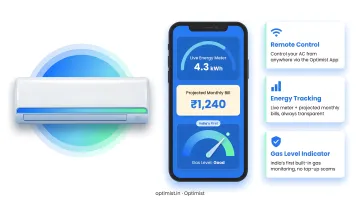
The first-ever gas level indicator, real-time app energy tracking, and projected monthly bill display make it the most transparent AC for monitoring actual consumption.
| Spec Category | Details |
|---|---|
| Capacity | 1.4 Ton |
| ISEER | 6.05 (India's highest) |
| Star Rating | 5 Star |
| Estimated Bill Savings | 25–35% lower electricity bills |
| Turbo+ Mode | 135% capacity (1.9 tons equivalent) |
| Corrosion Testing | 1000 hours (15× market standard, ASTM B368) |
| Warranty | 5-year all-inclusive + 10-year compressor |
| Standout Feature | First-ever gas level indicator; real-time app energy tracking |
Panasonic CS/CU-NU18BKY5WX
Panasonic's flagship 1.5-ton 5-star inverter split AC carries an ISEER of 5.80 with annual energy consumption of 681.01 kWh, verified from Panasonic India's official product page. It operates at ambient temperatures up to 55°C.
Its 8-in-1 convertible modes (40% to high-capacity) allow the compressor to match cooling output to actual room load, contributing to real-world savings beyond the ISEER figure. India's first Matter-enabled room AC through the MirAIe platform, a PM 0.1 ultra-fine air purification filter, and DustBuster auto-cleaning technology for the outdoor unit add practical value for buyers prioritising air quality and low-maintenance operation.
| Spec Category | Details |
|---|---|
| Capacity | 1.5 Ton |
| ISEER | 5.80 |
| Annual Energy Consumption | 681.01 kWh/year |
| Max Ambient | 55°C |
| Convertible Modes | 8-in-1 (40% to HC) |
| Smart Features | Matter-enabled (MirAIe), Wi-Fi control |
| Standout Feature | PM 0.1 filter; ShieldBlu+ corrosion coating indoor + outdoor |
LG AS-Q19YNZE1
LG's 2026 dual inverter model for the 1.5-ton 5-star segment features a dual-rotor compressor that reduces energy loss through dual-rotation mechanics. Verified from LG India's official product page, it supports 6-in-1 AI+ convertible modes and VIRAAT Mode at 124% capacity for extreme heat days.
Maximum ambient is confirmed at 55°C, with rated cooling at 5000 W and maximum cooling at 5800 W. The exact ISEER and annual kWh were not stated on the verified official page: confirm from the product's BEE star label before purchasing. Ocean Black Protection plus Gold Fin+ on condenser coils ensures durability in coastal and high-humidity regions.
| Spec Category | Details |
|---|---|
| Capacity | 1.5 Ton |
| ISEER | Verify from BEE label |
| Rated / Max Cooling | 5000 W / 5800 W |
| Max Ambient | 55°C |
| Convertible Modes | 6-in-1 AI+ |
| VIRAAT Mode | 124% capacity |
| Standout Feature | Ocean Black Protection + Gold Fin+; Diet Mode Plus; ~31 dB indoor noise |
Daikin MTKM50XV16
Daikin's premium 1.5-ton 5-star inverter split AC is verified from Daikin India's official page with an ISEER of 5.70, annual energy consumption of 678.92 kWh/year, rated cooling of 5.00 kW, and an operating range of 10°C–55°C.
Its triple LED display showing real-time power consumption, set temperature, and error codes is a practical differentiator for energy-conscious users: at any moment, you can see exactly how many watts the unit is drawing. Econo Mode limits input power for use during periods of limited electricity supply, while the self-healing transparent anti-corrosive evaporator coating adds durability in humid conditions.
| Spec Category | Details |
|---|---|
| Capacity | 1.5 Ton |
| ISEER | 5.70 |
| Annual Energy Consumption | 678.92 kWh/year |
| Operating Range | 10°C–55°C |
| Energy Feature | Econo Mode; real-time power display |
| Standout Feature | Triple LED display; Power Chill Operation; 3D airflow with 4-way auto swing |
Lloyd GLS18I5KWGGW
Lloyd, supported by Havells' pan-India service network, is a strong mid-range option particularly for buyers in tier-2 and tier-3 cities. The GLS18I5KWGGW is a 1.5-ton 5-star inverter split AC with 5-in-1 convertible cooling that reaches up to 110% capacity for peak summer performance.
Note: Exact ISEER value and annual kWh for this specific model were not confirmed from Lloyd's official product page during research. Verify both figures from the product's BEE star label before purchasing. Blue Fin evaporator coating provides corrosion resistance in humid conditions.
| Spec Category | Details |
|---|---|
| Capacity | 1.5 Ton |
| ISEER | Verify from BEE label |
| Star Rating | 5 Star |
| Convertible Modes | 5-in-1 including 110% mode |
| Corrosion Protection | Blue Fin evaporator coating |
| Standout Feature | Havells service network; hidden LED display; stabiliser-free operation |
Voltas 185V Vectra CAR
Voltas operates India's widest AC service network, extending into rural and tier-3 coverage that no other brand matches. The 185V Vectra CAR is a 1.5-ton 5-star inverter split AC positioned as the most accessible entry point for energy-efficient cooling.
Note: Exact ISEER and annual kWh for the Vectra CAR model specifically were not confirmed from Voltas' official pages during research — verify from the product's BEE star label. While its efficiency rating sits below premium models on this list, the Voltas service network remains a genuine advantage for buyers outside major metros.
| Spec Category | Details |
|---|---|
| Capacity | 1.5 Ton |
| ISEER | Verify from BEE label |
| Star Rating | 5 Star |
| Convertible Modes | 4-in-1 adjustable |
| Humidity Feature | Super Dry Mode |
| Standout Feature | India's widest service network; anti-microbial filter; memory restart; 5-year product warranty |
How to Choose the Right Energy-Efficient Inverter AC
The Evaluation Framework
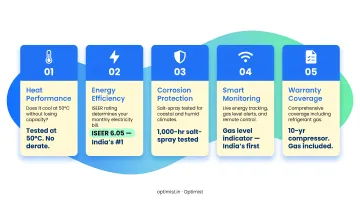
When shortlisting models, these factors determine real-world savings over a 5–10 year ownership period:
- ISEER value — minimum 5-star BEE certification, but check the actual ISEER number. The gap between ISEER 4.8 and 6.05 translates directly into annual electricity cost differences, especially at 8+ hours of daily use.
- Full cooling above 45°C — check whether the AC maintains rated capacity in high-ambient conditions, or derates when temperatures climb.
- Convertible modes — allow the compressor to run at lower capacity during mild weather, saving power on moderate days.
- Corrosion protection — degraded coils reduce heat transfer efficiency over time, gradually increasing power consumption year after year.
- Smart energy monitoring — scheduled operation and usage tracking help users actively manage consumption habits.
BEE Star Ratings vs. ISEER Values
Star ratings and ISEER values are related but not interchangeable. BEE revises its star band thresholds periodically — under the 2026 revision (effective 1 January 2026), the thresholds tightened. Under 2026 norms, that same model may now fall into the 4-star band.
The only reliable approach: check the exact ISEER value directly from the BEE Star Label portal or the physical label on the product. Don't rely on the star count alone — a model with more stars isn't always more efficient than one with fewer stars but a higher ISEER.
That label reading matters more than most buyers realise. A May 2026 BEE-hosted survey of 4,321 households found ACs account for 11% of total household electricity use — the single largest controllable appliance cost in the home. Choosing based on ISEER rather than brand familiarity is the most direct way to reduce that share.
Conclusion
The ISEER value, performance above 45°C, and build durability are what actually separate a capable inverter AC from a costly one. Star ratings are a starting point, not a final answer.
For homeowners running their AC 8+ hours daily through an Indian summer, the gap between a mid-range ISEER and a high ISEER unit compounds into real money over the years. Calculate estimated annual savings using the kWh figures on each model's BEE label before deciding — the math usually justifies the premium.
Once you run those numbers, Optimist's ISEER 6.05 (India's highest) tends to stand out. With real-time energy tracking, transparent bill projections, and cooling verified at 50°C, it's built for conditions most ACs on the market weren't designed to handle.
Visit optimist.in to explore the product, or reach out at care@optimist.in for any questions.
Frequently Asked Questions
Which inverter AC has the lowest power consumption?
The Optimist AC holds India's highest ISEER rating of 6.05, making it the lowest power-consuming inverter AC currently available. Among established brands, Panasonic's CS/CU-NU18BKY5WX at ISEER 5.80 and Daikin's MTKM50XV16 at ISEER 5.70 are the next most efficient 1.5-ton options with verified official figures.
Which 5-star AC has the lowest power consumption?
Within the 5-star category, ACs with higher ISEER values consume less electricity annually. Optimist's ISEER 6.05 exceeds the standard 5-star threshold, followed by Panasonic at 5.80 and Daikin at 5.70 for verified 1.5-ton models. Always compare the actual ISEER value — two 5-star ACs can have very different efficiency ratings.
What is ISEER and how does it affect my electricity bill?
A higher ISEER directly means fewer units of electricity consumed per hour of cooling — which lowers your monthly bills, especially if you run the AC 8 or more hours daily. ISEER (Indian Seasonal Energy Efficiency Ratio) is the ratio of total seasonal cooling output to total electrical energy consumed across the Indian cooling season.
Is a higher ISEER inverter AC worth the extra upfront cost?
The additional cost of a high-ISEER AC is typically recovered through electricity savings within 2–4 years, depending on daily usage hours and local electricity tariffs. The longer you run the AC each day, the faster the payback.
Do inverter ACs maintain efficiency when temperatures cross 45°C?
Most inverter ACs derate — reducing rated cooling capacity — when outdoor temperatures exceed 43–45°C. When this happens, the compressor runs harder and longer, consuming more power than the ISEER label suggests. ACs specifically tested and verified for full-capacity performance at 50°C — like Optimist — avoid this efficiency drop at the exact moments it would matter most.
What is the ideal AC capacity for a 150 sq. ft room in India?
A 1.5-ton inverter AC is the standard recommendation for rooms between 110–170 sq. ft, with Panasonic's official guidance citing 120–170 sq. ft for their 1.5-ton model. Direct sunlight exposure, top-floor placement, above-standard ceiling height, and high occupancy can all push heat load up. In those cases, a model with a convertible mode exceeding 100% rated output provides the necessary headroom.