Introduction
Summer electricity bills have become one of the most dreaded envelopes in Indian households. With peak temperatures in cities like Delhi and Rajasthan regularly crossing 45°C — and parts of the country touching 50°C during severe heatwaves — air conditioners run longer and harder than ever. Yet most homeowners have no clear sense of what their AC actually costs to run until the bill arrives.
DC inverter AC electricity consumption is not a fixed number — it shifts constantly based on several factors:
- Star rating and ISEER score
- AC tonnage relative to room size
- Your thermostat setting
- Outdoor temperature
- How well your room retains cool air
A 1.5-ton 5-star inverter AC and a 1.5-ton 3-star inverter AC can produce bills that differ by thousands of rupees over a single summer — even though they look identical on the shelf.
This guide breaks down consumption ranges by capacity and star rating, the factors that drive your bill up or down, how to calculate what you'll actually pay, and what you can do to reduce it.
Key Takeaways
- A 1.5-ton DC inverter AC typically consumes 0.8–1.5 kWh per hour depending on star rating and operating conditions
- ISEER is the single most reliable indicator of real-world efficiency — check the number, not just the star count
- BEE tests at 35°C outdoor — but Indian summers regularly hit 42–50°C, so real consumption runs higher
- DC inverter ACs offer 20–30% higher seasonal efficiency than fixed-speed units, per a 2025 energy study
- Setting your thermostat to 24°C instead of 18°C can cut consumption by approximately 36%
How Much Electricity Does a DC Inverter AC Consume?
DC inverter AC electricity consumption does not have a single answer — and treating it as fixed is where most homeowners go wrong.
The "DC inverter" part matters here. Unlike a conventional (fixed-speed) compressor that switches fully on or fully off, a DC inverter compressor runs at variable speeds. It ramps up when your room needs rapid cooling, then throttles back to a low hum once the target temperature is reached.
This means power draw fluctuates continuously rather than staying constant — which is why two identical-looking ACs with different ISEER ratings can produce very different electricity bills.
Consumption by Tonnage and Star Rating
BEE star labels include an annual energy consumption figure in kWh/year, calculated over 1,600 seasonal cooling hours. Dividing by 1,600 gives average seasonal kWh per hour — the most reliable basis for comparison.
| Capacity | Star Rating | ISEER | Annual kWh (Label) | Avg. kWh/Hour |
|---|---|---|---|---|
| 1.5 ton | 5-star | 5.2 | ~786 kWh | ~0.49 kWh |
| 1.5 ton | 3-star | ~3.5–3.9 | ~1,050–1,200 kWh (est.) | ~0.65–0.75 kWh |
| 2 ton | 5-star | 5.05 | ~936 kWh | ~0.59 kWh |
| 2 ton | 3-star | 4.05 | ~1,312 kWh | ~0.82 kWh |
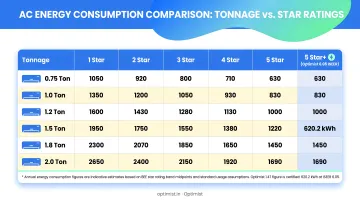
Source: Daikin FTKR 1.5T 5-star label, Blue Star 2T models. 3-star 1.5T estimate based on typical ISEER range — check the specific model's label for accuracy.
Important context: These figures come from BEE lab tests conducted at 35°C outdoor / 27°C indoor. Indian summers regularly hit 42–50°C outdoors. A 2022 review of residential ACs under high ambient temperatures found COP degradation of approximately 54% across the 35–55°C range — meaning real-world consumption in extreme heat runs higher — sometimes significantly — than the label figure.
Those label gaps add up fast when you translate them into monthly costs.
Monthly Consumption Estimates
For a 1.5-ton DC inverter AC running 8 hours per day at moderate conditions:
| Star Rating | Avg. kWh/Hour | Daily kWh | Monthly kWh (30 days) |
|---|---|---|---|
| 5-star (ISEER 5.2) | 0.49 | ~3.9 kWh | ~118 kWh |
| 3-star (ISEER ~3.7) | 0.70 | ~5.6 kWh | ~168 kWh |
Assumptions: 8 hrs/day, thermostat at 24°C, moderate ambient conditions. Peak summer or lower thermostat settings will push these figures higher.
Key Factors That Affect DC Inverter AC Electricity Consumption
The gap between the rated figure on the label and what you actually pay depends on a combination of technical, environmental, and behavioural factors.
ISEER Rating and Star Label
India's ISEER (Indian Seasonal Energy Efficiency Ratio) measures how much cooling a unit delivers per unit of electricity consumed across a full season of varying temperatures. A higher ISEER means fewer units consumed for the same cooling output.
Using the 2-ton Blue Star example above: the 3-star model (ISEER 4.05) consumes ~1,312 kWh/year on the BEE seasonal basis, while the 5-star model (ISEER 5.05) consumes ~936 kWh/year — a difference of roughly 376 kWh per season. At ₹8–10 per unit, that's ₹3,000–₹3,750 saved every year on a single AC.
One important caveat: the 2026 BEE revision raised the ISEER thresholds for each star band. A 5-star label today requires meeting stricter standards than a 5-star label from three years ago. Always check the actual ISEER value on the label, not just the star count — two 5-star ACs can have meaningfully different ISEER values.
Ambient Temperature and Indian Summer Conditions
BEE test conditions use 35°C outdoor temperature. Indian cities routinely see 42–50°C in peak summer — IMD recorded Churu at 50.5°C and parts of Delhi near 50°C during the 2024 heatwave.
At higher outdoor temperatures, the compressor must work harder and run at higher speeds to maintain the same indoor temperature. This pushes actual consumption well above the label figure — a reality that catches many buyers off guard when their first summer bill arrives.
Thermostat Setting and Usage Habits
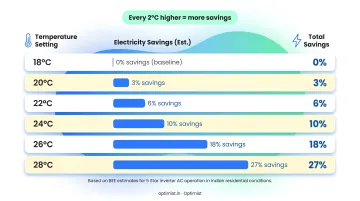
This is the most controllable factor. The Ministry of Power and BEE state that every 1°C increase in AC temperature setting saves approximately 6% electricity. That means:
- Running at 18°C vs. 24°C = roughly 36% more electricity consumed
- Running at 20°C vs. 24°C = roughly 24% more electricity consumed
BEE made 24°C the mandatory default setting for all room ACs covered under star labelling from January 1, 2020. It is the efficiency sweet spot — comfortable for most people and significantly cheaper to run than the 18–20°C settings many users default to.
Room Size, Insulation, and Heat Load
An undersized AC running continuously consumes more electricity than a correctly sized unit cycling normally. Common heat load problems in Indian homes include:
- West-facing walls absorbing afternoon sun
- Large glass windows with no curtains or blinds
- Top-floor or terrace-adjacent rooms
- Poor door and window sealing letting hot air in
All of these force the compressor to run at higher capacity more often. In a poorly insulated top-floor room, actual consumption can run 20–30% above the rated figure.
Maintenance: Filters, Coils, and Refrigerant
Dirty air filters restrict airflow and force the compressor to work harder. Dirty evaporator or condenser coils reduce heat transfer efficiency. Low refrigerant gas is especially damaging — it causes the compressor to run continuously at full load without ever reaching the target temperature.
Annual servicing — ideally before summer begins — keeps the AC at its rated efficiency. A pre-summer check should cover:
- Cleaning or replacing air filters
- Washing evaporator and condenser coils
- Checking refrigerant gas levels and top-up if needed
- Inspecting electrical connections and fan motors
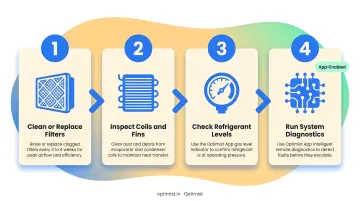
Optimist's app continuously monitors filter health and refrigerant gas levels, flagging maintenance needs before they start showing up on your electricity bill.
How to Calculate Your Monthly DC Inverter AC Electricity Bill
Step-by-Step Consumption Formula
The calculation has two parts: figuring out how many units your AC consumes, then applying your tariff.
Step 1 — Find your AC's average power draw: For inverter ACs, use the BEE label's annual kWh figure rather than the rated maximum input. The compressor modulates, so it rarely draws the rated maximum.
Formula: Average kWh/hour = Annual label kWh ÷ 1,600
If you cannot find the annual label figure, use 60–70% of the rated input wattage as a rough estimate for average use.
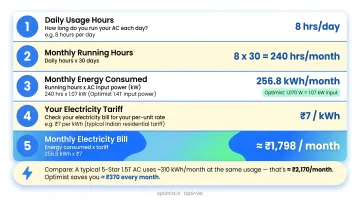
Step 2 — Calculate monthly consumption:
Daily kWh = Average kWh/hour × Hours used per day Monthly kWh = Daily kWh × 30
Worked example — 1.5-ton 5-star DC inverter AC (ISEER 5.2, label: 786 kWh/year):
- Average draw: 786 ÷ 1,600 = 0.49 kWh/hour
- Running 8 hrs/day: 0.49 × 8 = 3.9 kWh/day
- Monthly: 3.9 × 30 = ~118 kWh/month
- At ₹8/unit: ~₹944/month
Understanding India's Slab-Based Electricity Tariff
India's domestic electricity tariffs follow a slab system: the more you consume, the higher your per-unit rate. Bihar's FY 2025–26 urban domestic tariff is a useful reference point:
India's domestic electricity tariffs follow a slab system: the more you consume, the higher your per-unit rate. Bihar's FY 2025–26 urban domestic tariff is a useful reference point:
| Consumption | Rate per Unit |
|---|---|
| First 100 units | ₹7.42/kWh |
| Above 100 units | ₹8.95/kWh |
If your household normally consumes 90 units/month and your AC adds 118 units, you've moved entirely into the higher slab for that month. Every additional unit costs more than the ones before it, and the bill recalculates at the higher rate for all units above the threshold.
This is why summer bills can jump sharply for households who haven't checked where their consumption sits relative to their state's slab boundaries.
Using Your AC's App to Track Actual Consumption
Knowing your slab threshold helps — but tracking whether you're about to cross it is where the calculation becomes genuinely useful. Optimist's app tracks energy consumption in real time and displays a projected monthly bill based on actual usage to date, with no formulas needed. The dashboard shows kWh consumed, current bill amount, and a projected end-of-month figure. One recorded example: 82 kWh consumed mid-month, ₹986 billed so far, ₹1,100 projected. That kind of live visibility makes slab surprises avoidable.
DC Inverter AC vs Non-Inverter AC: Electricity Consumption Compared
A non-inverter (fixed-speed) compressor runs at full capacity and switches on and off repeatedly to maintain temperature. A DC inverter compressor modulates its speed continuously, settling at a low, efficient cruise once the room is cooled.
Consumption Comparison
For a 1.5-ton AC running 8 hours/day:
| Type | Est. kWh/Day | Monthly kWh | Monthly Bill (₹8/unit) |
|---|---|---|---|
| DC Inverter (5-star) | ~3.9 kWh | ~118 kWh | ~₹944 |
| Non-Inverter (3-star) | ~6.4 kWh | ~192 kWh | ~₹1,536 |
Non-inverter estimate based on rated input of ~1,800W running at full capacity 45% of the time (typical cycling). Actual savings vary by model.
A 2025 academic paper on India's AC market found that inverter technology delivers 20–30% higher seasonal efficiency than fixed-speed technology. CLASP research on variable-speed ACs indicates they can be up to 51% more efficient at part load compared to fixed-speed units.
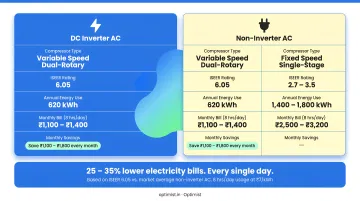
The efficiency advantage is most pronounced during moderate weather when the AC is doing partial-load work. In contrast, during extreme heat above 45°C when the compressor runs near maximum continuously, the gap narrows.
Long-Term Cost Savings
The payback calculation for a DC inverter AC over a non-inverter model is straightforward:
Payback months = Price premium ÷ Monthly bill savings
Using the example above: if a DC inverter AC costs ₹10,000 more upfront and saves ₹592/month in electricity, it pays for itself in ~17 months — well within the first two summers. Over a typical 10-year lifespan, that compounds into substantial savings — often ₹50,000–₹70,000 in total electricity costs avoided.
Tips to Reduce Your DC Inverter AC Electricity Consumption
Set the thermostat to 24°C. This is the BEE-recommended setting. Running at 18–20°C — the most common mistake — costs 24–36% more electricity for the same hours of use.
Choose the highest ISEER model your budget allows. ISEER is the definitive measure of seasonal efficiency, not the star count alone. A higher-rated AC (such as ISEER 6.05) maintains efficiency during Indian peak summer conditions, when many lower-rated units derate performance and consume more.
Service the unit every year. Clean filters, clean coils, and correct refrigerant charge restore the AC to its rated efficiency. Skipping annual maintenance is one of the most common reasons actual consumption exceeds the manufacturer's estimate.
Seal the room before running the AC. Close gaps under doors, draw curtains on sun-facing windows, and insulate the room where possible. Reducing heat ingress means the compressor reaches the target temperature faster and cycles down sooner.
What Most People Miss About DC Inverter AC Electricity Costs
Most buyers focus on the wrong numbers. Here's what actually drives your electricity costs:
- Purchase price vs. running cost: The AC's sticker price is a one-time payment. A model that costs ₹5,000 more upfront but saves ₹500/month pays for itself in 10 months — and saves ₹55,000 over ten years.
- Star rating vs. ISEER value: Not all 5-star ACs are equal. A model at ISEER 4.5 and one at ISEER 6.05 both carry 5-star labels, but their running costs are very different. Always check the actual ISEER number on the BEE label.
- Lab ratings vs. real Indian heat: Rated consumption is measured at 35°C outdoor temperature. At 45°C+, actual consumption climbs — buyers relying only on label figures will consistently underestimate their bills.
- Flat tariff vs. slab tariff: Running an AC more hours than planned can push a household into a higher tariff slab, making each additional unit disproportionately expensive. Most users only find this out after their first full-summer bill.
Frequently Asked Questions
How many units (kWh) does a 1.5-ton AC consume in 1 hour?
A 1.5-ton DC inverter AC typically consumes between 0.8 and 1.5 kWh per hour depending on the star rating, ambient temperature, and thermostat setting. A 5-star model at 24°C under moderate conditions averages closer to 0.49–0.6 kWh/hour based on BEE label data.
How much does it cost to run an AC for 1 hour?
Multiply your AC's hourly consumption by your tariff rate. At 0.49 kWh/hour and ₹8/unit, that's approximately ₹4 per hour. At 1.0 kWh/hour and ₹9/unit (higher slab), it's ₹9 per hour. Heavy users who cross a slab threshold pay more per unit for every additional hour.
Can I run a 1.5-ton AC on a home inverter (UPS)?
A 1.5-ton DC inverter AC draws a rated maximum of roughly 1,500–1,800W, so you need a home UPS with a continuous output of 2,000W or higher, plus a compatible battery bank. Because its variable-speed compressor often runs well below peak draw, a DC inverter model is more UPS-friendly than a fixed-speed AC.
How many air conditioners can a 3 kW inverter run?
A 3 kW home inverter can power one 1.5-ton AC (peak draw: ~1.5–1.8 kW), but adding other appliances simultaneously risks exceeding its continuous output. Always match the AC's rated maximum input against the inverter's continuous — not peak — output rating.
Is a DC inverter AC more energy-efficient than a regular inverter AC?
"DC inverter" refers specifically to the motor type: a DC brushless motor compared to the AC motor used in older variable-speed compressors. DC motors deliver better efficiency at low frequencies and quieter operation. Most modern high-star-rated ACs sold in India already use DC inverter technology — confirm this on the product specification sheet.
How can I check how much electricity my DC inverter AC is actually consuming?
Three practical methods: check the BEE label's annual energy consumption figure and use the formula above; use a plug-in energy meter or smart plug with power monitoring capability; or use the manufacturer's app if the AC has smart connectivity. Optimist's app, for example, tracks real-time kWh consumption and projects your monthly bill automatically.