Introduction
When you're running your AC for 8–10 hours a day through an Indian summer, the star rating on that label stops being a marketing detail and becomes a direct line to your electricity bill. A seemingly small difference in ISEER rating can translate to thousands of rupees saved — or wasted — every year. India's peak summer temperatures now regularly cross 45°C across large parts of the country, meaning your AC runs harder and longer than the lab conditions most star ratings are tested under.
Most buyers focus on the upfront price. That's understandable. But the real question is what you'll spend over the next 5–10 years. A 3-star AC that costs ₹3,000 less today could cost you ₹15,000 more in electricity over its lifetime if you're running it daily through Delhi or Rajasthan summers.
This guide breaks down the actual differences: energy consumption, bill calculations, performance in extreme heat, and the honest decision framework for your specific usage pattern.
Key Takeaways
- 5-star ACs consume roughly 20–28% less electricity than 3-star models of the same tonnage
- A 5-star AC's price premium of ₹5,000–₹10,000 is typically recovered within 1–4 years at 8 hours/day usage
- 3-star ACs make sense for 3–4 hours/day usage or short summer regions
- 5-star ACs are the better long-term choice for 6+ hours/day and high-heat states
- Check the ISEER number, not just the stars — BEE's ISEER standard is what actually determines efficiency
3-Star vs 5-Star AC: Quick Comparison
| Aspect | 3-Star AC | 5-Star AC |
|---|---|---|
| ISEER Range | 3.80 – 4.39 | 5.00 and above |
| Power Input (1.5T, full load) | ~1,600–1,700 W | ~1,200–1,350 W |
| Typical Price (1.5T) | ₹26,000–₹40,000 | ₹32,000–₹44,000 |
| Annual Electricity (BEE label) | ~1,026 kWh/year | ~786 kWh/year |
| Best Suited For | Light/occasional use | Daily heavy use, hot climates |
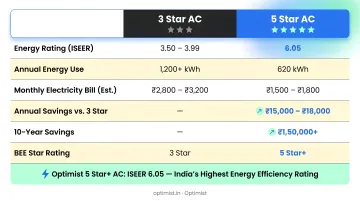
Price data based on 2024–25 Indian retail listings. ISEER thresholds from BEE's verified July 2022–December 2024 schedule.
What Do BEE Star Ratings Mean for ACs in India?
ISEER: The Number That Actually Matters
The Bureau of Energy Efficiency (BEE) assigns star ratings from 1 to 5 based on an AC's ISEER — Indian Seasonal Energy Efficiency Ratio. ISEER measures how much cooling an AC delivers per unit of electricity consumed across an entire season of varying temperatures, not just at one test condition.
This replaced the older EER (Energy Efficiency Ratio), which was measured at a single fixed laboratory condition. Your AC doesn't run that way — it cycles through 35°C afternoons, 45°C peak days, and cooler evenings. ISEER accounts for this variation, making it a more accurate predictor of your actual electricity bills.
Verified ISEER thresholds (BEE, July 2022–December 2024):
- 1-star: 3.30–3.49
- 2-star: 3.50–3.79
- 3-star: 3.80–4.39
- 4-star: 4.40–4.99
- 5-star: 5.00 and above
Why the Label Year Matters
Those ISEER thresholds don't stay fixed — BEE revises its star rating criteria every few years. An AC that earned 5 stars in 2020 may not meet today's 5-star threshold. When buying, look at the ISEER value printed on the label — not just the star count — and confirm it's based on a current BEE schedule.
Key Differences Between 3-Star and 5-Star ACs
Energy Consumption and Monthly Bill Impact
Here's the calculation that matters most. Using verified BEE label data:
- 1.5T 3-star inverter AC (Blue Star example): 1,026 kWh/year, rated input ~1,685 W
- 1.5T 5-star inverter AC (Daikin example): 786 kWh/year, rated input ~1,325 W
Monthly bill formula: Watts × hours/day × 30 ÷ 1,000 × ₹/kWh
For inverter ACs, the BEE seasonal method gives a more accurate estimate because the compressor doesn't run at full load continuously:
- Monthly kWh = Annual label kWh ÷ 1,600 × monthly operating hours
At 8 hours/day (240 hours/month):
| 3-Star (1.5T) | 5-Star (1.5T) | Difference | |
|---|---|---|---|
| Monthly kWh | ~154 kWh | ~118 kWh | ~36 kWh |
| Monthly cost at ₹7/unit | ~₹1,078 | ~₹826 | ₹252 saved |
| Monthly cost at ₹10/unit | ~₹1,540 | ~₹1,180 | ₹360 saved |
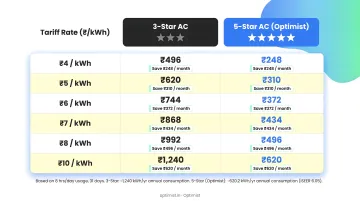
Tariff varies by state and consumption slab. Telangana's FY 2025-26 domestic rates go up to ₹9.50/kWh above 200 units. UP's urban domestic rate is ₹5.50/kWh for the first slab.
Annual Savings and Payback Period
At 8 hours/day usage, the annual savings on electricity bills range from roughly ₹2,600–₹4,300/year depending on your local tariff (₹6–₹10/kWh range).
With a typical price premium of ₹5,000–₹10,000 for a 5-star over a comparable 3-star model, the payback period works out to:
Payback = Price premium ÷ Annual savings
- ₹5,000 premium ÷ ₹4,300/year savings = ~1.2 years
- ₹10,000 premium ÷ ₹2,600/year savings = ~3.8 years
For anyone running their AC 6+ hours daily through a long Indian summer, the payback window sits well within a typical AC's useful life of 10–12 years.
Inverter Technology and Compressor Behaviour
Most 5-star ACs today are inverter-type — and so are most 3-star models in current retail. The real comparison is usually 3-star inverter vs 5-star inverter, not inverter vs non-inverter.
According to PIB data published in 2023, inverter-based AC market share in India rose from less than 1% in 2015 to 77% by 2022-23. Inverter compressors vary their speed to match the actual cooling load — they ramp up when the room is hot, throttle back once the target temperature is reached, and avoid the energy spikes of full on/off cycling.
The key difference between 3-star and 5-star inverter ACs is how efficiently the compressor operates at partial load — and that's exactly what ISEER is designed to measure.
Performance in Indian Heat Conditions
This is where star ratings have a real limitation most buyers don't know about.
Derating means an AC reduces its cooling output when outdoor temperatures climb above its design range. BEE's ISEER testing uses an outdoor temperature bin of 24°C–43°C. But in Rajasthan, Gujarat, Delhi NCR, and Telangana, ambient temperatures regularly exceed 45°C, and can push past 48°C during extreme heat events.
At these temperatures, many standard ACs deliver less cooling than their rated capacity. The star rating on the label doesn't tell you how the unit performs at 47°C outside.
High-ISEER 5-star ACs with proven high-ambient performance are better equipped for peak heat. Buyers in extreme-heat regions should verify a unit's performance claim at 45°C+ — not just its BEE star rating.
What to check before buying if you're in a hot-climate state:
- Rated cooling capacity at 46°C or 50°C outdoor temperature (not just 35°C)
- Whether the manufacturer publishes derating data or test results
- ISEER value — higher ISEER models tend to maintain efficiency across a wider load range
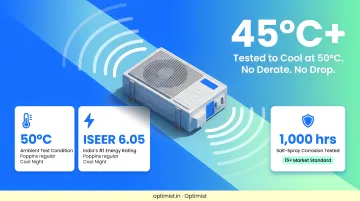
Optimist, for instance, publishes tested performance at 50°C and holds India's highest ISEER rating of 6.05. Its microchannel heat exchanger is designed specifically to maintain full cooling output at peak summer temperatures — a detail that matters in July, not just on a spec sheet.
Smart Features and Energy Monitoring
5-star ACs at the higher end increasingly include features that go beyond basic cooling:
- Real-time energy tracking — see how many units you're consuming per hour or day
- Projected monthly bill — estimate your upcoming electricity cost before it arrives
- Smart scheduling — pre-cool rooms before you arrive, reducing peak load
- Filter health alerts — know when cleaning is due (dirty filters reduce efficiency)
- Remote diagnostics — service teams can identify issues without a home visit
3-star models typically offer basic Wi-Fi connectivity (in newer variants) and standard timer functions. The gap isn't just in efficiency — it's in visibility and control over your usage.
3-Star vs 5-Star: Which Is Better for You?
The honest answer depends on five factors: climate intensity, daily usage hours, budget, room size, and your state's electricity tariff.
Choose a 3-Star AC if:
- You use the AC 3–4 hours or fewer per day
- You live in a region with mild or short summers (coastal areas, hills, or South India with good natural ventilation)
- You're budget-constrained and plan to upgrade within 3–4 years
- The room is a guest bedroom or occasional-use space
At low annual usage hours, the electricity savings from a 5-star model are too small to recover the price premium during the AC's useful life.
Choose a 5-Star AC if:
- You run the AC 6 or more hours daily through summer
- You live in high-heat states: Rajasthan, Delhi NCR, Gujarat, Haryana, Telangana, UP
- You plan to use the AC for 7–10 years
- Your electricity tariff is on the higher end (above ₹7/unit)
The payback math works clearly in your favour, often within 2 years in high-usage scenarios.
Consider Going Beyond Standard 5-Star if:
If your priority is the lowest possible electricity bills and reliable performance during extreme heat, the ISEER scale doesn't stop at 5.00. Research published in 2025 identified over 600 inverter AC models above the 5-star threshold, roughly 20% of all listed units. The efficiency gap between a 5.0 and a 6.0 ISEER is meaningful at scale.
Optimist's AC holds India's highest ISEER rating of 6.05, well above the standard 5-star floor. Engineered for Indian extreme heat with tested 50°C cooling performance and real-time energy tracking through its app, it's built for households that run their AC daily. In high-heat regions, that efficiency difference translates to real annual savings beyond what a standard 5-star delivers.
Quick ROI Check Before You Buy
Run this 3-step calculation before finalising your decision:
- Estimate annual usage hours: Hours/day × summer months × 30 (e.g., 8 hrs × 4 months × 30 = 960 hours)
- Calculate annual cost difference: (3-star kWh − 5-star kWh) ÷ 1,600 × your usage hours × your tariff
- Divide by price premium: Result = payback period in years
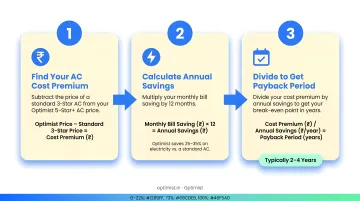
If the payback period is under 5 years, the 5-star pays for itself. A period over 7 years is a signal to reconsider — lighter usage patterns may make the 3-star the more practical call.
Frequently Asked Questions
Which is better to buy: a 3-star or 5-star AC?
5-star is better for heavy daily use (6+ hours) and hot climates — the lower electricity bills typically recover the price premium within 1–4 years. 3-star is sufficient and cost-effective for occasional or light use where total annual running hours are low.
How much does a 5-star AC cost to run per hour?
A 1.5T 5-star inverter AC consumes roughly 0.49–0.82 kWh per hour under seasonal load conditions (based on BEE label data). At ₹7–₹10/unit, that works out to approximately ₹3.50–₹8 per hour, varying by brand, ISEER value, room insulation, and outdoor temperature.
How much electricity does a 3-star AC consume per month?
A 1.5T 3-star inverter AC running 8 hours/day consumes approximately 154 kWh/month under BEE seasonal conditions. At ₹7/unit, that's ₹1,078/month — about ₹250–₹360 more per month than a comparable 5-star model at the same usage.
Is a 5-star AC worth the extra cost in India?
Yes, for anyone using the AC frequently — the payback period at 8 hours/day is typically 1–4 years, after which monthly savings continue indefinitely. For occasional use (under 4 hours/day), the savings may never recover the premium, making the 3-star the practical choice.
What is ISEER and how does it differ from EER?
ISEER (Indian Seasonal Energy Efficiency Ratio) measures AC efficiency across a full seasonal load profile using India's actual temperature distribution. This makes it far more representative of real-world performance than the older EER, which measured efficiency at a single standard operating point.
Does a 5-star AC cool faster than a 3-star AC?
A 5-star inverter AC can maintain temperatures more efficiently and avoid the on/off cycling of non-inverter models, but raw cooling speed depends primarily on tonnage relative to room size rather than star rating. Match tonnage to your room size first; the star rating determines your electricity cost, not cooling speed.