In India, this decision carries more financial weight than almost anywhere else. Indian summers are long, brutal, and getting worse — and an AC running 8-10 hours daily for five months isn't a convenience, it's infrastructure. According to CEEW research, roughly 60% of Indian households report ACs as a substantial contributor to their monthly electricity bills — yet only 14% of buyers actually purchase 4-star or 5-star models.
That gap is expensive. This guide cuts through the spec-sheet noise to help you make a practical choice based on real electricity costs, honest usage patterns, and Indian climate realities.
Key Takeaways
- A 5-star AC consumes roughly 30–35% less electricity than a 3-star model for the same cooling output
- The higher upfront cost is typically recovered within 1.5–2 years for daily users through electricity savings
- 3-star ACs suit occasional use, guest rooms, or tight budgets — only if you're running the AC fewer than 4–5 hours a day
- Always check the ISEER number on the energy label — not just the star count
- Your daily usage hours matter more than any other single factor in this decision
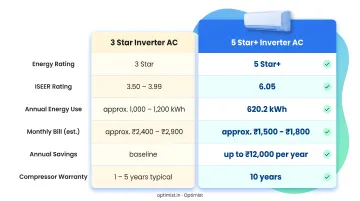
3 Star vs 5 Star AC: Quick Comparison
| Feature | 3-Star Inverter Split AC | 5-Star Inverter Split AC |
|---|---|---|
| ISEER Rating Range | 3.80–4.39 (BEE 2021-23 schedule) | ≥5.00 (BEE 2021-23 schedule) |
| Annual Energy Consumption (1.5 Ton) | ~1,077 kWh/year | ~753 kWh/year |
| Monthly Bill at 8 hrs/day (₹5.80/unit) | ~₹2,930/month | ~₹2,648/month |
| Annual Electricity Cost | ~₹6,247 | ~₹4,367 |
| Upfront Price Range (1.5 Ton Inverter) | ₹28,000–₹36,000 | ₹36,000–₹50,000+ |
| Break-Even Period | — | ~1.5–3 years depending on price gap paid |
| Best For | Budget-conscious buyers, guest rooms, occasional use | Daily users in hot-climate cities |
Note: Annual kWh figures are indicative, based on retailer product labels from Amazon India and Croma. Your actual monthly bill will differ based on: your city's electricity tariff (₹/unit), daily usage hours, room insulation, and outdoor temperature — especially during peak summer when ambient temperatures exceed 45°C across North and Central India.
Understanding the BEE Star Rating System
The Bureau of Energy Efficiency (BEE) assigns star ratings from 1 to 5 for room air conditioners in India. Five stars means highest efficiency. The rating reflects how much cooling the AC delivers per unit of electricity consumed — measured through the ISEER (Indian Seasonal Energy Efficiency Ratio).
What ISEER Actually Means
ISEER is calculated as the total annual heat removed from indoor air divided by the total annual energy consumed during the same period. A higher ISEER means more cooling extracted from each rupee of electricity you spend.
BEE's official AC notification confirms the verified ISEER thresholds for inverter split ACs under the 2021–2023 label schedule:
| Star Rating | ISEER Range |
|---|---|
| 3-Star | 3.80–4.39 |
| 4-Star | 4.40–4.99 |
| 5-Star | ≥5.00 |
The standard test conditions use indoor 27°C DB / 19°C WB and outdoor 35°C DB / 24°C WB — well different from a 46°C afternoon in Delhi.
The Recalibration Trap
BEE periodically raises its ISEER thresholds, meaning an older 5-star AC may have a lower ISEER than a newer 3-star model. A 5-star unit bought in 2019 carried a minimum ISEER of 4.50 — which now qualifies as only 4-star territory under the 2021 schedule.
Always read the ISEER number printed on the yellow BEE energy label. The stars are a shorthand; the number is the truth.
Electricity Consumption and Monthly Running Costs
A 5-star AC draws fewer watts to produce the same cooling as a 3-star unit. That difference compounds every hour the AC runs — and Indian summers are long.
A Practical Bill Calculation
Using retailer product label data and the verified BESCOM/KERC FY2025-26 residential tariff of ₹5.80/kWh:
| Calculation Step | Value |
|---|---|
| Annual kWh gap (3-star vs 5-star) | ~324 kWh/year |
| Monthly kWh difference (8 hrs/day) | ~49 kWh/month |
| Monthly cost difference at ₹5.80/unit | ~₹282/month |
| Annual cost difference | ~₹1,882/year |
At a higher tariff of ₹8/unit — common in many Indian metros — that annual gap widens to over ₹2,500/year.
The Climate Multiplier
Where you live matters as much as how long you run the AC:
- Delhi NCR, Jaipur, Ahmedabad, Hyderabad: ACs run 8–12 hours/day for 5–6 months. At these usage levels, the 5-star's monthly savings of ₹282–₹500+ compound quickly into thousands annually.
- Moderate climates (parts of Bangalore, coastal cities): Shorter cooling seasons of 3–4 months with 5–6 hours/day usage reduce the annual savings gap considerably.
Factors That Affect Real-World Consumption
The BEE label is calculated under controlled lab conditions. Indian summers are not controlled.
LBNL's analysis of Indian AC efficiency found that AC efficiency can fall by 20–30% when ambient temperature rises from 35°C to 45°C. Standard BEE test conditions use 35°C outdoor temperature — well below what North Indian cities regularly experience in May and June.
That 20–30% efficiency loss doesn't hit every AC equally. These factors determine how much of it lands on your bill:
- Outdoor temperature above 40°C forces the compressor to work harder
- Room size vs AC tonnage mismatch — an undersized AC in a large room loses efficiency advantage entirely
- Insulation quality — poorly sealed rooms bleed cool air continuously
- Thermostat setting — every degree lower increases energy draw
- Number of heat-generating appliances (TVs, laptops, occupants) adds to the cooling load
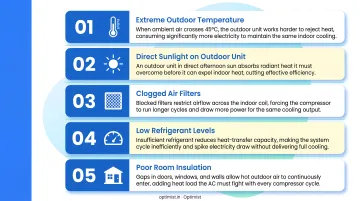
This is why ACs tested only at 35°C ambient — the BEE standard — can mislead buyers in cities where May temperatures routinely cross 45°C. An AC verified to maintain rated cooling at 50°C (as Optimist's units are) holds its efficiency advantage precisely when the efficiency gap matters most.
Upfront Cost vs Long-Term Savings
The Break-Even Reality
Based on retailer data from Croma and Flipkart, 3-star 1.5-ton inverter split ACs are priced between ₹28,000 and ₹36,000. 5-star models from leading brands typically carry a premium of ₹8,000–₹14,000 over comparable 3-star models.
Using the ₹282/month savings figure at ₹5.80/unit tariff:
| 5-Star Premium | Break-Even Period |
|---|---|
| ₹5,000 | ~18 months |
| ₹8,000 | ~28 months |
| ₹12,000 | ~42 months |
For a daily user in a hot-climate city, a ₹8,000–₹10,000 premium pays for itself in under 3 years. Everything after that is net savings.
Total Cost of Ownership Over 8–10 Years
The sticker price is the smallest part of what an AC costs you. For an AC used 8+ hours daily:
- Energy costs over 10 years can exceed the purchase price
- The ~324 kWh/year gap between 3-star and 5-star accumulates to roughly 3,240 kWh over a decade
- At ₹8/unit, that's approximately ₹25,920 in total electricity savings for choosing 5-star
That math holds — but only if you're actually running the AC long enough for the savings to accumulate. Usage patterns change everything.
When the 3-Star Wins Financially
The 5-star premium isn't always justified. A 3-star AC is a defensible financial choice when:
- Daily usage stays below 3-4 hours — the savings simply don't accumulate fast enough
- Your cooling season is 2-3 months or shorter, typical of moderate-climate cities
- The AC is for a guest room or rarely used space
- The upfront budget is a hard constraint, not a preference
In these scenarios, the break-even period for a 5-star AC can stretch to 4-5 years — and the net savings over a decade drop sharply, often below ₹12,000.
How to Choose: Key Decision Factors for Indian Homes
Usage Hours — The Single Most Important Factor
A simple rule of thumb:
- More than 6 hours/day regularly → 5-star AC will pay for itself quickly. Don't compromise.
- 3–4 hours/day → Either option is defensible depending on budget.
- Fewer than 3 hours/day or only 2-3 months/year → 3-star AC's lower purchase cost is justified.
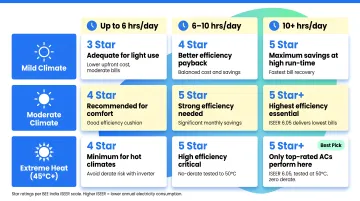
Climate and City Type
Local climate should directly influence your star rating decision:
- Extreme heat cities (Delhi NCR, Jaipur, Hyderabad, Ahmedabad, Nagpur): AC usage runs 6+ months, often 8-12 hours/day. 5-star efficiency delivers meaningful, compounding savings.
- Moderate or coastal climates (parts of Bangalore, hill stations): Shorter cooling seasons reduce the financial case for paying the 5-star premium — though India's warming summers are making this argument less reliable every year.
Room Type and Purpose
Match the star rating to the room's actual use:
- Primary bedroom or living room (daily, extended use) → 5-star is clearly justified
- Guest room or occasional space → 3-star is practical
- Home office or study used daily → treat it like the primary bedroom decision
One important caveat: room size matters independently of star rating. An undersized AC working constantly at full load loses the efficiency advantage regardless of its star rating.
When to Go Beyond the Standard 5-Star
For homeowners running ACs heavily through long, extreme summers, some manufacturers now offer ACs with ISEER ratings that exceed the standard 5-star threshold, which translates to a meaningfully different efficiency tier in practice.
Optimist's 5 Star+ Inverter Split AC carries an ISEER of 6.05 — India's highest as of 2026. Typical 5-star ACs from LG, Voltas, Daikin, and similar brands carry ISEERs of 5.0–5.4. That gap translates to 25–35% lower electricity bills, with annual energy consumption of just 620.2 kWh versus 750–800 kWh for standard alternatives.
At ₹8/unit, that's roughly ₹1,000–₹1,400 saved annually over a standard 5-star AC, adding up to ₹14,400 over 10 years in electricity costs alone.
The Optimist also delivers full rated cooling performance at 50°C ambient temperature with no derating. That matters when Delhi NCR regularly hits 47-48°C in June and most standard ACs begin losing cooling capacity above 43°C.
Conclusion
Neither 3-star nor 5-star is universally better. The right answer depends on honest answers to three questions:
- How many hours a day do I use it?
- How hot is my city?
- How long will I own this AC?
For daily heavy users in hot-climate Indian cities — Delhi, Jaipur, Hyderabad, Ahmedabad — a 5-star AC is the clear financial and practical choice. The electricity savings compound over years, the break-even period is short, and the gap only grows as electricity tariffs rise.
For occasional users, guest rooms, and moderate climates, a 3-star AC serves its purpose without overpaying for efficiency you won't fully use.
Indian summers are getting hotter and electricity tariffs are trending up — both trends widen the real-world cost gap between star ratings every year. If you're a heavy user in a hot city, a high-ISEER 5-star inverter AC (like Optimist's 1.4 Ton at ISEER 6.05, India's highest-rated) pays back faster than most buyers expect. If you're not, a 3-star unit does the job. Either way, match the star rating to your actual usage pattern — not the one you imagine you'll have.
Frequently Asked Questions
How much does it cost to run a 3-star vs 5-star AC?
At 8 hours/day and ₹5.80/unit (BESCOM FY2025-26 tariff), a 5-star 1.5-ton inverter AC costs approximately ₹282/month less than a comparable 3-star model. At ₹8/unit — closer to metro averages — that gap exceeds ₹350/month, adding up to ₹2,500–₹4,200 in annual savings depending on your city's rate.
Is a 3-star AC enough for a home?
A 3-star AC is sufficient if you run it fewer than 4 hours a day or only during a 2-3 month season. For homes in hot Indian cities running the AC 6–8 hours daily, a 3-star model ends up costing more over 3–5 years — higher bills outpace the lower purchase price.
What is ISEER rating and does it matter more than the star rating?
ISEER is the actual efficiency number — the star is just a label derived from it. ISEER measures total annual cooling delivered per unit of electricity consumed under Indian seasonal conditions. Always check the ISEER value on the energy label; a higher ISEER directly means lower electricity bills.
How long does it take for a 5-star AC to pay for itself in India?
For a daily user running the AC 8 hours/day, the extra cost of a 5-star AC over a 3-star model is typically recovered in 1.5 to 3 years through electricity savings, after which every additional year represents net savings on your bills.
Does a 5-star AC cool faster than a 3-star AC?
Cooling speed depends primarily on tonnage (capacity), not star rating. However, 5-star inverter ACs typically reach the set temperature faster and maintain it more consistently with less power fluctuation compared to many 3-star models.
Which AC is better for extreme Indian summers above 45°C?
A 5-star AC with a high ISEER rating is the right choice for extreme heat — efficiency gains are largest when the unit works hardest. One critical check: confirm the AC is rated for full cooling capacity above 43°C. Many standard models derate in peak summer, meaning your room may not cool below 28°C even at maximum setting.