
Inverter split ACs have moved from premium niche to mainstream — market share rose from 10% in 2015 to 70% of new AC sales by 2022. Yet AC ownership still sits at just 13% of Indian households, meaning the majority of buyers are making this decision for the first time.
This guide covers what an inverter split AC actually is, how it works, its real benefits, how it compares with regular split ACs, and what to check before buying.
Key Takeaways
- An inverter split AC uses a variable-speed compressor that adjusts output based on room temperature, instead of cycling on and off.
- The "split" format separates indoor and outdoor units, enabling quieter operation and flexible installation.
- ISEER — not generic EER — is the Indian government's efficiency metric, calculated across seasonal temperature conditions up to 43°C.
- Look for models rated to cool at 45°C+ ambient temperatures — not all inverter ACs perform equally in peak Indian heat.
- Smart features like real-time energy monitoring and gas-level indicators add practical value well beyond basic cooling.
What is an Inverter Split AC?
An inverter split AC is a two-unit air conditioning system that combines two separate technologies: a split physical format and inverter compressor control. Each component solves a different problem — and together, they define what most Indians are buying when they shop for an AC today.
The "Split" Component
A split AC divides the system across two units:
- Indoor unit — handles air intake, cooling via the evaporator coil, and air distribution into the room
- Outdoor unit — houses the compressor, condenser coil, and exhaust fan
The two units connect through copper refrigerant pipes that pass through a small wall opening, typically 65–80mm in diameter. This separation is what enables quiet indoor operation — the noisy, heat-generating components stay outside.
The "Inverter" Component
A conventional AC compressor has two states: fully on or fully off. When the room reaches the set temperature, it shuts down completely. When the temperature drifts, it restarts from zero.
An inverter AC compressor works differently. It uses a variable-frequency drive (VFD), an electronic controller that adjusts the electrical frequency supplied to the compressor motor, which directly controls motor speed. The result: the compressor runs across a continuous range of speeds rather than toggling between on and off.
One Important Market Clarification
All inverter ACs sold in India today are split ACs — but not all split ACs are inverter ACs. Some budget or older split models still use fixed-speed compressors. The word "inverter" needs to appear explicitly on the specification sheet. Don't assume it's included just because the unit has a split format.
How Does an Inverter Split AC Work?
The Refrigeration Cycle
The core process is a continuous loop:
- Warm room air passes over the evaporator coil (indoor unit) — refrigerant inside the coil absorbs the heat and evaporates
- The compressor pressurises the refrigerant vapour and pushes it to the outdoor unit
- The condenser coil (outdoor unit) releases that heat to the outside air; refrigerant returns to liquid state
- The cycle repeats continuously
The compressor is the engine driving this loop. Its speed determines how fast heat is removed.
How the Inverter Modulates Compressor Speed
A fixed-speed AC works like stop-start city driving — full throttle, then engine off, then full throttle again. An inverter AC is motorway cruising: a steady pace, with slight adjustments as conditions change.
In practice:
- Room far from set temperature → compressor runs at or near full speed for fast cooling
- Room near set temperature → compressor slows to a low maintenance speed
- Set temperature maintained → compressor keeps running slowly rather than switching off
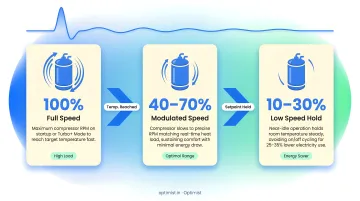
Temperature sensors in the indoor unit continuously feed data to the inverter control board, which adjusts the drive frequency in real time.
Why This Matters for Indian Conditions
Indian ACs commonly run 8–12 hours daily through a 5-month summer. Every full restart cycle draws a surge of current — mechanically stressful and electrically wasteful. Across hundreds of restart cycles per week, that adds up to real money by the end of summer.
Voltage fluctuations compound this. CEEW data shows one-third of Indian households experienced supply-quality issues — including low voltage and appliance damage — in the month before their survey. Fewer full restarts mean fewer high-current surge events when supply is already unstable.
Key Benefits of an Inverter Split AC
Energy Efficiency and Lower Electricity Bills
Because the compressor avoids constant restart surges and runs at the minimum speed needed to maintain comfort, it consumes less energy over time. The relevant Indian metric here is ISEER — Indian Seasonal Energy Efficiency Ratio.
| Metric | What It Means |
|---|---|
| ISEER formula | Cooling Seasonal Total Load ÷ Cooling Seasonal Energy Consumption |
| Temperature range | Calculated across outdoor bins from 24°C to 43°C |
| Annual hours | Based on 1,600 cooling hours per year |
| BEE 1-star improvement | 43% efficiency gain over baseline (per PIB) |
| BEE 5-star improvement | 61% efficiency gain — shows up directly in electricity bills |
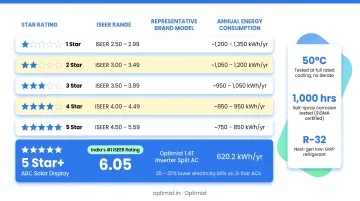
This makes ISEER far more relevant for Indian buying decisions than a single-point EER value.
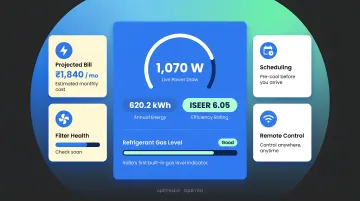
At the top end of the efficiency scale, Optimist's inverter split AC carries an ISEER of 6.05 — currently India's highest — with a 5-star BEE rating. Real-time energy tracking through the app lets users monitor actual running costs, not estimates.
Consistent Temperature and Comfort
Fixed-speed ACs create a predictable temperature wave: cool down to the setpoint, compressor off, temperature rises, compressor restarts. The room oscillates between slightly too cold and slightly too warm.
An inverter compressor running at low speed holds the room within a much narrower band around the setpoint. This is most noticeable during overnight sleep and long work-from-home sessions, where even small temperature swings break concentration or disturb rest.
Quieter Operation
Compressor noise peaks during startup, when mechanical and electrical loads are highest. By reducing the frequency and severity of full restarts, inverter split ACs operate more quietly — both indoors and outdoors.
In dense Indian housing layouts (apartments, row houses, builder floors), lower outdoor unit noise during late-night operation is a practical advantage.
Reduced Mechanical Wear
Cold starts are hard on compressor components: motor windings, valves, and refrigerant seals all experience their highest stress during startup. Running at variable but continuous speeds reduces the cumulative mechanical load across a long season.
No authoritative Indian source provides a verified year-by-year lifespan comparison between inverter and fixed-speed ACs — so that specific claim isn't made here. What the engineering logic does support: fewer high-stress events means less accumulated wear over time.
Performance in Extreme Heat
This is the specification most buyers overlook. The older IS 1391 standard uses 35°C outdoor dry-bulb as the standard rating condition, with a maximum operating condition of 46°C. BEE's ISEER calculation extends to 43°C outdoor temperature bins.
Meanwhile, observed Indian temperatures regularly exceed these thresholds:
- Sri Ganganagar, Rajasthan: 44.5°C recorded in April 2026
- Lucknow, UP: 46°C in April 2026
- Northwest India pockets recorded 45–48°C during May 2024
Many standard ACs begin to reduce effective cooling output (a process called derating) above their rated ambient temperature. A well-engineered inverter AC should maintain its rated capacity at 45°C and above. Optimist's unit is tested and rated for 50°C ambient performance.
Before buying any model, check the manufacturer's stated ambient operating temperature range, not just the tonnage.
Inverter Split AC vs Regular Split AC: Key Differences
Side-by-Side Comparison
| Feature | Fixed-Speed Split AC | Inverter Split AC |
|---|---|---|
| Compressor operation | On/Off (100% or 0%) | Variable speed (continuous range) |
| Temperature consistency | Oscillates around setpoint | Holds narrow band at setpoint |
| Energy consumption | Higher (restart surges, full-speed runs) | Lower (runs at minimum needed speed) |
| Noise level | Higher at startup | Lower overall |
| Startup stress on components | High (repeated cold starts) | Low (gradual speed changes) |
| Mechanical wear over time | Higher | Lower |
Upfront Cost vs. Lifecycle Cost
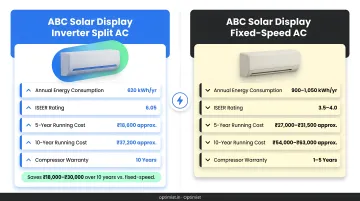
Inverter split ACs typically carry a higher purchase price than comparable fixed-speed models. The number that matters, though, is lifecycle cost: purchase price plus total electricity expenditure over the unit's operational life.
Three inputs determine that calculation:
- Annual kWh consumption from the model's BEE star label
- Your state electricity tariff (the national domestic average was ₹6.20/kWh for FY 2023-24, but state rates vary significantly)
- Daily usage hours — every additional hour of runtime accelerates the savings gap
No single payback figure applies universally because all three inputs differ by household. For homes running AC 8+ hours a day through a 5-month summer, the electricity savings are substantial enough to offset the price premium well within the unit's lifespan.
When a Fixed-Speed Model Might Still Make Sense
For genuinely low-usage scenarios — a guest room running fewer than 4 hours per day for only a few months — the payback period on the inverter premium extends considerably. The comfort and noise advantages remain, but the financial case weakens with lower usage hours.
What to Look for When Buying an Inverter Split AC in India
ISEER Rating and BEE Star Label
The BEE star label is printed on every certified AC unit in India. Inverter AC labelling became mandatory from 1 January 2018. The label shows:
- Star rating (1 to 5, with 5 being highest efficiency)
- Annual electricity consumption in units per year for that specific model
- ISEER value
The annual consumption figure on the label is your most reliable basis for estimating running costs — multiply it by your local per-unit tariff. A 5-star inverter AC at ISEER 5.00+ represents strong efficiency; models pushing ISEER 6.00+ (like Optimist's 6.05) represent the current efficiency ceiling in the Indian market.
Beyond the label, some models include companion apps with real-time energy tracking — worth considering if you want month-by-month visibility into actual versus estimated consumption. That brings up smart features, covered below.
Cooling Capacity and Ambient Temperature Rating
Matching tonnage to room size is the first step. A widely used Indian rule of thumb: room area (sq ft) ÷ 600 = approximate tonnage required, with adjustments for additional occupants or high ambient heat. As a reference, Optimist's 1.4-ton unit is rated for rooms of 120–200 sq ft.
The ambient temperature rating is equally important. Always check:
- At what outdoor temperature does the manufacturer claim rated cooling capacity?
- At what temperature does performance begin to derate?
For homes in Rajasthan, UP, Maharashtra, or Telangana — where summers regularly exceed 44°C — an AC that derates at 43°C will underperform exactly when you need it most. Check the spec sheet, not just the marketing copy.
Smart Features That Add Long-Term Value
Features worth prioritising:
- Scheduling — pre-cool a room before you arrive home; saves energy and eliminates the discomfort of walking into a hot space
- Filter health indicators — dirty filters degrade airflow and efficiency; automated alerts tell you exactly when to clean
- Wide voltage operation range — important in areas with unstable grid supply
- Gas level monitoring — refrigerant leaks degrade cooling performance silently over months; Optimist's first-ever built-in gas-level indicator displays refrigerant status and sends refill alerts through the app, so there are no surprises at annual servicing
Frequently Asked Questions
What is the difference between a split AC and an inverter split AC?
"Split AC" describes the physical format — two units connected by refrigerant pipes. "Inverter split AC" adds variable-speed compressor technology to that format. A regular split AC uses a fixed-speed compressor that cycles fully on and off; an inverter split AC uses a compressor that runs continuously at variable speeds, making it more energy-efficient and quieter.
What are the main benefits of an inverter split AC?
Three benefits stand out: lower electricity consumption (the compressor avoids high-current restarts and runs at minimum needed speed), more consistent room temperature (no hot-cold oscillation at the setpoint), and quieter, lower-stress operation that reduces component wear over time.
Is an inverter split AC good for Indian summers?
Yes — inverter technology suits India's long, intense summers well because efficiency gains compound over extended daily run times. Look for models that explicitly state their rated ambient operating temperature; models rated only to 35°C may derate significantly during India's peak heat periods.
Does an inverter split AC handle voltage fluctuations better?
Most inverter split ACs include a wider operating voltage range than fixed-speed models, which helps during the voltage fluctuations common across many Indian towns and cities. The specific range varies by model — check the specification sheet for the stated voltage operating band before purchasing.
How much electricity does an inverter split AC save compared to a regular AC?
Savings depend on usage hours, room size, and the ISEER ratings being compared. The annual electricity consumption figure on the BEE label is the most reliable benchmark — multiply it by your local tariff and run hours. BEE's star labelling data shows 5-star split ACs are 61% more efficient than the baseline.
What star rating should I look for?
Go for a 5-star BEE-rated inverter split AC. For households running AC 6–10 hours daily, the price premium over a 3-star model typically recovers within a few seasons — and the running cost advantage compounds every year after.