
Tonnage describes cooling capacity, not electricity draw. Two 1.5 ton ACs can consume wildly different amounts of power depending on their star rating, compressor type, and how they're used.
With 2026 summers expected to push past 45°C in several regions, understanding actual consumption matters more than ever. This guide breaks down hourly, daily, and monthly numbers, the factors that swing your bill, a simple cost-calculation formula, and practical ways to cut usage.
Key Takeaways
- A 1.5 ton AC draws 0.8 to 1.8 kWh per hour, depending on star rating and compressor type
- 5-star inverter models can save 20-35% more electricity than 2-star or fixed-speed units
- Running 8 hours daily, monthly bills range roughly from ₹1,500 to ₹3,600
- Room insulation, sun exposure, and thermostat habits can shift consumption by 10-20%
- High-ISEER ACs with app-based tracking offer the most reliable long-term bill control
How Much Electricity Does a 1.5 Ton AC Consume? (Consumption Overview)
"1.5 ton" refers to cooling output, not power input. It's one of the most misunderstood specs on an AC's box.
What "1.5 Ton" Actually Means in Electrical Terms
One ton of refrigeration equals 12,000 BTU/hr, or 3.516 kW of cooling capacity. So a 1.5 ton AC delivers roughly 18,000 BTU/hr, or about 5.27 kW of cooling, which is nowhere close to 5.27 kW of electricity consumption (BEE's HVAC energy performance guide).
What actually determines electricity draw is the ISEER (Indian Seasonal Energy Efficiency Ratio). A higher ISEER means more cooling delivered per unit of electricity consumed, making it the number to check instead of the tonnage badge.
Hourly Consumption by Star Rating and Type
Here's how consumption typically stacks up across common 1.5 ton categories:
| AC Type | Approx. Input Power | Typical Consumption |
|---|---|---|
| 5-star inverter | 900-1,300 W | 0.8-1.35 units/hour |
| 5-star non-inverter | 1,300-1,450 W | 1.3-1.5 units/hour |
| 3-star inverter | 1,300-1,580 W | 1.5-1.7 units/hour |
| 3-star non-inverter | 1,350-1,450 W | 1.4-1.6 units/hour |
| 2-star non-inverter | 1,450-1,600 W | 1.7-1.9 units/hour |
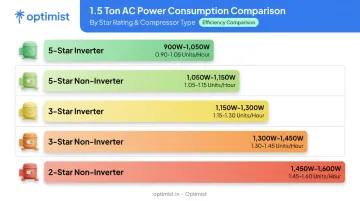
Inverter units drop further once the room stabilises near the set temperature. The compressor slows down rather than switching off, so hourly draw keeps falling the longer it runs.
Daily and Monthly Consumption Estimates
Assuming 8 hours of daily use:
- 5-star inverter: 6.4-10.8 units/day → roughly 192-324 units/month
- 3-star (either type): 11.2-13.6 units/day → roughly 336-408 units/month
- 2-star non-inverter: 13.6-15.2 units/day → roughly 408-456 units/month
On an annual basis, BEE label data for 1.5 ton models range from 615 kWh/year for efficient 5-star inverters to over 1,000 kWh/year for 3-star fixed-speed units. That gap compounds every summer, which is why Optimist's 1.4 ton inverter split (ISEER 6.05, 620.2 kWh/year) is built to undercut even the best 1.5 ton options while still delivering Turbo+ cooling equivalent to a 1.9 ton unit.
Key Factors That Affect 1.5 Ton AC Power Consumption
Consumption is never fixed. It depends on the machine's built-in efficiency and how well you use it.
Star Rating and ISEER Rating
A higher ISEER cuts electricity draw for the same cooling output. Comparable 1.5 ton models show a 3-star to 5-star gap of about 22%, meaningful savings for a machine that runs daily for months. in annual energy consumption for otherwise similar specifications.
Inverter vs Non-Inverter Compressor Technology
Inverter compressors modulate speed instead of cycling fully on and off. According to Daikin's guide to inverter technology, inverter ACs can use up to 40% less energy than typical non-inverter models by avoiding repeated full-power restarts. Fixed-speed compressors, by contrast, either run at full load or shut off, burning more electricity every time they restart.
Room Size, Insulation, and Sunlight Exposure
Poor insulation, large unshaded windows, or a west-facing wall exposed to afternoon sun force the compressor to work harder just to hold temperature. Homes with:
- Uninsulated roofs or top-floor rooms
- Large glass windows without curtains or films
- Frequent door openings
...typically see the compressor run longer per cycle, pushing consumption up by an estimated 10-20% versus a well-shaded, sealed room of the same size.
Outdoor Temperature and Usage Duration
BEE tests seasonal performance across outdoor temperatures from 24°C to 43°C. Beyond that, in genuine 45°C+ conditions, many standard ACs lose some cooling capacity — a phenomenon called derating. The AC then runs longer to compensate, raising monthly units consumed even though the room never feels adequately cool.
Maintenance, Gas Levels, and Filter Cleanliness
Dirty filters restrict airflow and make the compressor work harder. According to LG's guide on efficient AC use, cleaning filters regularly can lower energy consumption by 5-15%.
Low refrigerant gas has a similar effect: it reduces cooling ability without an obvious symptom until your bill arrives. This is exactly why features like a built-in gas-level indicator matter: catching a slow leak early avoids months of the compressor overworking itself.
How to Calculate Your 1.5 Ton AC's Monthly Electricity Bill
Total cost depends on more than the sticker rating. It's a simple formula anyone can apply.
Units consumed = (Watts ÷ 1,000) × Hours of use × Number of days
Worked example: Say your AC draws 1.3 units per hour and runs 8 hours a day for 30 days, at a tariff of ₹8/unit.
- Daily consumption: 1.3 × 8 = 10.4 units/day
- Monthly consumption: 10.4 × 30 = 312 units/month
- Monthly cost: 312 × ₹8 = ₹2,496/month
Here's how that plays out across different efficiency tiers:
| AC Rating | Units/Hour | 6 hrs/day (Monthly Cost @ ₹8/unit) | 8 hrs/day (Monthly Cost @ ₹8/unit) |
|---|---|---|---|
| 5-star inverter | 1.0 | ₹1,440 | ₹1,920 |
| 3-star | 1.6 | ₹2,304 | ₹3,072 |
| 2-star non-inverter | 1.8 | ₹2,592 | ₹3,456 |
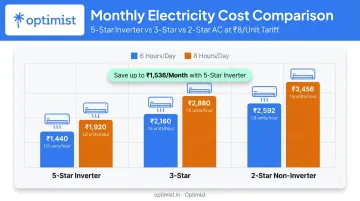
Remember, actual bills also carry fixed charges, slabs, and surcharges that vary by city — Delhi, Mumbai, and Bengaluru each apply different tariff structures. Treat these figures as a working scenario, not a universal number.
Over a year, that gap between a 5-star and 3-star unit adds up. A comparison between comparable 1.5 ton models showed an annual saving of nearly 200 units, translating to roughly ₹1,100-₹2,000 depending on your local rate. You recover that money every single summer, not just once.
Inverter vs Non-Inverter & Star Ratings — Which Saves You More?
Two ACs with identical tonnage can have very different running costs, depending on these two specs.
Inverter vs Non-Inverter
| Factor | Inverter | Non-Inverter |
|---|---|---|
| Average units/hour | Lower, drops further after stabilising | Higher, stays constant when running |
| Cooling consistency | Smooth, minimal temperature swings | Noticeable on-off cycling |
| Noise levels | Quieter (avoids repeated restarts) | Louder during compressor kick-in |
| Long-term savings | Higher upfront cost, recovered over seasons | Cheaper upfront, costlier to run |
This difference alone can swing your monthly bill by several hundred rupees over a season. But the inverter tag is only half the picture; the star rating stamped on the box matters just as much for your final bill.
3-Star vs 5-Star
A 5-star model costs more initially, but the electricity savings usually pay that difference back within a few cooling seasons of regular daily use, faster if you run the AC 8+ hours a day through a long Indian summer.
Not all "5-star" ACs are equal, though. The BEE 5-star band starts around an ISEER of 5.0, but some models push well past that floor.
Optimist's 1.4 Ton 5 Star+ inverter AC carries an ISEER of 6.05, India's highest as of 2026 and roughly 21% above the standard 5-star threshold. That translates to an annual consumption of just 620.2 kWh.
That efficiency comes from a few specific engineering choices:
- A dual-rotary inverter compressor paired with a micro-channel heat exchanger (1,180 flow paths) for faster heat transfer
- Turbo+ mode, which boosts effective cooling to a 1.9-ton equivalent, enough to match a standard 1.5 ton unit's output
- Full cooling performance tested at 50°C ambient, while many standard ACs start derating past 40°C
Together, these upgrades let a 1.4 ton machine cool like a larger unit while consuming less power than its 1.5 ton rivals.
Tips to Reduce 1.5 Ton AC Power Consumption
Small habits shift consumption by double-digit percentages. Here's what actually moves the needle:
- Set the thermostat between 24-26°C and pair it with a ceiling fan; every degree lower can add 6-8% to your compressor load
- Clean filters every 2-3 weeks and get annual servicing done; dirty filters alone can cost you 5-15% in wasted energy
- Check refrigerant levels: platforms with live energy monitoring flag inefficiencies before they show up as an inflated bill
That last point matters more than it sounds. Optimist's app, for instance, shows a live energy meter, projected monthly bills, and a colour-coded gas-level gauge that surfaces refrigerant issues before cooling performance drops.
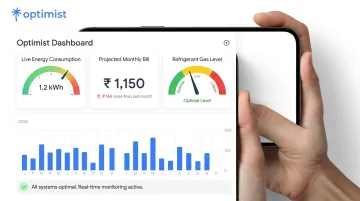
One user described catching a low-gas warning through the app as a welcome relief: a small alert that avoided weeks of the compressor overworking itself unnoticed.
Frequently Asked Questions
How much electricity does a 1.5 ton AC consume per hour?
Most 1.5 ton ACs draw between 0.8 and 1.8 units per hour. 5-star inverter models sit at the lower end, while 2-star or non-inverter models draw closer to the upper end.
Can a 1.5 ton AC run on a 1 kW load?
Not reliably. Most 1.5 ton ACs draw 1.2-1.8 kW at peak, so a connection limited to 1 kW would likely be insufficient except for the most efficient inverter models under low-load, stabilised conditions.
What is the monthly electricity bill for a 1.5 ton AC?
For 8 hours of daily use, expect roughly ₹1,500 to ₹3,600 a month, depending on the AC's star rating and your local electricity tariff.
How much current does a 1.5 ton AC draw?
Typically 5-8 amps at 230V, though this varies by model, compressor type, and star rating.
Does an inverter AC really save more electricity than a non-inverter one?
Yes. Inverter compressors modulate speed instead of cycling on and off, and manufacturers report savings of up to 40% versus comparable non-inverter units.
Is a 5-star 1.5 ton AC worth the extra upfront cost?
For daily, long-duration use, yes: the electricity savings typically recover the price premium within a few cooling seasons. High-ISEER models push this further, such as Optimist's 1.4 ton unit rated at ISEER 6.05, which delivers 1.5-ton-equivalent cooling via Turbo+ mode while consuming less power.