
What most people don't know is that two 1.5 ton ACs running identical hours can produce bills that differ by ₹1,000 or more per month, purely because of star rating and thermostat habits. That gap is entirely avoidable.
This guide covers: how much electricity a 1.5 ton AC actually consumes by star rating, a straightforward formula to calculate your personal monthly bill, why the number varies so much across cities, and the specific habits that cut costs meaningfully.
Key Takeaways
- A 1.5 ton AC consumes roughly 1.0–1.8 kWh per hour depending on star rating and inverter type
- Monthly bill typically falls between ₹1,500 and ₹3,500, based on AC type, usage hours, and your state's electricity tariff
- BEE star rating and ISEER score matter most: a higher-rated unit cuts your bill by 25–40% versus a lower-rated one
- Setting the thermostat to 24°C saves approximately 6% per degree versus lower settings
- Cleaning filters regularly recovers 5–15% of lost efficiency
How Much Electricity Does a 1.5 Ton AC Consume Per Month?
"1.5 ton" refers to cooling capacity (18,000 BTU/hr) — not wattage. The actual power draw depends on the AC's star rating, inverter technology, and real-world conditions.
One important caveat: BEE's ISEER rating is calculated using outdoor temperature bins from 24°C to 43°C across 1,600 annual operating hours — not a single fixed test at 35°C as is commonly assumed. In peak North Indian summer conditions (Delhi, Rajasthan, Ahmedabad regularly hitting 45°C+), actual consumption tends to run higher than the label suggests.
Consumption and Cost by AC Type
The table below uses verified model-level data where available and reasonable published estimates for other categories. Monthly bill is calculated at 8 hrs/day × 30 days.
| AC Type | Approx. kWh/hour | Monthly Units (8 hrs × 30 days) | Monthly Bill @ ₹7/unit |
|---|---|---|---|
| 5-star inverter (ISEER ≥5.0) | ~1.0–1.1 | ~240–264 | ~₹1,680–₹1,850 |
| 4-star inverter (ISEER 4.40–4.99) | ~1.2–1.3 | ~288–312 | ~₹2,015–₹2,185 |
| 3-star inverter (ISEER 3.80–4.39) | ~1.3–1.5 | ~312–360 | ~₹2,185–₹2,520 |
| 3-star non-inverter (fixed-speed) | ~1.5–1.8 | ~360–432 | ~₹2,520–₹3,025 |
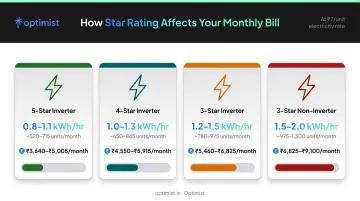
Note: kWh/hour figures are approximate category estimates. Actual consumption varies by model — use your BEE label's annual kWh figure for a precise calculation (see the formula section below).
City-Wise Tariff Reality Check
The same AC running the same hours costs noticeably different amounts depending on where you live, because electricity tariffs are set by state DISCOMs, not centrally. Here are verified FY2024-25 rates for major cities:
| City / Utility | Applicable Energy Charge |
|---|---|
| Bengaluru (BESCOM) | ₹5.90/kWh |
| Hyderabad (TSSPDCL) | ₹7.70–₹9.00/kWh (units 201–400) |
| Ahmedabad (DGVCL) | ₹4.15/kWh (units 101–250); ₹5.20 above 250 |
| Delhi (BRPL/BYPL) | ~₹4.50/kWh (units 201–400; confirm on DERC website) |
Chennai and Mumbai tariffs follow telescopic slab structures — check your TANGEDCO or AEML/BEST bill for your applicable rate. Fixed charges, fuel adjustment, and electricity duty are additional in all states.
Realistic monthly bill range: For a typical household running a 1.5 ton AC 8 hours/day for 30 days, the bill falls between ₹1,500 (5-star inverter in a lower-tariff state like Gujarat) and ₹3,500 (3-star non-inverter in a high-tariff state like Telangana). Your exact figure sits at the intersection of your AC's star rating and your state's tariff slab — use the formula in the next section to pin it down.
Key Factors That Affect Your Monthly Bill
The monthly figure is the product of five variables. Change even one and the bill shifts by hundreds of rupees.
Star Rating and ISEER Score
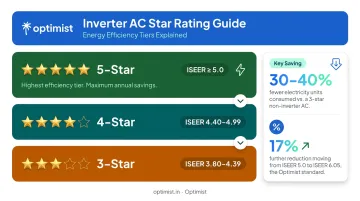
BEE awards star ratings based on ISEER — Indian Seasonal Energy Efficiency Ratio. For variable-speed (inverter) split ACs under the current BEE schedule, the bands are:
- 3-star: ISEER 3.80–4.39
- 4-star: ISEER 4.40–4.99
- 5-star: ISEER ≥5.00 (no upper boundary)
A 5-star inverter AC with ISEER 5.0 consumes roughly 30–40% fewer units per hour than a 3-star non-inverter for identical cooling output — a direct reduction in your monthly bill without any comfort trade-off.
The 5-star band also has meaningful internal variation. A baseline 5-star unit at ISEER 5.0 and a high-ISEER unit at 6.05 are both technically "5-star," but the ISEER 6.05 unit consumes approximately 17% less electricity than the baseline.
Optimist's 1.4 Ton 5 Star+ AC carries an ISEER of 6.05 — currently India's highest declared ISEER — with an annual consumption of just 620.2 kWh against a typical 5-star unit's 850–920 kWh.
Inverter vs. Non-Inverter Technology
A non-inverter compressor runs at full power constantly — on or off. An inverter compressor modulates speed based on cooling demand, drawing significantly less power once the room reaches the set temperature.
For anyone using the AC more than 6 hours a day, this difference is not marginal. The LG 5-star inverter 1.5 ton model lists a rated input of 1,310 W versus the LG 3-star inverter at 1,760 W — a 26% rated input difference before accounting for the inverter's part-load efficiency advantage.
Thermostat Setting
The Ministry of Power confirmed in 2018 that each 1°C increase in thermostat setting saves approximately 6% on electricity. BEE's FAQ estimated around 24% savings from shifting a typical 20–21°C habit to 24°C — which is why BEE made 24°C the mandatory factory default from 1 January 2020.
Setting the AC at 18°C versus 24°C doesn't cool the room faster. It makes the compressor work harder for longer, running up a bill 30–35% higher for the same cooling outcome.
Maintenance Condition
According to the US Department of Energy, cleaning or replacing a clogged filter can lower AC energy consumption by 5–15%. A 25% refrigerant undercharge reduces system efficiency by approximately 15% on its own.
Stack those two problems together and an AC that hasn't been serviced in 2 years can easily be running at 15–25% below its rated efficiency — with the homeowner none the wiser without a diagnostic check.
This is where Optimist's built-in gas level indicator proves its worth. It's India's first AC with real-time refrigerant monitoring visible directly in the Optimist App — so you can verify whether gas is actually low before authorising a service call, rather than taking a technician's word for it. Gas top-up scams in India typically cost ₹2,500–₹7,000 per visit.
How to Calculate Your Monthly Bill
The formula is straightforward:
Monthly Bill = Power Draw (kW) × Daily Hours × 30 × Electricity Tariff (₹/unit)
- Power draw: Find annual kWh on your BEE label, divide by 1,600 (BEE's standard annual hours). That gives the label-average kWh per hour.
- Tariff: Check your latest electricity bill or your state DISCOM's website.
Worked Example 1: 5-Star Inverter AC
- Power draw: ~1.0 kW (label-average for a 5-star inverter)
- Daily hours: 8
- Tariff: ₹8/unit
1.0 × 8 × 30 × 8 = ₹1,920/month
Worked Example 2: 3-Star Non-Inverter AC
- Power draw: ~1.5 kW
- Daily hours: 8
- Tariff: ₹8/unit
1.5 × 8 × 30 × 8 = ₹2,880/month
The difference: ₹960/month — nearly ₹5,000 over a five-month summer. Same room temperature, meaningfully different bill.
Practical tip: For a model-specific figure, take the annual kWh on your BEE label, divide by 1,600, then multiply by your daily hours and tariff. This gives you a model-specific number, not a category average.
3-Star vs. 5-Star vs. High-ISEER: How Much Does the Bill Actually Differ?
Most buyers focus on the upfront price gap between a 3-star and 5-star AC, yet the electricity bill difference over a single summer season often exceeds that price gap — the table below shows exactly by how much.
Comparison Table (8 hrs/day, ₹7/unit tariff)
| AC Type | ISEER | Est. Monthly Bill | 5-Month Summer Bill | 5-Year Operating Cost |
|---|---|---|---|---|
| 3-star non-inverter | ~3.1–3.5 | ~₹2,520–₹3,025 | ~₹12,600–₹15,125 | ~₹63,000–₹75,000 |
| 3-star inverter | ~3.80–4.39 | ~₹2,185–₹2,520 | ~₹10,925–₹12,600 | ~₹54,625–₹63,000 |
| 5-star inverter | ≥5.0 | ~₹1,680–₹1,850 | ~₹8,400–₹9,250 | ~₹42,000–₹46,250 |
| High-ISEER (6.05) | 6.05 | ~₹1,450–₹1,600 | ~₹7,250–₹8,000 | ~₹36,250–₹40,000 |
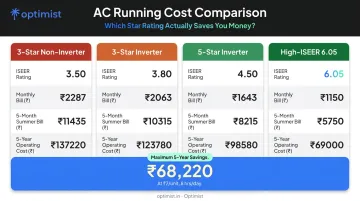
Estimates based on category consumption ranges; actual bills depend on model-specific BEE label and state tariff.
The ISEER 6.05 row reflects units like Optimist's 1.4 Ton 5 Star+ AC, which carries a BEE-declared annual consumption of 620.2 kWh. Compared to a baseline ISEER 5.0 unit at ₹5.50/unit, that translates to roughly ₹1,650 in annual savings — a 27–33% lower electricity cost. Against a 3-star non-inverter, the five-year gap widens to ₹26,750–₹38,750. Put differently, the ISEER 6.05 advantage over a standard 5-star unit is a further 17% reduction in consumption — savings that compound every year the AC runs.
Proven Ways to Lower Your Monthly AC Bill
These habits are backed by verified data. Each one has a measurable impact:
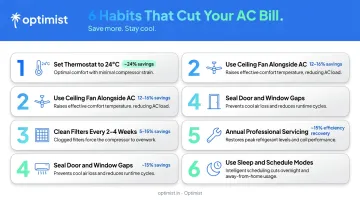
Set the thermostat to 24°C — saves ~6% per degree versus lower settings. Going from 20°C to 24°C saves approximately 24% on AC running costs.
Use a ceiling fan alongside the AC — a fan costs ~30W; running it allows a 2°C thermostat raise without any perceived comfort loss, saving 12–16% on the AC bill.
Clean filters every 2–4 weeks — recovers 5–15% efficiency lost to clogging, per DOE benchmarks. This single habit is one of the most overlooked cost savers.
Seal door and window gaps — prevents cool air from leaking out. Even a 1 cm gap under a door significantly increases the time the compressor runs to maintain temperature.
Get the AC professionally serviced annually — includes refrigerant check, coil cleaning, and drainage inspection. A unit running at 25% refrigerant undercharge operates at roughly 15% below rated efficiency.
Use sleep and schedule modes — set the AC to switch off 30–45 minutes after you sleep, and schedule it to turn on before you arrive home rather than running continuously.
If your actual bill is significantly higher than the formula predicts for your AC type, two causes cover 90% of cases: a maintenance issue (dirty coils, low refrigerant) or a thermostat habit below 22°C. Both are fixable.
Tracking which cause applies is easier with real-time data. The Optimist App includes a live energy meter that shows cumulative kWh consumed and a projected monthly bill, calculated automatically. You can see whether your usage habits are pushing the bill up or down before the month ends — no manual logging needed.
Frequently Asked Questions
What is the monthly electricity bill for a 1.5 ton AC?
At 8 hrs/day use, a 5-star inverter AC typically costs ₹1,500–₹1,900/month while a 3-star non-inverter can run ₹2,500–₹3,500/month. The exact figure depends on your AC's star rating and your state's electricity tariff — Hyderabad and Bengaluru residents pay materially more per unit than those in Gujarat.
How much electricity does a 1.5 ton AC consume in 1 hour?
A 5-star inverter 1.5 ton AC draws approximately 1.0–1.1 kWh per hour, a 3-star inverter roughly 1.3–1.5 kWh/hr, and a 3-star non-inverter around 1.5–1.8 kWh/hr. For your specific model, divide its BEE label annual kWh by 1,600 to get a precise per-hour figure.
Can a 1.5 ton AC run for 8 hours a day?
Yes — 8 hrs/day is a standard Indian household usage pattern. Inverter ACs are actually more efficient running continuously at variable speed than cycling on and off repeatedly, so sustained use isn't a concern.
How many 1.5 ton AC units can run on a 3 kW supply?
A single 1.5 ton 5-star inverter AC peaks at approximately 1.5–1.8 kW, so a 3 kW supply can technically run one unit but leaves minimal headroom for other appliances. Check your MCB rating and consult a licensed electrician — dedicated circuits for AC units are strongly advisable.
Is a 5-star inverter AC significantly cheaper to run than a 3-star non-inverter?
Yes. The monthly bill difference is typically ₹700–₹1,000 at 8 hrs/day, adding up to ₹3,500–₹5,000 in savings over a five-month Indian summer — enough to recover the higher purchase price within two seasons. ACs rated above standard 5-star (ISEER 6.05+, like the Optimist 1.4T) push those savings even higher.