
That's because consumption isn't fixed. It swings based on star rating, whether the compressor is inverter or fixed-speed, how insulated your room is, and how many hours you actually run it. A 5-star inverter unit and a 2-star fixed-speed unit of the identical "1.5 ton" label can differ by nearly 2x in monthly units consumed.
This guide breaks down hourly, daily, and monthly consumption figures, the factors that push your bill up or down, a worked bill calculation, and practical ways to cut consumption in 2026.
Key Takeaways
- Hourly draw ranges from 0.8 to 1.9 units, depending on star rating and inverter technology
- Star rating and ISEER score matter more than tonnage when comparing electricity use
- Monthly consumption typically falls between 240-450 units for 8 hours of daily use
- Homes with poor insulation or older ACs see 10-20% higher bills from avoidable inefficiency
- High-ISEER inverter models can cut electricity bills meaningfully compared to standard 5-star units
How Much Electricity Does a 1.5 Ton AC Consume?
Here's a common misconception worth clearing up first: 1.5 ton does not mean 1,500 watts. Ton is a measure of cooling capacity, not electrical draw.
One ton of refrigeration equals 12,000 BTU/hour of heat removal, a standard defined by ASHRAE. So 1.5 ton simply means the unit removes 18,000 BTU/hour of heat from your room. The actual electricity it draws to do that job depends entirely on the compressor's efficiency, measured by its ISEER rating, not its tonnage.
Per Hour Consumption
Real-world hourly draw for a 1.5 ton unit varies by category:
- 5-star inverter AC: approximately 0.8-1.35 units/hour
- 3-star AC: approximately 1.5-1.7 units/hour
- 2-star non-inverter AC: approximately 1.7-1.9 units/hour
Inverter models draw less once the room stabilises, since the compressor throttles down instead of running at full load continuously.
Per Day (24-Hour) Consumption
Almost nobody actually runs their AC for a full 24 hours. But since this is a common search, here are both scenarios:
- Continuous 24-hour run (3-star, ~1.5 units/hour): roughly 36 units/day
- Realistic 8-10 hour use (typical bedroom pattern): about 12-17 units/day
Most Indian households fall into the second bucket, running the AC overnight or during peak afternoon heat, not around the clock.
Per Month Consumption
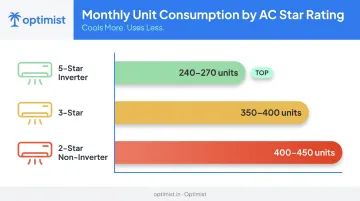
Assuming 8 hours of daily use over 30 days, monthly consumption typically ranges from 240 to 450 units, depending on star rating:
| Star rating | Approx. units/month |
|---|---|
| 5-star inverter | 240-270 |
| 3-star | 350-400 |
| 2-star non-inverter | 400-450 |
Not every 5-star inverter delivers equal savings, though. Optimist's 1.4 Ton unit carries an ISEER of 6.05, India's highest, and uses Turbo+ mode to match 1.9-ton cooling while drawing less power than a typical 1.5 ton 5-star model.
These figures cover normal compressor cycling. They exclude standby draw, voltage-stabiliser load, and any extra consumption from a struggling compressor due to low refrigerant, which we'll cover next.
Key Factors That Affect 1.5 Ton AC Power Consumption
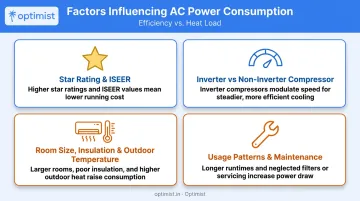
Tonnage tells you cooling capacity. It doesn't tell you electricity draw. Four factors do most of that work.
Star Rating and ISEER Rating
BEE star ratings are built entirely on ISEER, the Indian Seasonal Energy Efficiency Ratio. As of 2026, the validated bands for split ACs (through December 2027) are 3-star at 3.80-4.39 ISEER and 5-star at 5.00 or higher. The higher the ISEER, the more cooling you get per unit of electricity.
This is where the spread gets dramatic. Optimist's 1.4 ton inverter split AC carries an ISEER of 6.05, which the company positions as India's highest declared rating, against BEE's standard 5-star floor of 5.00. That efficiency gap is why two "5-star" labelled ACs can still consume noticeably different amounts of power.
Inverter vs Non-Inverter Compressor Technology
A fixed-speed compressor works like a light switch: full power, then off, then full power again. Every restart is a power spike. An inverter compressor instead varies its speed to match the room's cooling demand, running at a low, steady draw once the temperature stabilises.
This is also where dual-rotary inverter compressors (used in some newer 5-star+ models) differ from standard single-rotary units. Two compression chambers working in tandem allow smoother output and let the compressor sustain higher loads without derating in extreme heat.
Room Size, Insulation and Outdoor Temperature
An undersized AC in an oversized or poorly insulated room simply runs longer to reach the set temperature, and it never gets the chance to throttle down.
There's a second, less obvious issue: most standard ACs derate above 43°C. As outdoor temperatures climb toward 45-50°C, a typical unit loses cooling capacity right when you need it most, forcing longer runtimes to compensate.
Usage Patterns and Maintenance
Thermostat setting, daily runtime, and maintenance habits swing consumption by 10-20%:
- A dirty filter restricts airflow, forcing the compressor to work harder
- Low refrigerant gas levels reduce cooling efficiency silently, often unnoticed until the bill arrives
- Setting the thermostat too low (18-20°C) forces near-continuous compressor operation
Real-time monitoring, like a live energy tracker on a connected app, catches these issues before they inflate a full month's bill rather than after.
Monthly Electricity Bill: Cost Breakdown and Calculation
Your electricity bill for a 1.5 ton AC depends on three variables, not the tonnage rating alone:
Units (kWh) = Power (kW) × Hours run Cost = Units × Per-unit tariff rate
Worked Example
Take a 3-star unit averaging 1.3 kW draw, run for 8 hours a day across 30 days, at a mid-range tariff of ₹8/unit:
- 1.3 × 8 × 30 = 312 units
- 312 × ₹8 = ₹2,496 for the month
Run the same math on Optimist's 1.4-ton 5-star+ inverter model, rated at just 1.07 kW input power, and the monthly bill drops to roughly ₹2,054 — a difference of over ₹440 for identical usage hours.
Bill Range by Star Rating
For 8 hours/day usage at tariffs ranging ₹6-8/unit:
| Star rating | Monthly units | Monthly bill (approx.) |
|---|---|---|
| 5-star inverter | 240-270 | ₹1,440-2,160 |
| 3-star | 350-400 | ₹2,100-3,200 |
| 2-star non-inverter | 400-450 | ₹2,400-3,600 |
Tariff slabs vary widely by state and utility. Delhi's BRPL domestic tariff schedule, for instance, ranges from roughly ₹3/unit at the lowest slab to ₹8/unit once consumption crosses 1,200 units in a cycle. So identical AC usage can produce very different bills depending purely on which slab your total household consumption falls into.
3-Star vs 5-Star vs Inverter AC: Which Saves More?
Star rating and inverter technology combine to determine efficiency; neither works in isolation. A 3-star inverter can sometimes beat a 5-star fixed-speed unit in real conditions, though 5-star inverter models remain the most efficient category overall.
| Category | Avg. units/hour | Monthly units (8 hrs/day) | Est. annual cost (₹8/unit) |
|---|---|---|---|
| 3-star (mostly fixed-speed) | 1.5-1.7 | 350-400 | ₹33,600-38,400 |
| 5-star inverter | 0.8-1.35 | 240-270 | ₹23,040-25,920 |
| High-ISEER 5-star+ inverter | 0.6-0.9 | 180-220 | ₹17,280-21,120 |
The gap widens further during extreme heat, when older units start drawing more power just to hold the same room temperature:
- 3-star units commonly derate past 43°C, running longer for the same cooling
- High-ISEER inverter models sustain rated efficiency at 45-50°C, avoiding that consumption spike
- Optimist's 6.05 ISEER model, for instance, holds full cooling output at 50°C ambient, precisely where standard units start losing ground
Tips to Reduce Your 1.5 Ton AC's Electricity Consumption
Small habit changes compound into real monthly savings:
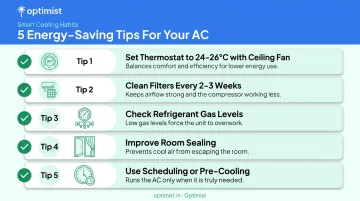
- Set the thermostat to 24-26°C and run a ceiling fan alongside it. BEE data shows raising the AC setting by just 1°C can save around 6% power
- Clean or replace filters every 2-3 weeks. A clogged filter forces the compressor to work harder for the same output
- Check refrigerant gas levels regularly. Low gas raises bills without warning until cooling visibly drops. Optimist's built-in gas level indicator, India's first, flags this early
- Improve room sealing. Closing doors, drawing curtains during peak sun hours, and sealing window gaps all reduce the heat load the compressor fights
- Use scheduling or pre-cooling features to cool the room before peak heat hours instead of fighting the hottest part of the day head-on
Frequently Asked Questions
How much electricity does a 1.5 ton AC consume per hour?
Typical draw ranges from 0.8 to 1.8 units per hour. Inverter technology and higher star ratings push this toward the lower end, while older fixed-speed 2-star units sit at the higher end.
How much electricity does a 1.5 ton AC use in 24 hours?
Continuous 24-hour use on a 3-star unit works out to roughly 36 units. Most homes run 8-10 hours daily instead, which is closer to 12-17 units per day.
Which 1.5 ton ACs consume less electricity?
5-star inverter ACs with ISEER ratings above 5.0 consume the least among mainstream 1.5 ton options. Optimist's 1.4 Ton unit, rated ISEER 6.05, delivers Turbo+ 1.9-Ton effective cooling while holding that efficiency even at 50°C ambient heat, making it a lower-consumption alternative to standalone 1.5 ton models.
What is the 3-minute rule for ACs?
It means waiting at least 3 minutes before restarting an AC after switching it off. This protects the compressor from excess current draw during restart and prevents overload tripping.
How much does running a 1.5 ton AC cost per month in 2026?
For 8 hours of daily use, expect roughly ₹1,440 to ₹3,600 per month, depending on star rating and your state's tariff slab. Higher-ISEER units sit at the lower end of that range.
Does an inverter AC consume significantly less electricity than a non-inverter AC?
Generally yes. Variable-speed compressors avoid the repeated full-power cycling of fixed-speed units, typically translating to noticeably lower average consumption, though the exact percentage varies by model and usage pattern.